
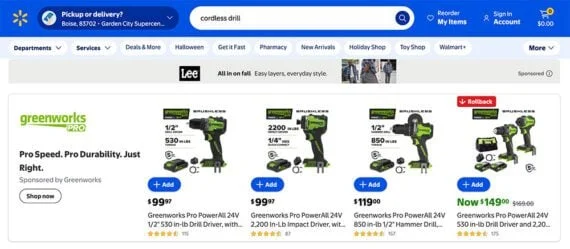
A recent examination of Walmart’s ecommerce platform, specifically a search for “cordless drill,” illuminated a pervasive and often understated tension unfolding across numerous enterprise online retail sites: the complex interplay between merchandising strategies and the burgeoning field of retail media. The search results page, a critical juncture in the customer journey, showcased a distinct dominance of sponsored content, raising fundamental questions about the evolving definition of online retail and the strategic allocation of prime digital real estate.
On this particular search query, the top four product listings were occupied by Greenworks-sponsored brand modules. Immediately following these, three more sponsored products appeared. It wasn’t until the seventh position that an organic search result, uninfluenced by advertising spend, became visible to the shopper. While all the advertisements presented were relevant to the search term, the sheer volume and placement of sponsored content initiated a crucial inquiry: what criteria dictated the prioritization of these products, and by what underlying mechanisms were these decisions made? This scenario is not an isolated incident but rather a recurring theme for retailers actively developing and expanding their retail media businesses. As advertising increasingly influences the visibility of products on these platforms, the lines between traditional merchandising principles and media sales strategies begin to blur, posing a significant challenge for maintaining a balanced and user-centric shopping experience.
The Dual Imperatives of Product Placement
The prominence of a product on an ecommerce search results page or category page is a coveted position, driven by two fundamentally distinct yet increasingly intertwined objectives. On one hand, merchandising teams aim to optimize these high-visibility slots for conversion, customer satisfaction, and overall profitability. Their goal is to ensure that shoppers are presented with the most relevant, high-quality, and commercially advantageous products. This might involve highlighting bestsellers, new arrivals, seasonal items, or products with strong profit margins, all determined by sales data, inventory levels, and strategic marketing initiatives. The underlying philosophy here is to guide the customer efficiently towards a purchase that aligns with both their needs and the retailer’s business objectives.
On the other hand, the rise of retail media networks has introduced a powerful new revenue stream for retailers. These networks allow brands and manufacturers to pay for prominent placement of their products on retail websites, leveraging the retailer’s vast customer base and purchase intent data. For retail media teams, the objective is to maximize advertising revenue and foster strong relationships with brand partners. This often translates into prioritizing ad placements that command higher bids or offer greater immediate financial returns. Consequently, the most valuable digital real estate on a retail website – the top positions in search results and on category pages – becomes a battleground where these two competing objectives converge. The algorithm might favor organic rankings based on relevance and sales signals, while sponsored products vie for the same coveted spots through advertising auctions. This convergence necessitates a reevaluation of how these prime digital assets are managed and allocated.
The Governance Conundrum: Merchandising vs. Media Teams
The inherent conflict between merchandising and media objectives is often exacerbated by the organizational structure of large retail enterprises. Typically, the merchandising and retail media functions operate within separate departments, each measured by distinct key performance indicators (KPIs). The merchandising team is evaluated on metrics such as conversion rates, sell-through percentages, inventory turnover, and gross margin. Their success is tied to the overall health and profitability of product sales.
Conversely, the retail media team is primarily judged on advertising revenue generated, advertiser acquisition and retention rates, and campaign performance for their brand partners. Their focus is on the commercial success of the advertising marketplace they manage. When these two teams are tasked with optimizing the same digital spaces, such as the search results page, a structural imbalance can emerge.
The allure of retail media revenue is immediate, easily attributable to specific campaigns, and straightforward to report to senior leadership. An ad sale generates tangible revenue that can be booked quickly. In contrast, the cost of a displaced organic placement is often diffuse, delayed, and significantly harder to quantify. A sponsored slot that generates advertising revenue in the current month might inadvertently depress overall conversion rates or negatively impact the discovery of less-advertised but potentially more suitable products. This subtle erosion of organic performance can be difficult for the merchandising team to prove definitively, especially when faced with the concrete financial gains reported by the media team.
This dynamic underscores the critical importance of establishing clear governance protocols. The question of who "owns" the search results page and the rules by which merchandising and media teams share this valuable digital real estate becomes a strategic imperative. Without such governance, the immediate financial incentives of retail media can easily overshadow the long-term benefits of a well-curated and user-friendly organic shopping experience.
The Crucial Role of Relevance in Bridging the Divide
Despite the inherent tensions, the objectives of merchandising and retail media do not have to be mutually exclusive. A sponsored product can, and ideally should, align with what the retailer would naturally want a shopper to discover. The example of Greenworks cordless drills on Walmart’s site, where the paid placements were indeed relevant to the search term, illustrates this potential synergy. In such instances, advertising enhances, rather than detracts from, the customer’s shopping experience.
Sherry Smith, President of Retail Media at Criteo, emphasizes this point: "The key is making sure media adds to the experience rather than getting in the way of it or simply replacing organic discovery. At the end of the day, relevance matters. If the advertising is useful to the shopper, it’s much more likely to create value for everyone involved."

Relevance, therefore, emerges as the most natural and effective boundary between the merchandising and media functions. When a product identified as a top contender by the merchandising algorithm also happens to be a strong candidate for a paid placement due to a brand’s advertising efforts, a harmonious outcome is achieved. The retailer generates incremental revenue without compromising the organic search experience.
The conflict arises when paid placements disproportionately elevate products that are less relevant or less aligned with merchandising signals than other available options. This can lead to a suboptimal customer experience, where shoppers are presented with products that may not be their best fit, simply because they are being advertised. This situation can lead to increased bounce rates, abandoned carts, and a decline in overall customer trust and satisfaction.
Establishing Rules for Equitable Digital Real Estate Allocation
Retailers who approach the governance of their ecommerce platforms with a serious commitment to both revenue generation and customer experience often converge on a set of practical rules for sharing digital real estate. These rules aim to create a balanced ecosystem where both merchandising and media objectives can be met without undermining each other.
Firstly, a fundamental principle is to prioritize relevance and shopper value. Sponsored placements should, at a minimum, meet the same relevance criteria as organic listings. This means that advertising should not be used to push products that are demonstrably less suited to the shopper’s query than other available options. Algorithms and human oversight should work in tandem to ensure that paid products are genuinely aligned with customer intent.
Secondly, clear delineation and labeling of sponsored content are crucial. Shoppers need to be aware when they are viewing an advertisement versus an organic recommendation. Transparent labeling helps manage expectations and allows customers to make informed decisions about the content they engage with. This builds trust and avoids the perception of deceptive practices.
Thirdly, strategic allocation of prime real estate is essential. Not every available ad slot needs to be in the absolute top position. Retailers can implement tiered approaches where the very top positions might be reserved for a combination of highly relevant organic results and exceptionally well-aligned sponsored content. Lower but still visible positions can accommodate a broader range of advertising. This allows for maximum ad revenue while safeguarding the most critical positions for organic discovery and best-fit products.
Fourthly, establishing a cross-functional governance committee is vital. This committee, comprising representatives from merchandising, media sales, marketing, and technology, can set policies, resolve disputes, and regularly review the performance of both organic and sponsored placements. Their mandate would be to ensure that the overall customer experience and the retailer’s long-term strategic goals are prioritized.
Finally, continuous monitoring and data analysis are indispensable. Retailers must rigorously track the performance of both sponsored and organic listings, paying close attention to metrics beyond just immediate ad revenue. This includes analyzing conversion rates for sponsored vs. organic products, click-through rates, bounce rates, average order value, and customer lifetime value associated with different types of placements. This data-driven approach allows for iterative refinement of placement strategies.
The Broader Impact on the Retail Landscape
The ongoing evolution of retail media networks and their integration into core ecommerce functions carries significant implications for the broader retail landscape. Retail media offers a powerful new avenue for retailers to monetize their existing digital assets, including their website traffic, valuable customer data, and the very moments when consumers are actively engaged in the purchase journey. This represents a substantial opportunity to create new value streams and enhance profitability.
However, as Sherry Smith notes, "Retail media gives retailers another way to create value from assets they already have, including their digital traffic, shopper data, and the moments when consumers are actively looking for products." The true potential of this opportunity is realized when advertising genuinely adds to the commerce business, rather than simply occupying or displacing the space that the core retail business has already created.
The integration of retail media presents a strategic inflection point. Retailers that successfully navigate this transition by establishing robust governance, prioritizing relevance, and ensuring transparency will likely foster stronger customer loyalty and achieve sustainable growth. Those that allow the pursuit of immediate advertising revenue to undermine the organic shopping experience risk alienating customers, eroding trust, and ultimately diminishing the long-term value of their ecommerce platforms. The quiet struggle playing out on search pages is, in essence, a microcosm of a larger strategic challenge facing the entire ecommerce industry: how to balance the lucrative potential of advertising with the fundamental imperative of providing an exceptional and trustworthy shopping experience for consumers. The future success of enterprise ecommerce will hinge on their ability to find this equilibrium.

