
The traditional lifecycle of a corporate website follows a predictable, if ultimately disappointing, trajectory: a peak of performance and aesthetic perfection on launch day followed by a steady decline in relevance and technical health. This phenomenon, often termed "digital decay," occurs not because the underlying code fails, but because the pace of market shifts, brand evolution, and technological standards quickly outstrips the capacity of human teams to maintain a static asset. However, a new paradigm in web development is emerging through the deployment of autonomous agents—AI-driven systems designed to optimize, fix, and update websites in real-time. While the technological hurdles for such systems are being cleared, industry leaders are discovering that the primary challenge is not the capability of the AI, but the human requirement for granular control and the preservation of creative judgment.
The Paradox of the Perfect Launch
In the current development landscape, a website is arguably at its zenith the moment the final branch is merged and the site goes live. At this junction, every design token is aligned, every asset is optimized, and the messaging is perfectly synchronized with the company’s strategic goals. Yet, this state of "brief perfection" is famously fragile. Industry data suggests that within six months of launch, many websites begin to suffer from "content rot" or "technical drift." This includes broken internal links resulting from URL restructuring, unoptimized media uploaded by non-technical staff, and accessibility regressions introduced by incremental updates.
The cost of this decay is measurable. According to a 2023 analysis of the top one million web pages, over 95% of homepages had detectable WCAG 2.0 failures. Furthermore, research by Google has consistently shown that even a one-second delay in mobile load times can impact conversion rates by up to 20%. For most organizations, the "law of nature" has been that keeping a site at its launch-day quality requires a level of manual labor that is economically unsustainable.
The Emergence of Agentic Web Platforms
The concept of the "autonomous website" aims to disrupt this cycle of decay. Pierre Burgy, a prominent figure in the headless CMS space and founder of the autonomous platform Fimo, posits that websites should be capable of quietly optimizing themselves while the primary development team focuses on higher-order innovation. In this vision, autonomous agents serve as a 24/7 maintenance crew.
Technically, these agents operate as specialized software layers that monitor the site’s health against a set of predefined rules. For instance, an asset agent might automatically detect uncompressed PNG files and convert them to modern formats like WebP or AVIF. An accessibility agent might scan for missing ARIA labels or low-contrast text and apply fixes based on the site’s established design system. This "agentic" approach moves beyond simple automation; it involves systems that can identify problems, propose solutions, and, in some cases, execute those solutions without human intervention.
The Chronology of Autonomy: From Static to Self-Optimizing
The transition toward autonomous web management has occurred in distinct phases over the last two decades:
- The Monolithic Era (2000–2010): Websites were largely static or managed through rigid Content Management Systems (CMS) where any change required manual intervention and often a full redeployment.
- The Headless Revolution (2010–2020): The decoupling of the frontend and backend allowed for more flexible content delivery across multiple platforms, but maintenance still relied heavily on developer "tickets" and manual QA.
- The Automation Influx (2020–2023): CI/CD pipelines and automated testing suites began to catch errors before deployment, though post-launch decay remained unaddressed.
- The Autonomous Era (2024–Present): The integration of Large Language Models (LLMs) and agentic workflows allows for continuous, post-deployment optimization where the site actively responds to its own performance metrics and environmental changes.
The Human Barrier: Why Full Autonomy Is Not the Goal
Despite the technical feasibility of a fully autonomous website, early deployments revealed a significant psychological and professional hurdle: stakeholders generally do not want a website that changes entirely on its own. The hesitation stems from the fact that a website is a multi-disciplinary asset with no single owner. A marketing director, a lead designer, and a senior developer each view the site through a different lens of "value."
Through the development of the Fimo platform, Burgy and his team observed that users were reluctant to grant agents "god-mode" access. The resistance was not based on a lack of trust in the AI’s technical accuracy, but rather on the subjective nature of web design. This led to a critical realization in the field: the goal of autonomous web management should not be total independence, but rather "tunable autonomy."
Categorizing the Labor: Chores vs. Taste
To address the issue of control, industry experts have begun categorizing web maintenance tasks into three distinct tiers. This taxonomy helps teams decide where the "autonomy line" should be drawn.
Tier 1: Rule-Bound Chores (The 80%)
The vast majority of website maintenance consists of repetitive, rule-based tasks. This includes ensuring alt-text is present, managing meta-tags for SEO, compressing images, and updating dependencies. These tasks require no creative "taste" and are universally viewed as a burden by skilled professionals. Agents are highly effective here because the success of the task is binary—it is either compliant with the rules or it is not. Automating this "eighty percent" provides immediate ROI by freeing human talent for more strategic work.
Tier 2: The Untouchables (Strategic Judgment)
At the opposite end of the spectrum are tasks involving brand identity, emotional resonance, and strategic pivot points. An AI agent can check if a page follows a style guide, but it cannot decide if a new design "feels" right for a luxury brand or if a messaging shift accurately reflects a company’s new mission. This is the realm of human judgment and is where the value of designers and copywriters is most concentrated.
Tier 3: The Subjective Grey Area
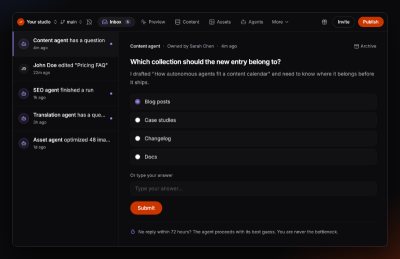
The most complex tier involves tasks where the definition of a "chore" versus a "decision" depends on the observer. For example, changing the default site theme to "dark mode" based on user system settings might be viewed as a technical best practice by a developer (a chore), but as a significant brand statement by a creative director (a decision). In these instances, the autonomy must be granular, allowing different team members to set their own thresholds for when an agent requires approval.
Supporting Data: The Impact of Continuous Optimization
The shift toward autonomous maintenance is supported by compelling performance data. Sites utilizing continuous optimization agents have shown:
- Performance Stability: A 30% reduction in "performance drift," maintaining Lighthouse scores above 90 over a 12-month period without manual intervention.
- Accessibility Compliance: A 90% decrease in accessibility regressions, significantly lowering the legal risk associated with Americans with Disabilities Act (ADA) compliance.
- Operational Efficiency: Development teams report spending up to 40% less time on "maintenance tickets," allowing for a faster cadence of new feature releases.
Industry Implications and the Future of Web Development
The rise of autonomous agents suggests a fundamental shift in the role of the web developer and designer. Instead of being the primary executors of every minor change, professionals are becoming "orchestrators" of agents. This mirrors the evolution of manufacturing, where human expertise shifted from manual assembly to the oversight of sophisticated robotic systems.
Critics of autonomy express concerns regarding "hallucinations" or agents making unauthorized changes that could damage a brand. However, the emerging standard for autonomous platforms includes robust version control and "human-in-the-loop" safeguards. By providing detailed logs, before-and-after comparisons, and expiration deadlines for manual approvals, these systems allow trust to be earned incrementally.
Conclusion: Mitigating the Risk of the Frozen Site
The primary risk to a modern digital presence is not the introduction of an autonomous agent, but the stagnation of the website itself. A "frozen" site—one that remains static because the team lacks the bandwidth to maintain it—eventually becomes a liability. It fails to reflect the current state of the company, it drops in search engine rankings due to technical obsolescence, and it provides a sub-optimal user experience.
The integration of autonomous agents represents a move toward "living" digital assets. By delegating the "chores" to AI while retaining human control over "taste," organizations can ensure that their website’s launch day is no longer its best day, but merely its starting point. The future of the web is not one of total automation, but of a collaborative environment where agents handle the decay, and humans handle the vision.

