
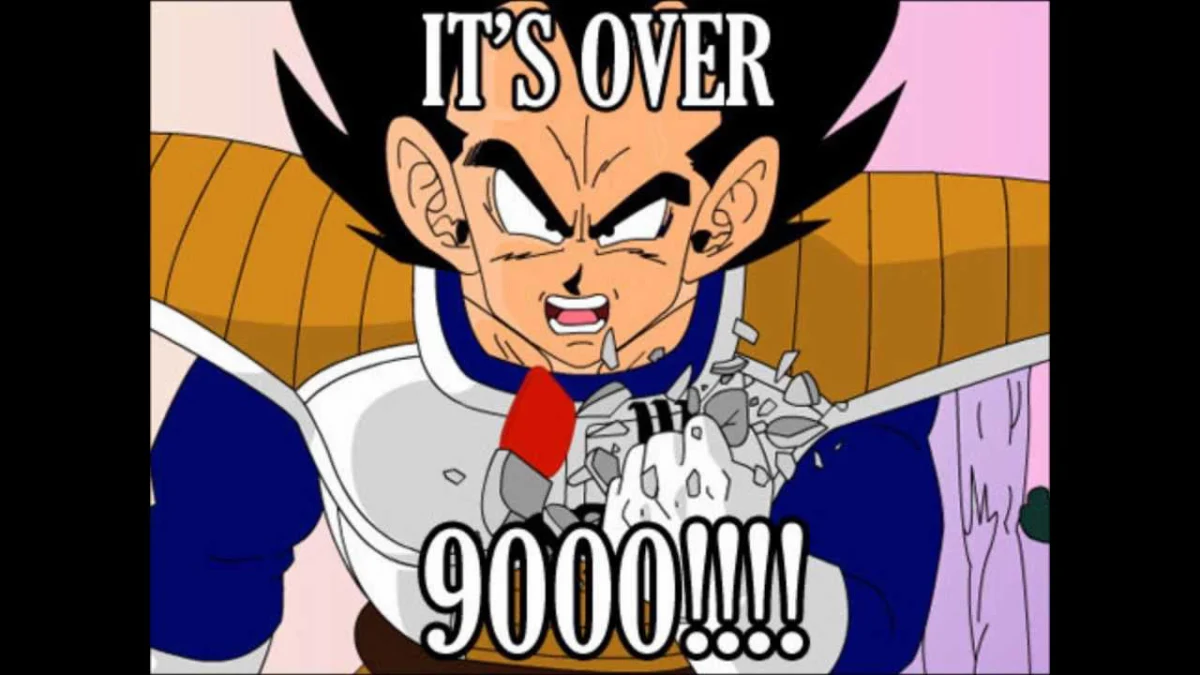
The phrase "Over 9000" serves as a foundational pillar of modern internet culture, originating from a specific translation choice in the English-language dubbing of the Japanese manga and anime series Dragon Ball Z. While initially a minor line of dialogue intended to convey the staggering strength of the protagonist, Goku, the phrase has transitioned into a universal "innumerable quantifier." In contemporary digital linguistics, it is frequently employed to describe an overwhelming or incomprehensible quantity, ranging from "several" to "metric tonnes." The history of the meme is a complex tapestry involving international licensing agreements, the rise of video-sharing platforms, and the influential subcultures of the early 2000s web.
The Narrative Origin and the Saiyan Saga
The origin of the phrase traces back to the "Saiyan Saga," the opening arc of the Dragon Ball Z series. Specifically, the line occurs in the 21st episode of the English dub, titled "The Return of Goku," which made its North American television debut on April 19, 1997. The plot centers on the arrival of the Saiyan warriors Vegeta and Nappa on Earth. Following the death of his companion Piccolo, the protagonist Goku returns from training in the "Other World" and begins to power up in a fit of righteous fury.
In this pivotal scene, Nappa asks Vegeta to assess Goku’s power using a "scouter," a wearable device that calculates a combatant’s numerical strength. As Vegeta observes the device, he witnesses an explosive increase in Goku’s energy levels. In the English dub provided by the Ocean Group, Vegeta, voiced by actor Brian Drummond, crushes his scouter in his hand and shouts, "It’s over nine thousand!" This exclamation was met with shock by Nappa, who famously replied, "What? Nine thousand? There’s no way that can be right!"
The Discrepancy: Eight Thousand versus Nine Thousand
A significant point of interest for scholars of media translation is that the "9,000" figure was technically a deviation from the original source material. In Akira Toriyama’s original Japanese manga, as well as the original Japanese anime broadcast (where Vegeta was voiced by Ryō Horikawa), the power level was stated to be "over 8,000" (hassen ijō).
The shift from 8,000 to 9,000 in the English dub remains a subject of debate among fans and industry historians. Some suggest the change was made to better match the "mouth flaps" (lip-syncing) of the animation, as "nine" is a one-syllable word that allows for a more forceful, open-mouthed delivery than the Japanese "hachi" or the English "eight." Others attribute it to a simple clerical error during the localization process. Regardless of the intent, the "9,000" variation became the definitive version for English-speaking audiences, despite later "uncut" redubs by Funimation occasionally reverting the number to 8,000 to maintain fidelity to the Japanese script.
The Digital Resurrection: 2006-2007
While the episode aired in 1997, the phrase did not achieve meme status until nearly a decade later. The catalyst for its viral spread was the emergence of YouTube and the image-board culture of 4chan. On October 17, 2006, a user known as Kajetokun uploaded a video clip of the scene to YouTube. Originally intended as an "inside joke" for a small group of friends, the video was quickly shared on 4chan’s /b/ (random) board.
The impact was instantaneous. Within 24 hours, the video garnered 20,000 views, a significant number for the mid-2000s internet. After being featured on the front page of the popular gaming webcomic VG Cats, the view count surged to over 200,000. This exposure triggered a wave of "remix culture," where users synchronized Vegeta’s voice to various musical tracks, created "image macros" (text-over-image memes), and developed "demotivational posters" that utilized the phrase to describe anything of high magnitude.
By late 2006, "Over 9000" had become a staple of the YTMND (You’re the Man Now, Dog) community, a site dedicated to looped images and audio. On November 21, 2006, the phrase received its first entry in Urban Dictionary, cementing its place in the digital lexicon.
The Concept of Power Levels in Dragon Ball Lore
To understand why the phrase resonated so deeply, one must understand the "Power Level" system within the Dragon Ball franchise. Power levels were introduced as a way to quantify the combat strength of various characters, providing a sense of scale to the escalating stakes of the series.

According to data compiled by the Dragon Ball Wikia and official Japanese publications like V-Jump, the numbers mentioned in the series grew exponentially over time. While Goku’s "over 9,000" was considered staggering at the time of the Saiyan Saga, it was quickly eclipsed. For example:
- Captain Ginyu: During the Namek Saga, his scouter read Goku’s power level at 180,000.
- Frieza: The villain Frieza famously claimed a power level of 530,000 in his first form.
- Super Saiyan Gogeta: V-Jump estimated this character’s power level at a staggering 2,500,000,000.
The "Over 9,000" line represented the first time the series’ protagonists broke into a tier of strength that was previously thought impossible for "low-class" warriors, making the line a symbolic turning point for the franchise’s power scaling.
The Oprah Winfrey Incident: A Mainstream Collision
The meme reached a new level of notoriety in September 2008 through an unexpected collision with mainstream media. An anonymous user on 4chan’s /b/ board successfully "trolled" the official message boards of Oprah Winfrey’s talk show. The user posted an alarming, fabricated warning about an organized network of "9,000 pedophiles."
Unaware of the internet slang, Oprah Winfrey read the post aloud during a broadcast of The Oprah Winfrey Show. She told her audience, "He doesn’t forgive, he doesn’t forget… his group has over 9,000 penises, and they’re all raping children." The inclusion of the "9,000" figure was a clear nod to the Dragon Ball Z meme, intended by the pranksters to signal their involvement to the Anonymous community.
The clip of Oprah unwittingly participating in a 4chan prank became an "epic win" for the subculture. Despite copyright takedown attempts by Harpo Productions, the "9,000 penises" remix became a viral sensation in its own right, marking one of the earliest and most prominent examples of internet subcultures influencing national television narratives.
Quantifying Cultural Impact and Search Interest
The longevity of "Over 9000" is evidenced by its performance in search engine data. Analysis of Google Trends reveals that for several years, searches for the "Over 9000" reference consistently outperformed searches for "HAL 9000," the iconic artificial intelligence from Stanley Kubrick’s 1968 masterpiece 2001: A Space Odyssey.
The phrase has also permeated professional media and other gaming franchises. References to the meme have appeared in:
- World of Warcraft: The game features an achievement titled "It’s Over Nine Thousand!" awarded to players who earn more than 9,000 achievement points.
- Doom (2016): A reference to the power level can be found in the game’s codex.
- Mainstream Journalism: Writers for publications like The New York Times and The Wall Street Journal have occasionally used the phrase in headlines to describe large statistics, often to appeal to a tech-savvy demographic.
Analysis of the Meme’s Longevity
The persistence of "Over 9000" can be attributed to its utility as a linguistic tool. Unlike many memes that are tied to a specific news event or a fleeting trend, "Over 9000" functions as a versatile hyperbolic expression. It satisfies a need in digital communication for an exaggerated number that conveys enthusiasm or disbelief.
Furthermore, the "Ocean Dub" performance by Brian Drummond provided a unique auditory signature. The "gravelly" and "over-the-top" delivery of the line made it ripe for parody. It captured the essence of the "extreme" aesthetic of 1990s Western anime localization, which prioritized high energy and dramatic flair over literal translation.
Chronology of Key Events
- April 19, 1997: The episode "The Return of Goku" airs in North America, introducing the line to the English-speaking world.
- October 17, 2006: Kajetokun uploads the original clip to YouTube, initiating the viral cycle.
- Late 2006: 4chan moderators implement a "word filter" that changes the number 7 to "over 9000," forcing the meme into thousands of conversations.
- April 2008: Kajetokun is interviewed by Japanator, where he expresses shock at the global reach of what began as a private joke.
- September 2008: Oprah Winfrey reads the "9,000 penises" post on her show, marking the meme’s peak mainstream exposure.
- 2010s-Present: The phrase remains a standard part of internet slang, appearing in merchandise, video games, and official Dragon Ball promotional materials.
Conclusion
The "Over 9000" phenomenon illustrates the unpredictable nature of digital media. What began as a translation discrepancy in a localized cartoon evolved into a linguistic shorthand used by millions. It represents a bridge between the niche anime communities of the 1990s and the mainstream digital culture of the 21st century. As Dragon Ball continues to see new releases and a growing global fanbase, the legacy of Vegeta’s shattered scouter remains a testament to the power of a single, well-delivered line of dialogue to define an entire era of the internet.

