
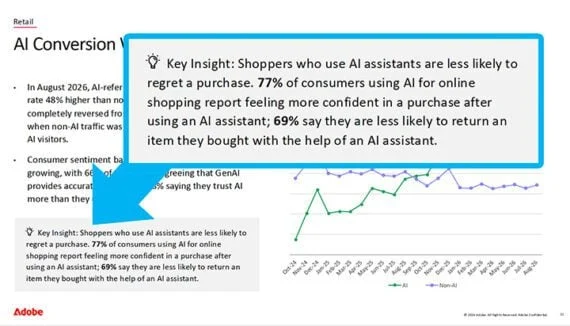
Early findings from Adobe’s comprehensive "AI Traffic Trends Report" for August 2026 indicate a significant potential for artificial intelligence to address one of e-commerce’s most persistent and costly challenges: product returns. The report, which analyzed over one trillion visits to U.S. retail websites and 100 million stock-keeping units (SKUs), also incorporated survey data from 5,000 U.S. consumers conducted in July 2026. This extensive dataset suggests that consumers who utilize AI tools during their online shopping journeys are demonstrably less likely to return their purchases, a trend that could translate into substantial cost savings for online retailers.
The pivotal insight, embedded within a broader analysis of e-commerce traffic trends, highlights a direct correlation between AI-assisted shopping and a reduced propensity for returns. Specifically, the survey revealed that 69% of respondents who had employed AI for online shopping indicated they were less inclined to return an item acquired with AI assistance. This statistic is further bolstered by the finding that 77% of these same consumers reported increased confidence in their purchase decisions when guided by an AI assistant. This dual effect of reduced return likelihood and enhanced purchase confidence presents a compelling case for the integration of AI into the online retail ecosystem.
The "AI Traffic Trends Report," a 59-page document released by Adobe, a leader in digital marketing and analytics, delves into various aspects of online consumer behavior and the evolving digital landscape. While the findings concerning AI and returns are presented in a dedicated section, their implications extend far beyond a singular metric. The report’s methodology, leveraging Adobe Analytics, a robust platform used by a vast array of U.S. retailers, lends significant weight to its conclusions. The sheer scale of data analyzed—over a trillion website visits—provides a granular view of consumer interactions and purchasing patterns across the e-commerce spectrum.
Background and the Genesis of the Report
Adobe’s consistent output of industry trend reports underscores its commitment to providing actionable insights for businesses navigating the complexities of the digital marketplace. The August 2026 report, released in September of the same year, follows a series of analyses that have tracked the burgeoning influence of artificial intelligence across various sectors. The inclusion of a consumer survey, conducted just prior to the report’s publication, aimed to capture contemporary consumer sentiment and adoption rates of new technologies. The July 2026 survey, therefore, reflects a snapshot of consumer experiences with AI in online shopping at a specific, and rapidly evolving, point in time. The timing of the report’s release, shortly after the survey data was collected, ensures its findings are as current and relevant as possible for businesses making strategic decisions.
The report’s focus on AI traffic trends is particularly pertinent given the accelerated adoption of AI technologies by both consumers and businesses throughout the mid-2020s. E-commerce platforms have been at the forefront of this integration, seeking to enhance customer experience, streamline operations, and drive sales. AI’s ability to personalize recommendations, answer queries, and even assist in product discovery has become a key differentiator. However, the indirect benefit of reduced returns, as suggested by this report, could prove to be one of the most impactful financial outcomes of this technological shift.
Informed Shoppers, Fewer Returns: The Data Unpacked
Adobe’s data paints a clear picture: shoppers who arrive at merchant websites via AI platforms often exhibit a more defined purchasing intent. In July 2026, Adobe observed that AI-referred retail visitors demonstrated a 60% higher conversion rate compared to traffic originating from non-AI sources. Furthermore, these AI-referred consumers generated 53% more revenue per visit, indicating not only higher purchase rates but also potentially larger basket sizes or higher-value items.
This phenomenon can be attributed to the enhanced research capabilities that AI assistants now offer. Prior to the widespread integration of sophisticated AI, a consumer would typically spend considerable time navigating multiple e-commerce sites to compare product features, dimensions, compatibility, read reviews, and analyze pricing. In 2026, however, an AI assistant can efficiently perform much of this legwork. By leveraging virtual web browsers and vast data processing capabilities, AI tools can scour numerous retail websites, gather relevant information, and then present curated recommendations to the consumer. Meta’s Muse, for instance, serves as a timely example of this evolving capability. Muse can autonomously visit dozens of e-commerce sites, gathering intelligence before suggesting a specific product. This pre-purchase research, facilitated by AI, often occurs after the consumer, through their interaction with the AI, has already narrowed down their options and resolved any initial uncertainties. This streamlined, AI-driven research process directly contributes to more informed purchasing decisions.
The Crucial Role of Enhanced Product Information
For e-commerce merchants, the implications of these findings extend beyond simply optimizing for AI-driven traffic. The true leverage lies in the quality and comprehensiveness of the product information they provide. AI shopping assistants can only effectively reduce purchase uncertainty if they are equipped with accurate, detailed, and extensive data about the products they are recommending. This includes a thorough listing of specifications, precise dimensions, compatibility details with other products or systems, available variants (color, size, material), realistic delivery estimates, customer reviews, frequently asked questions (FAQs), and comparative analyses with similar items.
When AI assistants possess this rich product data, they are better positioned to accurately assess whether a particular item truly aligns with a shopper’s specific needs and preferences. This meticulous matching process, facilitated by robust product information, is the underlying mechanism that leads to more confident purchases and, consequently, fewer returns. The potential benefit for merchants is twofold: not only can they secure a sale through a well-matched AI recommendation, but they can also significantly mitigate the costly burden of processing and restocking returned items. This synergy between advanced AI capabilities and detailed product data represents a critical evolution in online retail strategy.

The Return on Investment: Quantifying the Impact
While it is still relatively early to definitively quantify the long-term impact of AI-aided shopping on overall e-commerce return rates, the initial evidence is compelling and logically sound. The fundamental principle at play is that better-informed shoppers are inherently more likely to make purchasing decisions that result in satisfaction and retention of the product. Returns often stem from mismatches in expectations, incorrect product selection due to insufficient information, or unforeseen compatibility issues. AI, when powered by comprehensive data, directly addresses these pain points.
The financial implications of reduced returns are substantial. According to industry analyses from earlier in the decade, product returns cost the U.S. e-commerce industry billions of dollars annually. These costs encompass not only the direct expenses of shipping, processing, and repackaging returned goods but also the loss of potential revenue from reselling the item, potential damage to returned products, and the administrative overhead associated with managing the returns process. A significant reduction in these return rates could therefore lead to a considerable boost in profitability for online retailers.
Consider the lifecycle of a returned item. It incurs reverse logistics costs, requires inspection and restocking, and may need to be sold at a discount if damaged or out of season. If AI can preemptively prevent a substantial percentage of these returns by ensuring the right product reaches the right customer the first time, the cost savings could be transformative. This aligns with the broader trend of businesses seeking greater efficiency and profitability through technological adoption.
Industry Reactions and Expert Perspectives (Inferred)
While specific official statements from e-commerce giants or AI developers directly responding to this particular Adobe report were not immediately available at the time of its release, the findings are consistent with broader industry discussions and strategic priorities.
E-commerce executives have long acknowledged the substantial drain that returns place on their bottom lines. Discussions at industry conferences and in trade publications frequently revolve around strategies to minimize returns, including improving product descriptions, offering detailed sizing guides, and leveraging customer reviews. The Adobe report suggests that AI represents a powerful new tool in this ongoing effort.
AI developers and platform providers, such as Meta and Google, are actively investing in enhancing their AI capabilities to provide more sophisticated shopping assistance. The promise of reduced returns is likely a significant motivator, as it strengthens the value proposition of their AI tools for both consumers and the retailers they serve. Companies that can demonstrate a clear ROI for their AI solutions, including tangible cost savings like reduced returns, are likely to see accelerated adoption.
From a consumer perspective, the findings suggest a growing trust in AI as a shopping companion. As AI assistants become more adept at understanding individual needs and preferences, consumers may increasingly rely on them to navigate the often overwhelming choices available online. This increased confidence in AI-driven recommendations can lead to a more positive and less stressful online shopping experience, ultimately benefiting both consumers and retailers.
Broader Implications for the E-commerce Landscape
The implications of AI-aided shopping leading to fewer returns extend beyond immediate cost savings. This trend could reshape several aspects of the e-commerce industry:
- Supply Chain Optimization: A reduction in returns would alleviate pressure on reverse logistics and warehousing operations. This could allow businesses to streamline their supply chains, potentially leading to faster fulfillment times and reduced inventory holding costs.
- Sustainability Initiatives: Product returns have an environmental impact due to additional shipping and packaging. By decreasing the volume of returned goods, AI could contribute to e-commerce’s sustainability efforts, a growing concern for both consumers and regulatory bodies.
- Customer Loyalty and Satisfaction: When customers consistently make successful purchases with AI assistance, their overall satisfaction with the shopping experience increases. This can foster greater customer loyalty and encourage repeat business. Conversely, a high rate of returns can lead to frustration and a diminished perception of a retailer’s reliability.
- Product Development and Merchandising: Insights gleaned from AI-assisted shopping interactions, particularly concerning why certain products are recommended and retained, could provide valuable feedback for product development and merchandising strategies. Retailers might gain a deeper understanding of consumer preferences that drives successful purchases.
- Competitive Advantage: Retailers that effectively integrate AI into their shopping journeys and optimize their product data to support these AI tools are likely to gain a competitive edge. They will be able to offer a superior customer experience and operate with greater efficiency.
The Road Ahead: Continued Evolution and Data Collection
As AI technology continues to advance and its integration into e-commerce deepens, ongoing data collection and analysis will be crucial. The initial findings from Adobe’s report provide a strong indication of a positive trend, but longitudinal studies will be necessary to confirm the sustained impact on return rates. Factors such as the sophistication of AI algorithms, the quality of product data, and evolving consumer behavior will all play a role in shaping this future.
The current data suggests a paradigm shift in how consumers approach online shopping, with AI emerging as a powerful facilitator of more informed and confident purchasing decisions. The potential for AI to significantly reduce product returns represents a tangible and substantial benefit, promising to enhance the profitability and sustainability of the e-commerce industry for years to come. The call to action for retailers is clear: invest in robust product data and explore strategic AI integrations to capitalize on this transformative opportunity.

