
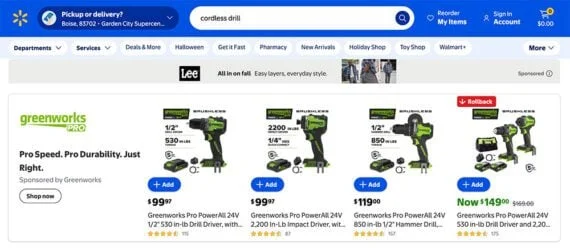
A recent deep dive into Walmart’s ecommerce platform, specifically a search for "cordless drill," illuminated a pervasive and increasingly complex challenge faced by major online retailers: the burgeoning conflict between traditional merchandising strategies and the lucrative, yet potentially disruptive, rise of retail media networks. The search results page, a prime piece of digital real estate, revealed a striking scenario where sponsored product listings, driven by advertising revenue, dominated the top positions, pushing organic, algorithmically determined results further down the page. This phenomenon is not isolated to Walmart but represents a broader trend reshaping how enterprise ecommerce sites operate and generate value.
The examination of the "cordless drill" search on Walmart showcased a sponsored brand module occupying the apex of the results, featuring four Greenworks products. Immediately following this, three more sponsored listings continued the advertising-driven display. It wasn’t until the seventh product position that an organic result, determined by Walmart’s internal search algorithms based on relevance, sales history, and other merchandising factors, made its appearance. While the advertised products were all relevant to the search query, the sheer volume of sponsored listings raised critical questions about the evolving balance of power between product discovery driven by organic relevance and visibility secured through paid media placements.
This dynamic underscores a fundamental dilemma for retailers venturing into or expanding their retail media businesses. As advertising increasingly dictates the initial visibility of products, the traditional lines between merchandising – the art and science of presenting products to shoppers – and media – the strategic deployment of advertising to drive revenue – are becoming irrevocably blurred. This shift necessitates a re-evaluation of how these digital storefronts are managed and how value is ultimately created for both the retailer and the consumer.
The Dual Objectives Shaping Digital Shelf Space
At the heart of this evolving landscape lie two primary, often competing, objectives that merchants strive to achieve when placing products prominently on their ecommerce sites. The first, and historically dominant, objective is merchandising for conversion. This involves strategically positioning products that are most likely to resonate with shoppers, based on factors like sales performance, customer reviews, seasonal relevance, newness, and overall alignment with user intent. The goal is to maximize sales volume, enhance customer satisfaction, and optimize profit margins through effective product presentation. Merchandisers are tasked with ensuring that the most compelling and relevant products are easily discoverable, thereby driving efficient customer journeys and maximizing the site’s commercial potential.
The second objective, rapidly gaining prominence, is media revenue generation. Retail media networks allow brands to pay for enhanced visibility on retailer websites, effectively purchasing prime digital shelf space. This revenue stream can be substantial, offering retailers a new and significant avenue for profit. For the media teams responsible for these networks, the objective is to maximize advertising revenue, attract and retain advertisers, and demonstrate the efficacy of their media products. This often translates into prioritizing placements that yield the highest advertising bids, regardless of whether those products are the absolute top organic contenders.
These two powerful objectives are now converging in some of the most critical areas of an ecommerce site. The search results page, as exemplified by the "cordless drill" search, is a prime battleground. Here, the retailer’s inherent algorithm, designed to surface relevant and popular products, now contends with the auction-driven placements of sponsored listings. Similarly, category pages, traditionally curated by merchandisers to highlight best-sellers, seasonal items, or new arrivals, are increasingly becoming available for advertising placements, offering brands the opportunity to capture shopper attention within specific product categories.
Sherry Smith, president of retail media at Criteo, offered a nuanced perspective on this integration. "Retailers also need to be thoughtful about where and how they introduce advertising," Smith stated in a written response. "More inventory doesn’t necessarily mean more value. The focus should be on placements that perform for advertisers, remain useful to shoppers, and create incremental value for the retailer once the costs of running the program are taken into account." This highlights the crucial need for a balanced approach that prioritizes both commercial success and a positive shopper experience.
The Governance Imperative: Resolving the Merchandising-Media Divide
The tension between these two objectives is more than a mere layout or aesthetic consideration; it is fundamentally a governance challenge. In large retail organizations, the teams responsible for merchandising and retail media often operate with distinct mandates, metrics, and reporting structures.
The merchandising team is typically measured on key performance indicators such as conversion rates, sell-through percentages, inventory turnover, and gross margin. Their success is tied to the overall commercial health and efficiency of product sales. Conversely, the media team is evaluated primarily on advertising revenue generated, advertiser acquisition and retention rates, and the performance of advertising campaigns. Their focus is on maximizing the financial returns from the retail media network.
When these teams’ incentives are applied to the same prime digital real estate, such as a search results page, a structural conflict arises. Each team has a rational incentive to claim the most valuable positions. The merchandiser seeks to place the products most likely to convert and satisfy customers. Simultaneously, the retail media team aims to secure these same high-visibility spots for their most lucrative advertising partners.
Without clear governance and defined protocols, the media side often holds a structural advantage. The revenue generated from advertising is typically immediate, directly attributable to specific campaigns, and easily reported upwards to senior leadership. In contrast, the cost of a displaced organic placement – a potentially lost sale due to a less optimal product appearing higher on the page – is often diffuse, delayed, and notoriously difficult to quantify. A sponsored slot that generates revenue this month might inadvertently depress overall conversion rates, appearing as a win on the media team’s dashboard but a subtle, unprovable loss for the merchandising team. This asymmetry in measurability and immediacy can lead to a gradual erosion of the organic search experience in favor of advertising-driven revenue.
Therefore, defining where merchandising ends and media begins is a critical governance decision. It requires answering fundamental questions: Who ultimately "owns" the digital shelf space? What are the established rules and protocols for how these two powerful functions share it? Establishing a framework for collaboration and conflict resolution is paramount to ensuring that the pursuit of advertising revenue does not undermine the core retail mission of providing a seamless and satisfying shopping experience.

Relevance as the Natural Boundary
The inherent conflict between merchandising and media objectives does not, however, necessitate an irreconcilable schism. A sponsored product can, and ideally should, align perfectly with what the retailer would want a shopper to discover organically. The key lies in ensuring that paid placements enhance, rather than detract from, the shopper’s journey.
The "cordless drill" example on Walmart, where all the paid placements were indeed relevant to the search query, serves as a positive illustration. While advertising determined the initial order, the shopper was still presented with products that met their stated need. This highlights the potential for synergy when advertising is not merely a mechanism for displacing organic discovery but rather a means of amplifying relevant offerings.
"The key is making sure media adds to the experience rather than getting in the way of it or simply replacing organic discovery," Smith elaborated. "At the end of the day, relevance matters. If the advertising is useful to the shopper, it’s much more likely to create value for everyone involved." This sentiment points to relevance as the most natural and sustainable boundary between the two facets of the business.
When a paid placement and the merchandising algorithm independently identify the same product as a top contender, there is no conflict. Retail media revenue is generated without compromising the organic shopping experience. The tension arises when a sponsored slot elevates a product that merchandising signals would otherwise deem less relevant or less optimal compared to other available options. This is where the governance framework and established rules for sharing digital real estate become indispensable.
Establishing Rules for Equitable Sharing
Retailers that approach the governance question with seriousness and a genuine recognition of the value of relevant advertising are likely to converge on several practical rules. These rules aim to create a balanced ecosystem where both merchandising and media objectives can be met without undermining the overall customer experience or the retailer’s long-term commercial health.
One foundational rule could be the prioritization of organic relevance for core search and category pages. This means that for highly transactional or intent-driven searches, the top positions should be primarily reserved for products that the retailer’s algorithm identifies as the most relevant and highest-performing based on organic signals. Sponsored products can then be strategically integrated below this initial layer of organic results, or in designated ad units, ensuring that the most critical discovery moments are driven by genuine shopper intent.
Another critical principle is the implementation of contextual relevance thresholds for sponsored placements. Retail media networks should be designed to ensure that sponsored products are not only relevant to the broad search query but also align with the specific context of the user’s journey. This might involve sophisticated algorithms that match advertisers to highly specific shopper segments or intent signals, ensuring that paid placements are as useful and pertinent as organic ones. For instance, if a shopper is browsing high-end cordless drills, sponsored listings for budget models might be deemed less relevant and therefore de-prioritized, even if the advertiser bids highly.
Furthermore, a robust system for measuring and attributing the impact of sponsored placements on organic performance is essential. Retailers need to move beyond simply tracking ad revenue and begin to understand the ripple effects of paid media on overall conversion rates, average order value, and customer lifetime value. This requires advanced analytics capabilities that can disentangle the impact of sponsored listings from organic ones, allowing for a more holistic assessment of performance. If a sponsored placement consistently cannibalizes organic sales without generating sufficient incremental revenue or advertiser value, governance mechanisms should be in place to re-evaluate its placement or efficacy.
Finally, the establishment of clear and transparent communication channels and decision-making processes between merchandising and media teams is crucial. Regular inter-departmental meetings, joint performance reviews, and collaborative planning sessions can help foster understanding, mitigate conflicts, and ensure that both teams are working towards aligned goals. This might involve establishing an oversight committee or a dedicated role responsible for managing the balance between merchandising and media, ensuring that decisions are made with the best interests of the retailer and the shopper in mind.
The Broader Impact: Enhancing Commerce, Not Just Occupying Space
Retail media presents a significant opportunity for retailers to unlock new value streams from existing assets, including their vast digital traffic, rich shopper data, and the critical moments when consumers are actively seeking to make purchases. As Sherry Smith noted, "Retail media gives retailers another way to create value from assets they already have, including their digital traffic, shopper data, and the moments when consumers are actively looking for products."
This opportunity is maximized when retail media acts as a genuine enhancement to the commerce business, rather than merely occupying the digital real estate that commerce itself has created. When sponsored products are highly relevant and add to the shopper’s discovery process, they can lead to increased sales, greater product variety for the consumer, and a more dynamic and engaging shopping experience. This symbiotic relationship strengthens the overall ecommerce ecosystem.
The challenge, therefore, lies in evolving retail media from a purely revenue-driven initiative to a strategic component of the commerce platform. This requires a sophisticated approach to governance, a deep commitment to relevance, and a willingness to measure success holistically. By carefully navigating the intersection of merchandising and media, enterprise retailers can harness the power of their digital platforms to drive both significant advertising revenue and sustained, positive commercial growth, ensuring that the digital shelf remains a place of discovery and value for every shopper. The ongoing evolution of these digital marketplaces will be defined by how effectively retailers manage this delicate, yet vital, balance.

