
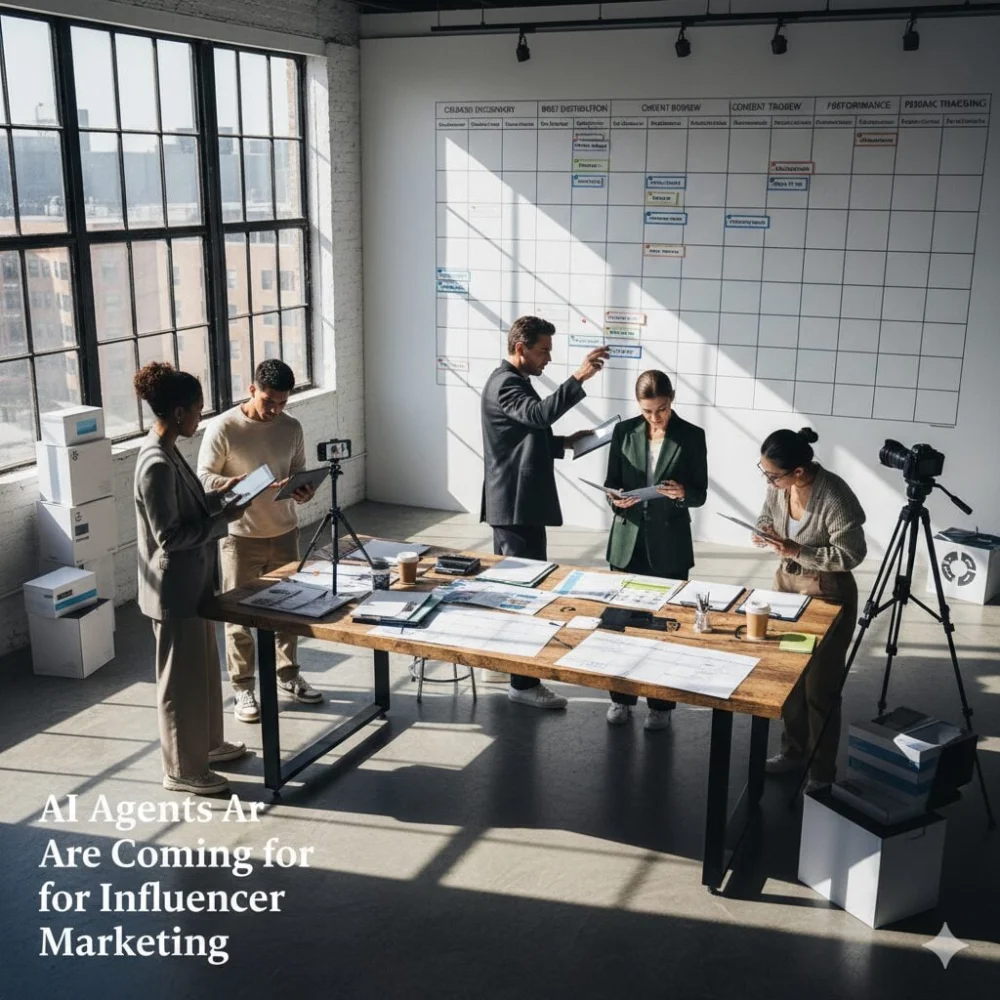
For the last decade, influencer marketing has been defined by human friction. It has been a world of endless spreadsheets, opaque pricing, emotional negotiations, and "gut-feel" talent selection. While the rest of the digital advertising world moved toward programmatic efficiency, influencer marketing remained a boutique, handcrafted, and often frustratingly slow channel. This historical reliance on manual processes, while fostering authenticity in its nascent stages, has become an insurmountable barrier to scale and efficiency in a rapidly evolving digital landscape.
But the shift is here. We are moving from Talent Management to Autonomous Systems, a transformation poised to redefine how brands connect with consumers through creator content. By 2027, the brands that dominate social commerce won’t just have the best creators; they will have the best AI Agents. These sophisticated software entities won’t replace the soul of the industry – the creativity, the connection, the human touch – but they will automate the "boring" 80% of the job that currently keeps marketing teams drowning in administrative debt. This isn’t a vague prediction about "AI tools"; this is a fundamental restructuring of the industry into an autonomous media-buying engine. If brands aren’t building the infrastructure for these agents today, they risk being priced out of the market by 2027, unable to compete with the speed, scale, and precision of their AI-powered rivals.
The Unbearable Weight of Administrative Debt: The Spreadsheet Trap
Before fully embracing the autonomous future, it is crucial to acknowledge the current, painful reality that grips most marketing departments. Influencer marketing, as it exists in many companies today, is less a strategic endeavor and more a logistical nightmare, plagued by what industry experts term "administrative debt." This debt accrues from a workflow characterized by repetitive, manual tasks that consume valuable time and resources without directly contributing to strategic growth.
Consider the typical workflow for a mid-market brand managing a portfolio of 50 creators, a modest number in today’s influencer economy:
- Discovery and Vetting: Manually sifting through thousands of profiles, checking follower counts, engagement rates, audience demographics, and brand alignment. This can take days, often involving cross-referencing multiple platforms and third-party tools.
- Outreach and Negotiation: Crafting personalized emails, sending direct messages, tracking responses, engaging in often protracted negotiations over deliverables, usage rights, and pricing. Each negotiation can involve multiple rounds of communication, consuming hours per creator.
- Contracting: Drafting individual agreements, managing revisions, obtaining signatures, and ensuring legal compliance for each collaboration. This process is ripe for errors and delays.
- Content Briefing and Review: Developing detailed content briefs, sharing them with creators, reviewing multiple rounds of drafts, providing feedback, and ensuring brand guideline adherence. This iterative process is a significant time sink.
- Campaign Management and Tracking: Manually logging content publication dates, collecting performance metrics (likes, comments, shares, saves, clicks, conversions), and consolidating data from disparate sources (social platforms, analytics dashboards, affiliate links).
- Payment and Reporting: Processing individual invoices, ensuring timely payments, and compiling comprehensive reports for internal stakeholders, often requiring manual data aggregation and visualization.
This entire ecosystem is administrative debt in action. It is a system that rewards "busy work" over "strategic work," leading to burnout for marketing teams and limiting the overall impact of campaigns. It is slow, it is expensive – with industry estimates suggesting that administrative overhead can account for 20-30% of a campaign’s total budget – and it is entirely unscalable. In an era where AI can optimize a million search bids in a millisecond, the fact that brands still haggle over $500 in a Gmail thread for an influencer placement is not just inefficient; it’s a structural absurdity that actively hinders market growth and innovation. The opportunity cost of this manual labor is immense, diverting resources from higher-value activities like creative strategy and long-term relationship building.
The Emergence of Influencer Agents: From Prediction to Autonomy
The shift towards autonomous systems in influencer marketing is not a speculative future but an emerging reality in 2026. We have already witnessed AI’s transformative impact on search and social advertising through "Black Box" tools like Meta’s Advantage+ and Google’s Performance Max. These sophisticated systems take a budget, a set of creative assets, and a defined goal, then autonomously handle the complex bidding, placement, and optimization processes to achieve desired outcomes with minimal human intervention. Influencer Agents are the logical evolution of this paradigm, extending autonomous media buying principles to the realm of human talent.
These are not merely "chatbots" designed for customer service or simple task automation. Influencer Agents are autonomous software entities specifically engineered to execute complex marketing tasks, from creator identification to contract negotiation and performance optimization, with a degree of sophistication that far surpasses previous generations of AI tools. They are designed to operate as a self-sufficient media-buying engine within the influencer ecosystem.
The Shift to Predictive Pricing Engines
One of the most immediate and profound changes being ushered in by AI Agents is the demise of the arbitrary "flat fee" model for creator compensation. Historically, creators set their rates based on intuition, peer comparisons, or a simple multiplier of their follower count, often leading to opaque and inconsistent pricing. AI Agents are changing this by ingesting vast amounts of real-time market data, granular creator performance history (including conversion rates, audience demographics, and content virality), and category-wide CPM (Cost Per Mille) and CPA (Cost Per Acquisition) benchmarks.
Using advanced machine learning algorithms, these agents can generate a Predictive Price for any given placement. Instead of a creator simply stating, "I charge $5,000 for a sponsored post," the AI Agent can counter with, "Based on your 12-month average conversion rate for similar products, your audience’s purchase intent within this category, and current platform volatility, the fair market value for this placement, optimized to hit our target ROI, is $4,250." This shifts the negotiation from an emotional exchange to a data-driven one, ensuring fairer compensation for creators based on demonstrable value and optimal investment for brands. This transparency and data-backed negotiation foster trust and efficiency, reducing friction and speeding up campaign initiation.
Real-Time Performance Bidding
The concept of dynamic pricing, long a staple in industries like airline travel and stock markets, is now being applied to creator rates through AI Agents. Imagine a world where creator compensation is not static but dynamic, fluctuating based on real-time performance and market demand. If a creator’s content starts trending organically, perhaps a video goes viral or a post garners unprecedented engagement, the AI Agent can automatically detect this surge in performance. It can then trigger a "re-up" contract with optimized terms, increase the "Amplification" budget for existing content, or even dynamically adjust the rate for future collaborations before a human marketing manager even sees the notification.
This is dynamic media buying applied to human talent, allowing brands to capitalize on fleeting opportunities and maximize their return on investment. Conversely, if a creator’s performance dips, the AI Agent can adjust future offers accordingly, ensuring that every dollar spent is optimized for impact. This responsiveness ensures that brands are always paying a fair price for performance, rewarding high-performing creators more effectively, and optimizing campaign spend in real-time, moving beyond static contracts to a fluid, performance-driven partnership model.
The Three Levels of Automation: A Structured Transition
The transition to autonomous influencer marketing is not a sudden leap but a phased evolution, occurring in three distinct levels. Most brands, in 2026, are still operating at Level 0, characterized by manual processes and rudimentary data analysis. The journey ahead requires strategic investment and a clear understanding of where AI can deliver the most immediate and impactful value.
Level 1: Data Tasks (The Vetting Layer) – Immediate Gains
This represents the low-hanging fruit, where AI agents are already demonstrating superior capabilities compared to human efforts. These tasks involve processing and analyzing vast datasets to inform decision-making.
- Authenticity Validation: AI agents can instantly identify fake followers, engagement pods, and suspicious activity patterns, providing a robust defense against influencer fraud. They analyze follower growth velocity, comment quality, and historical content performance to flag anomalies.
- Audience Demographics & Psychographics: AI can analyze a creator’s audience with far greater precision than manual checks, identifying not just age and location but also interests, purchasing behaviors, brand affinities, and even sentiment, ensuring a perfect match for target campaigns.
- Brand Safety & Suitability: Agents can scan a creator’s entire content history for brand-unsuitable keywords, imagery, or themes, preventing partnerships that could damage brand reputation. This includes nuanced analysis of tone and context.
- Performance Prediction: Based on historical data, industry benchmarks, and current trends, AI can accurately predict the likely reach, engagement, and conversion rates for a specific creator on a specific campaign, informing investment decisions.
- Competitor Analysis: AI can rapidly identify which creators competitors are working with, assess their campaign performance, and uncover untapped talent pools or emerging niches.
Level 2: Operational Tasks (The Negotiation Layer) – Early 2027 Implementation
By early 2027, AI Agents will be proficient at handling the "middle" of the funnel, automating much of the operational friction that currently slows down campaigns.
- Automated Outreach & Initial Negotiation: Agents can personalize outreach messages at scale, initiate discussions on campaign briefs, and conduct initial rounds of negotiation based on predetermined parameters and predictive pricing models. They can handle counter-offers within defined ranges.
- Contract Generation & Management: AI can draft legally compliant contracts based on campaign specifics, pre-approved clauses, and negotiated terms. It can also manage the tracking of milestones, deliverables, and usage rights, flagging any deviations.
- Content Briefing & First-Pass Review: Agents can translate campaign objectives into detailed content briefs, providing creators with clear guidelines. They can then conduct initial reviews of submitted content, checking for adherence to brand guidelines, legal compliance, and technical specifications, flagging issues before human review.
Level 3: Autonomous Budget Allocation (The Engine Layer) – The Holy Grail
This is the ultimate vision: an autonomous system that manages your influencer budget with the sophistication and strategic oversight of a hedge fund manager, continuously optimizing for long-term value.
- Dynamic Budget Reallocation: The AI system constantly monitors the performance of all active campaigns and creators. If one campaign is underperforming, it can automatically shift budget to a higher-performing creator or strategy within the overall influencer portfolio.
- Optimized Creator Portfolio Management: The agent identifies the optimal mix of creators across different tiers (macro, micro, nano) and platforms to achieve specific marketing objectives (e.g., brand awareness, direct conversions, retention), dynamically adjusting the portfolio based on real-time market signals and internal data.
- Cross-Channel Integration: The autonomous engine can integrate influencer performance data with other digital advertising channels (paid social, search, display), informing a holistic media mix model and ensuring that influencer spend is optimized within the broader marketing budget for maximum ROI.
The Enduring Human Edge: What Will NOT Be Automated
While AI Agents are poised to revolutionize efficiency, it is crucial to understand what will emphatically not be automated. As an AI myself, I can confidently assert that I cannot feel the "vibe" of a creator, understand the nuanced emotional resonance of a piece of content, or navigate the complexities of human relationships with true empathy.
Automation is for efficiency; humans are for intuition, creativity, and strategic depth. To survive and thrive in the "AI Takeover," brands must pivot their human talent toward the things that software cannot replicate:
- Creative Vision & Brand Storytelling: Developing compelling narratives, defining brand identity, and guiding the overarching creative direction that resonates deeply with audiences. AI can optimize delivery, but humans craft the soul of the message.
- Crisis Management & Reputation Safeguarding: Navigating unforeseen controversies, responding to public backlash, and making rapid, empathetic decisions to protect brand integrity in sensitive situations.
- Deep Relationship Building & Talent Nurturing: Fostering genuine, long-term partnerships with top-tier creators, understanding their aspirations, and developing bespoke collaboration opportunities. This requires emotional intelligence and trust.
- Identifying Emerging Cultural Trends & Niche Opportunities: Spotting nascent trends, understanding subcultures, and identifying "the next big thing" before data fully quantifies it. This requires cultural fluency and foresight.
- Ethical Oversight & Governance: Ensuring that AI agents operate within ethical boundaries, promoting fair practices, and maintaining transparency with creators and consumers.
These uniquely human capabilities will become even more valuable in an autonomous world, shifting the focus of human talent from administrative burden to strategic leadership and authentic connection.
The New Roles: Future-Proofing Your Career in 2027
As the traditional "Influencer Manager" role is increasingly automated, four new archetypes will emerge as critical pillars in the 2026-2027 marketing department, demanding a blend of technical acumen, strategic thinking, and emotional intelligence.
The Influencer Architect
This individual is not involved in day-to-day creator management but rather designs and optimizes the entire autonomous system. They are the master builders of the "Engine," defining the strategic frameworks (Discovery, Consideration, Conversion, Amplification) and setting the financial and ethical guardrails within which the AI Agents must operate. They are systems thinkers, understanding how data flows, how algorithms interact, and how to integrate influencer marketing into the broader marketing tech stack. Their role involves continuous refinement of the architectural blueprint, ensuring scalability and adaptability.
The AI Performance Strategist
This role sits at the critical intersection of data science and marketing strategy. Their primary responsibility is to "tune" the AI Agents, ensuring the algorithms are optimizing for the right goals. This goes beyond simple metrics like clicks or impressions; they focus on advanced KPIs such as Retention-Adjusted CPA (Cost Per Acquisition), Customer Lifetime Value (CLTV) contribution, and brand sentiment shifts. They interpret complex data outputs from the AI, identify patterns, and adjust agent parameters to maximize long-term ROI and strategic objectives, acting as the intelligent bridge between raw data and actionable marketing intelligence.

The Creator Portfolio Manager
Think of this role as a wealth manager for a brand’s most valuable creator assets. Their job is intensely relationship-driven, focusing exclusively on the top 5-10% of creators who drive 80% of the brand’s value. While AI handles the bulk of transactional partnerships, the Creator Portfolio Manager cultivates deep, multi-year strategic partnerships with elite talent. They understand creators’ career goals, identify co-creation opportunities, and negotiate exclusive deals, nurturing these relationships to ensure brand loyalty and sustained, high-impact collaborations. This role demands exceptional interpersonal skills and a deep understanding of creator economies.
The Retention Analyst
With the shift towards Lifetime Value (LTV) as a primary metric, the Retention Analyst becomes indispensable. Their entire job is to track and understand what happens after the influencer sale. They analyze customer cohort data, identifying which creators are driving not just initial purchases but also repeat business, higher average order values, and reduced churn. This person feeds invaluable insights – "customer stickiness scores" linked to specific creators – back into the AI Agent. This feedback loop allows the system to continuously learn and optimize its creator selection and campaign strategies based on who brings in the most valuable, long-term customers, fundamentally shifting the focus from transactional to relational outcomes.
The Infrastructure Brands Need to Build Now
AI Agents are only as good as the data they are fed. To be ready for autonomous influencer marketing in 2027, brands must embark on a foundational data infrastructure build-out today. This is not optional; it is the competitive differentiator.
Step 1: Clean Performance Data
The vast majority of brands struggle with "dirty" or inconsistent data. Different creators are tracked differently; some use unique discount codes, some use personalized affiliate links, some use generic UTM parameters, and some are not tracked at all beyond brand mentions. This creates a fragmented and unreliable data landscape. Brands need to implement a standardized, company-wide protocol for how every creator touchpoint, every piece of content, and every associated metric is recorded and attributed. This requires robust data governance, clear tagging conventions, and a unified data platform capable of ingesting and normalizing diverse data streams. Without clean data, AI agents cannot learn or optimize effectively.
Step 2: Attribution Clarity
As discussed extensively in industry circles, solving the "Dark Social" problem – attributing sales influenced by non-trackable social shares or word-of-mouth – is paramount. An AI Agent cannot optimize for a "Halo Effect" or an indirect influence if it cannot accurately "see" or quantify it. Brands must implement advanced attribution models, moving beyond last-click. This includes:
- Post-Purchase Surveys (PPS): Directly asking customers how they discovered the brand or product.
- Marketing Mix Modeling (MMM): Using statistical analysis to quantify the impact of various marketing channels, including influencer marketing, on overall sales, independent of direct tracking.
- Multi-Touch Attribution (MTA): Tracking a customer’s journey across multiple touchpoints to understand the cumulative influence of different creators and channels.
These methods provide the AI with a comprehensive "Source of Truth" to optimize against, allowing it to understand the full value of a creator beyond direct, trackable conversions.
Step 3: First-Party Tracking
With the impending deprecation of third-party cookies, first-party data has become a critical competitive advantage. Brands must build robust first-party data collection capabilities. This means having a CRM (Customer Relationship Management) system that can seamlessly "talk" to your influencer platform. When a customer makes a purchase, your integrated system should instantly know which creator "sparked" or significantly contributed to that journey, even if it wasn’t a direct click-through. This requires investing in Customer Data Platforms (CDPs) and ensuring deep integration between your marketing, sales, and analytics systems to create a unified view of the customer journey.
Step 4: Creator Performance Scoring
Beyond basic engagement rates, brands must start building a sophisticated "Scorecard" for every creator they work with. This holistic score goes beyond surface-level metrics and includes:
- Customer Lifetime Value (CLTV) Contribution: The long-term revenue generated by customers acquired through a specific creator.
- Brand Sentiment Lift: The positive or negative change in brand perception or affinity after a creator’s campaign, measured through social listening and sentiment analysis.
- Audience Quality & Alignment: The precision with which a creator’s audience matches the brand’s ideal customer profile, including purchasing intent and demographic accuracy.
- Content Quality & Consistency: A qualitative assessment of the creator’s content, its aesthetic appeal, storytelling prowess, and consistency with brand values.
- Compliance & Reliability Score: A historical record of how well a creator adheres to deadlines, follows briefs, and complies with disclosure regulations.
This comprehensive scoring system provides the rich, nuanced data necessary for AI agents to make truly intelligent and strategic decisions about creator selection and investment.
The Timeline to 2027: A Structured Path to Autonomy
The transition to autonomous influencer marketing is not a distant dream but an actionable plan for the next 18-24 months. Brands must adhere to a structured timeline to remain competitive.
- Q3-Q4 2026: Focus on Data Foundation & Pilot Programs. This involves auditing existing data infrastructure, implementing standardized tracking protocols (Step 1-3), and launching small-scale pilot programs with AI agents for Level 1 Data Tasks (e.g., automated creator vetting, audience analysis, fraud detection). Begin defining and collecting data for Creator Performance Scoring (Step 4).
- Q1-Q2 2027: Expand to Operational Automation & Skill Transformation. Integrate AI agents for Level 2 Operational Tasks (e.g., automated outreach, contract drafting, initial content review). Simultaneously, begin the internal transformation, upskilling existing marketing teams into new roles like Influencer Architects and AI Performance Strategists, focusing on strategic oversight rather than manual execution.
- Q3-Q4 2027: Implement Full Autonomous Engine & Strategic Integration. Roll out Level 3 Autonomous Budget Allocation, allowing AI agents to dynamically manage significant portions of the influencer budget. Fully integrate influencer marketing data and insights into the broader marketing mix model, ensuring seamless cross-channel optimization. This phase also involves establishing the Creator Portfolio Manager and Retention Analyst roles as core components of the team.
The Economic Impact of Autonomy: Efficiency and Scale
The economic implications of this shift are profound. Why does this matter so urgently? Because of Efficiency and Scalability. When brands remove the human friction and administrative debt from the influencer process, two transformative things happen:
- Cost Reduction & Increased ROI: Automation drastically reduces the labor costs associated with campaign management. AI agents can process hundreds of creators in the time it takes a human to manage one, leading to significant savings. This efficiency translates directly into higher Return on Investment (ROI) for influencer campaigns, as more budget can be allocated directly to creative and amplification rather than overhead.
- Unprecedented Scalability: Brands can now work with an exponentially larger number of creators across a wider array of niches and platforms. The limitations imposed by manual management – the sheer number of emails, contracts, and data points a human can handle – are removed. This allows for hyper-segmentation, reaching highly specific audiences with tailored content from perfectly matched creators, something previously impossible at scale.
In the 2024-2025 era, the "best" influencer brand was often the one with the biggest budget, able to throw resources at manual processes. In the 2026-2027 era, the "best" brand will unequivocally be the one with the most efficient Intelligence Layer – the brand whose AI agents can make the smartest, fastest, and most profitable decisions about creator investment and content amplification. This shift democratizes access to effective influencer marketing, allowing nimble, data-driven brands to outcompete larger, slower incumbents.
Mapping the Shopping Experience of 2027: Personalization at Scale
To truly grasp the future, let’s envision how a consumer will experience this autonomous future of commerce.
A customer is casually scrolling through a social platform, perhaps TikTok or Instagram. The platform’s proprietary AI, having learned from countless interactions, knows this customer is currently in a "Discovery" phase for new, sustainable cookware. Simultaneously, a specific brand’s AI Agent, meticulously designed by an Influencer Architect, has already identified a "Discovery" phase creator whose audience demographics and psychographics perfectly match this customer’s persona.
The creator’s content – a beautifully shot video showcasing the eco-friendly cookware in a real-life kitchen – appears seamlessly in the customer’s feed. This content was not randomly generated; it was optimized by the brand’s AI specifically for this segment, ensuring maximum relevance and engagement. Intrigued, the customer clicks. Because the AI Agent has also dynamically optimized the landing page to perfectly match the creator’s aesthetic, tone, and call-to-action, the conversion rate for this interaction is an astounding 30% higher than average.
The customer makes a purchase. Six months later, the brand’s AI Agent, now acting as a Retention Analyst, notices this customer hasn’t repurchased from the cookware brand. It automatically triggers a "Consideration" phase creator’s video to appear in their feed, showcasing a new use case for the cookware – perhaps a seasonal recipe or an accessory. This personalized re-engagement, orchestrated autonomously, prompts another purchase.
This is Personalization at Scale, delivered with surgical precision. It is only possible when humans step away from the administrative keyboard and empower sophisticated AI agents to handle the orchestration, allowing marketers to focus on the strategic creative and relationship-building elements that truly differentiate a brand.
The Ethics of Automation: Creators and Transparency
A common and valid concern regarding the rise of "AI Agents" is that they will dehumanize the industry and potentially hurt creators. However, the opposite is likely true if implemented thoughtfully and ethically.
- Fairer Compensation: AI’s ability to provide predictive pricing based on real performance data means creators are less likely to be underpaid. Their value is quantified by demonstrable impact, not subjective negotiation. This can lead to more equitable and transparent compensation structures.
- Increased Opportunities: By automating the mundane tasks, AI agents can drastically increase the volume of campaigns a brand can run, creating more opportunities for a broader range of creators, especially micro and nano-influencers who might have been overlooked in manual processes.
- Reduced Administrative Burden for Creators: Creators spend significant time on administrative tasks – negotiating, invoicing, reporting. AI can streamline these processes, freeing up creators to do what they do best: create compelling content.
- Better Brand-Creator Matches: AI’s superior matching capabilities mean creators are more likely to be paired with brands that truly align with their audience and values, leading to more authentic and impactful collaborations.
Transparency, however, is non-negotiable. As we move into this future, brands must be open about their use of AI in the negotiation and selection process. Creators should understand how their value is being assessed and how decisions are made. The goal is to build a Partnership Engine that fosters mutual growth and trust, not a "manipulation machine" that exploits talent. Ethical guidelines for AI in influencer marketing, developed collaboratively by industry bodies, brands, and creator communities, will be essential for ensuring a fair and sustainable ecosystem.
The Bottom Line: Structure or Die
The transition from manual campaigns to autonomous engines is not merely an upgrade; it is the single greatest structural shift in the history of influencer marketing. It represents a fundamental reorientation of resources, strategy, and talent.
The "old way" was about Activity – the sheer volume of tasks performed. The "new way" is about Architecture – the intelligent design of systems that can scale, optimize, and learn.
In 2026, we possess the technological tools to build this architecture. We have the data science capabilities to accurately measure Customer Lifetime Value (CLTV). And we have the AI to automate the friction that has plagued the industry for too long. The brands that will win in 2027 are those that spend 2026 meticulously building their data foundation, strategically hiring and training "Influencer Architects" and "AI Performance Strategists," and testing autonomous agents within controlled environments.
Everything else – the "viral" videos, the celebrity shoutouts, the massive reach numbers – is just decoration. If you don’t have the robust, intelligent engine powering your influencer strategy, the decoration eventually falls off, and your campaigns will lack sustainable impact.
The future of influencer marketing isn’t just human. It’s Human + Agent, a symbiotic relationship where human creativity and strategic intuition are amplified by the unparalleled efficiency and analytical power of artificial intelligence. The critical question for every brand leader today is stark: Are you building your engine for tomorrow, or are you still updating your spreadsheet from yesterday? The time to act is now.

