
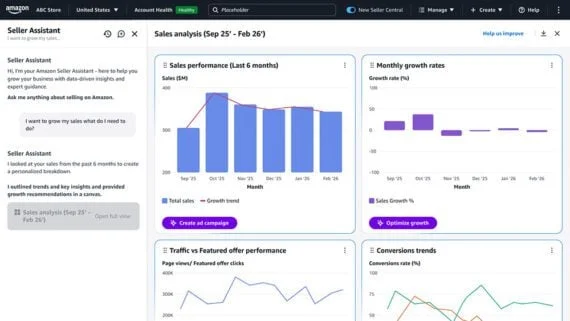
Amazon has launched a groundbreaking artificial intelligence feature within its Seller Central platform, ushering in a new era of data analysis for online merchants. This innovative tool replaces static reports with a dynamic, visual workspace, allowing sellers to explore their performance data through intuitive, conversational interactions. Dubbed a "dynamic canvas experience," this development signals a significant shift in business intelligence software, potentially paving the way for what can be termed "conversational business intelligence" within e-commerce ecosystems.
The core of this new functionality lies in its AI assistant, which empowers sellers to engage with their marketplace data in a more interactive and exploratory manner. Instead of navigating through complex spreadsheets or predefined reports, merchants can now pose natural language questions to the AI. For instance, a seller might inquire about the direct impact of specific advertising campaigns on their product sales, or request a comparative analysis of sales performance between two distinct time periods. The AI then intelligently generates relevant charts, graphs, and visualizations directly within the seller’s custom workspace, effectively transforming Amazon’s vast marketplace datasets into an accessible, chat-based interface.
This "canvas experience" encourages experimentation and deeper understanding by enabling sellers to arrange and manipulate these visual elements freely. Amazon’s description emphasizes the tool’s potential to facilitate a more hands-on approach to data exploration, moving beyond passive consumption of reports to active engagement with performance metrics. The accompanying visual, a screenshot of the Seller Central canvas, illustrates this concept, showcasing a potential arrangement of charts and graphs that provide a synthesized view of crucial business indicators.
The Ascendance of Workspace-Centric BI
The introduction of the Seller Central AI canvas is not an isolated event but rather a reflection of a broader, accelerating trend in business analysis software. As artificial intelligence continues its rapid evolution and finds increasingly sophisticated applications, platforms are moving towards more integrated and user-friendly data exploration methods. This shift suggests a future where traditional reliance on spreadsheets, manual report generation, and even existing business intelligence tools might diminish, supplanted by AI systems capable of not only interpreting data signals but also offering informed recommendations and potentially automating decision-making processes.
The fundamental paradigm of performance analysis is being reshaped. Rather than a process of painstaking data digging and report construction, it is evolving into a more fluid, conversational exchange. Tools like the Seller Central AI canvas point towards a future where e-commerce analytics will diverge from the conventional dashboard model, transforming into an ongoing dialogue. The seller initiates the interaction by asking pertinent questions, the AI surfaces actionable insights, and informed decisions naturally follow.
Evidence of this burgeoning trend extends beyond Amazon. Shopify, a major competitor in the e-commerce platform space, has also been aggressively integrating AI into its offerings. The company’s Winter ’26 platform update, for example, featured over 150 AI-related enhancements, prominently including significant upgrades to its AI assistant, Sidekick. Features like Sidekick Pulse are designed to assist merchants with data analysis, task generation, and workflow automation. Similar to Amazon’s offering, merchants can query Sidekick about sales trends, inventory levels, or marketing performance, fostering a more dynamic approach to business management.

The Dawn of Conversational Business Intelligence
The concept of querying AI systems for insights into business data is not entirely novel. Variations of what is now being termed "conversational business intelligence" (CBI) have been emerging in dedicated analytics software for some time. Established platforms like Microsoft Power BI, Google’s Looker, and Qlik have incorporated natural language query capabilities. These tools allow users to ask questions in plain English, such as "Why did our conversion rate drop yesterday?" or "What were the top-selling products in the last quarter?" and receive immediate, data-driven responses in the form of charts, summaries, and textual explanations.
However, the integration of such capabilities directly into the operational platforms of major e-commerce marketplaces, like Amazon’s Seller Central, represents a significant democratization of advanced analytics. Historically, accessing and analyzing the depth of data provided by Amazon required specialized skills, additional software, or considerable time investment. The Seller Central AI canvas aims to bridge this gap, making sophisticated data interpretation accessible to a wider range of sellers, regardless of their technical expertise.
Profound Implications for Online Merchants
The sheer volume of data generated by online selling platforms like Amazon is staggering. Sellers already have access to a wealth of reports covering critical areas such as website traffic, conversion rates, advertising campaign performance, customer reviews, and inventory levels. The challenge has always been in effectively synthesizing this information and understanding the intricate relationships between these disparate metrics. Traditionally, this often necessitated exporting data into spreadsheets, employing external business intelligence tools, or relying on the expertise of data analysts.
Conversational business intelligence promises to alleviate this complexity considerably. Instead of meticulously sifting through numerous reports or building custom queries, a merchant can simply ask a question and receive immediate, digestible insights in the form of visualizations and concise explanations. As these tools mature, they are poised to fundamentally alter how merchants interact with their e-commerce data in several key ways:
- Accelerated Decision-Making: The ability to get instant answers to critical business questions significantly speeds up the decision-making process. This agility is crucial in the fast-paced world of e-commerce, where timely interventions can mean the difference between success and stagnation.
- Democratization of Data Analysis: By removing the technical barriers associated with traditional data analysis, CBI empowers a broader spectrum of users to leverage data for strategic advantage. This can lead to more informed decisions across all levels of a business, not just those with dedicated analytics teams.
- Proactive Performance Monitoring: As AI systems become more sophisticated, they can move beyond simply answering queries to proactively identifying trends, anomalies, and opportunities. This shift from reactive to proactive analysis can help merchants stay ahead of market changes and customer demands.
- Enhanced Operational Efficiency: By automating aspects of data interpretation and reporting, CBI frees up valuable time for merchants to focus on core business activities such as product development, marketing strategy, and customer service.
Despite these advancements, it is important to note that conversational business analysis is unlikely to completely replace traditional reporting methods in the immediate future. Merchants will continue to require robust data models, clearly defined key performance indicators (KPIs), and a deep understanding of their business operations to effectively interpret the insights provided by AI. The human element of strategic thinking and business acumen remains indispensable.
Towards Automated Business Management
Looking further ahead, the evolution of AI technology suggests that these systems may transcend merely answering queries. As AI capabilities advance, they could begin to proactively recommend specific actions or even automate their execution within defined parameters. Imagine an AI assistant that, based on real-time performance data, automatically increases the budget for a highly profitable advertising campaign, pauses a keyword group that is underperforming and consuming budget inefficiently, or proactively alerts a merchant to impending low inventory levels for a popular product, perhaps even initiating a reorder process.
This trajectory suggests that conversational business intelligence could herald a more automated business environment. In this future, software would not only illuminate the data but also play a more integral role in the day-to-day running of the business. For now, tools such as Amazon’s Seller Central canvas primarily function as sophisticated query responders. However, as AI continues to embed itself within e-commerce platforms, the gap between gaining insight from data and taking decisive action is expected to shrink dramatically, leading to more agile, data-driven, and ultimately, more successful online businesses. The implications for how merchants manage their operations and interact with their customer base are profound, promising a future where data is not just analyzed, but actively harnessed to drive growth and efficiency.

