
Google Ads is set to implement significant changes to its bidding system on August 17th, a move the company asserts will lead to more predictable campaign performance. However, industry observers and advertisers are bracing for potential "unpredictable swings" as the platform shifts its algorithmic priorities, particularly for target-based bidding strategies. The core alteration lies in how Google Ads will now interpret and execute campaigns utilizing Cost Per Acquisition (CPA) or Target Return on Ad Spend (tROAS). Previously, these strategies aimed to optimize within a given target range. The forthcoming update mandates a more stringent adherence to the set goal, even if current campaign performance significantly exceeds it. For instance, a campaign targeting a 300% tROAS that is currently delivering 500% may now be adjusted by Google’s algorithm to more closely align with the 300% objective, a stark departure from a system that historically allowed for exceeding targets. While Google has indicated that the changes will primarily affect budget-limited campaigns, prudent advertisers are advised to review all campaign types to mitigate any unforeseen consequences.
Understanding the Shift: From Optimization Range to Goal-Centric Bidding
For years, Google Ads has empowered advertisers to set specific performance benchmarks through strategies like tROAS and Target CPA. These tools were designed to automate bidding in a manner that aimed to achieve a desired return on investment or cost per conversion. However, the implicit understanding was that over-performance was a positive outcome, allowing for potentially higher revenue or more conversions within a budget. The upcoming modification fundamentally alters this dynamic. Google’s official communication highlights a commitment to making "actual performance closer to the goal." This suggests a recalibration of the algorithm’s objective function, prioritizing the achievement of the stated target above all else, potentially at the expense of current, superior performance metrics.
This shift has been met with a mixture of apprehension and cautious optimism within the digital advertising community. While the promise of predictability is appealing, the execution of this new paradigm could lead to a reduction in efficiency for campaigns that are currently outperforming their targets. The underlying technology powering these bidding strategies relies on machine learning models that analyze vast amounts of data to predict user behavior and optimize ad delivery. The recalibration of these models to enforce a stricter adherence to targets introduces a new variable that advertisers will need to understand and manage.
The "Why" Behind the Change: Google’s Perspective and Market Dynamics
While Google has not provided extensive public commentary beyond the initial announcement, industry analysts suggest several potential drivers for this significant update. One prevailing theory is that Google aims to create a more streamlined and easily understandable bidding environment for a broader range of advertisers, including those less experienced with complex optimization strategies. By making performance more directly tied to stated goals, the platform might be seeking to demystify its automated bidding capabilities.
Another possibility relates to market pressures and competition. The digital advertising landscape is increasingly competitive, with platforms constantly vying for advertiser spend. By offering a seemingly more controlled and predictable performance environment, Google Ads could be attempting to retain and attract advertisers who prioritize stability and a clear correlation between their investment and stated objectives. Furthermore, the ongoing evolution of privacy regulations and the deprecation of third-party cookies are forcing platforms to rely more heavily on first-party data and on-platform signals. This change in bidding strategy could be a way to optimize the use of these available data points for more direct goal achievement.
Preparing for the New Landscape: Advertiser Strategies and Recommended Actions
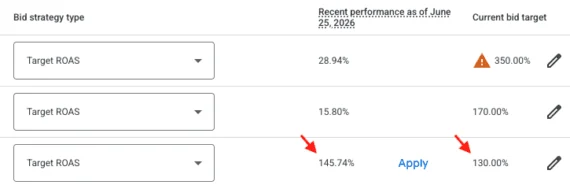
The onus is now on advertisers to proactively prepare for this algorithmic shift. The first and most crucial step is to establish a clear understanding of individual performance preferences and objectives. This involves a thorough review of current campaign goals, historical performance data, and future business objectives. Google itself has acknowledged the need for advertisers to make informed decisions and has introduced a "bid target adjustment tool" to aid in this transition. This tool provides a crucial snapshot of current targets alongside recent performance metrics, allowing advertisers to identify potential discrepancies.
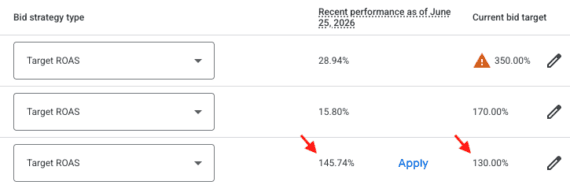
For example, the provided illustration showcases a campaign with a target ROAS of 130.00% that has been consistently achieving 145.74%. Under the new system, without any intervention, this campaign’s optimization would naturally steer performance downwards towards the 130.00% target. This highlights a critical juncture where inaction could lead to a decline in otherwise strong performance.
Google Ads has outlined four primary options for advertisers to consider when faced with such scenarios:
-
Keep the Target As Is: For advertisers who are content with the current target and accept that performance may revert to that level, no immediate action is required. This strategy is best suited for those who have a long-term view and believe the stated target is sufficient for their business objectives, even if current performance is higher.
-
Maintain Recent Performance: This option involves proactively adjusting the target to align with current, superior performance. However, a cautious approach is recommended. Google suggests gradually increasing the target, particularly if recent performance significantly exceeds the existing target (e.g., by more than 20%). For instance, if a campaign is achieving a 200% ROAS against a 130% target, increasing the target incrementally, perhaps to no more than 156% initially, and then further after a period of sustained performance, is advised. This gradual adjustment allows advertisers to experiment with the new system and learn how it responds to upward adjustments, while also considering the overall health of their account performance. A sudden, drastic increase in individual campaign targets could negatively impact the aggregate account-level ROAS if not carefully managed.
-
Adjust the Custom Target: In situations where a current target is demonstrably too low and a higher performance level is consistently achievable and realistic, advertisers may opt to set a new, custom target. This is not about gradual adjustment but about establishing a new benchmark that reflects a more ambitious and attainable performance level. For example, if 400% ROAS is a realistic and sustainable performance, setting the custom target to 400% would be more appropriate than a gradual increase from 300%.
-
Switch to Maximize Strategy: For advertisers whose primary objective is to maximize the volume of conversions or the total conversion value within a fixed budget, irrespective of a specific ROAS or CPA target, switching to a "Maximize Conversions" or "Maximize Conversion Value" strategy may be the most suitable option. This approach prioritizes achieving the highest possible volume of desired outcomes, potentially at the cost of efficiency. While this could lead to an increase in overall volume, advertisers should be prepared for a potential decline in their efficiency metrics.
Broader Implications and the Evolving Digital Advertising Ecosystem
The implications of this Google Ads bidding system change extend beyond individual campaign performance. It signals a broader trend within the digital advertising ecosystem towards greater automation and algorithmic control. As platforms evolve and data privacy concerns reshape the advertising landscape, advertisers are increasingly reliant on the sophisticated tools and machine learning capabilities offered by major players like Google.
This shift also highlights the importance of data analysis and strategic planning. Advertisers who actively monitor their campaign performance, understand the nuances of Google’s algorithms, and are prepared to adapt their strategies will be best positioned to navigate these changes successfully. The introduction of the bid target adjustment tool is a positive step, empowering advertisers with more visibility. However, the ultimate responsibility for successful campaign management will continue to rest with the advertiser’s ability to interpret this data and make informed decisions.
The long-term impact of this change will likely depend on how effectively advertisers adapt and how Google continues to refine its algorithms. The promise of predictability is attractive, but the potential for unintended consequences, such as the suppression of high-performing campaigns, cannot be ignored. As the August 17th deadline approaches, the digital advertising world will be watching closely to see how this significant alteration reshapes the performance and profitability of campaigns across the Google Ads network. The era of simply "setting and forgetting" automated bidding strategies may be giving way to a more dynamic and responsive approach, demanding greater advertiser engagement and strategic foresight.

