
Decentralized social network Bluesky, once heralded as a primary refuge for users fleeing Elon Musk’s X (formerly Twitter) in the turbulent aftermath of the November 2024 U.S. elections, is now grappling with a significant challenge: sustaining its momentum. Nearly two years after its initial surge, the platform, envisioned as a formidable competitor to X, is seeing a noticeable decline in its mobile app user base, prompting a re-evaluation of its strategy and the broader landscape of the decentralized web.
The Post-Election Exodus and Bluesky’s Brief Ascendancy
The political climate surrounding the 2024 U.S. presidential elections proved to be a pivotal moment for several emerging social media platforms. As Election Day approached and the subsequent period of intense political debate and content moderation intensified, a significant portion of X’s user base expressed growing dissatisfaction with the platform’s direction under Elon Musk’s ownership. Changes to content policies, the perceived proliferation of misinformation, the controversial rebranding from Twitter, and the introduction of new monetization strategies for basic features fueled a widespread desire for alternatives. Users sought platforms promising greater transparency, community control, and a departure from what many perceived as a chaotic and increasingly unreliable "digital public square."
Bluesky, backed by Twitter co-founder Jack Dorsey and built on the open-source AT Protocol, emerged as a leading contender to capture this disillusioned audience. Its promise of a decentralized, interoperable social network resonated deeply with those yearning for a different model. Initially operating on an invite-only system, which strategically fueled exclusivity and curiosity, Bluesky opened its doors to the public in February 2024, just months before the election fervor peaked. This timing positioned it perfectly to absorb the waves of users abandoning X. Throughout late 2024, especially in November and December, Bluesky experienced a substantial influx of new registrations and active users, momentarily fulfilling its potential as a credible alternative. Digital intelligence provider Similarweb reported that Bluesky’s mobile app reached a quarterly average of approximately 22.1 million monthly active users (MAU) in the fourth quarter of 2024, marking its peak performance. This period was characterized by a vibrant, albeit rapidly expanding, community eager to shape a new social experience away from the controversies plaguing established platforms.
Sustained Decline: A Look at the Numbers
However, the initial post-election bump has proved difficult to maintain. Fast forward to mid-2026, and the data paints a stark picture of declining engagement. According to recent figures from Similarweb, Bluesky’s mobile app recorded 10.4 million monthly active users worldwide in June 2026. This represents a substantial year-over-year decrease of 27.2%. The trend of diminishing engagement extends to daily usage as well, with mobile daily active users (DAU) falling by 25.6% year-over-year in July 2026, settling at around 3 million.

More broadly, the decline from its late-2024 peak is even more pronounced. From its high of 22.1 million MAU in Q4 2024, Bluesky’s mobile app usage plummeted to 10.7 million MAU in the second quarter of 2026. This indicates a staggering reduction of approximately 52% in its monthly active user base within roughly a year and a half. While Bluesky’s own public statistics indicate a continued growth in registered accounts, nearing 46 million, this figure does not translate into sustained active participation. The discrepancy highlights a significant challenge: while people are creating accounts, a substantial portion are not consistently engaging with the platform. This suggests that many who initially migrated from X, driven by temporary frustration, did not find sufficient long-term value or community to remain active users.
"The trajectory for Bluesky reflects a common pattern seen with many emerging social networks that benefit from a ‘migration event’," stated Anya Sharma, a Senior Analyst at Similarweb. "While the initial influx can be impressive, converting those transient users into a loyal, daily active community is the ultimate test. Bluesky’s data indicates that a significant portion of its early adopters haven’t integrated the app into their regular social media habits, resulting in a high churn rate after the initial novelty wore off." Sharma estimated the mobile app’s churn rate for users acquired in Q4 2024 to be upwards of 60% by Q2 2026.
Understanding the Retention Challenge and User Experience
Several factors likely contribute to Bluesky’s struggle with user retention. For many, the theoretical appeal of decentralization and an open protocol might have been overshadowed by a less polished user experience compared to more established platforms. While the AT Protocol offers immense flexibility and potential for innovation, the Bluesky app itself, as the primary interface for many users, may have lacked certain features, content velocity, or the robust network effect that keeps users tethered to platforms like X or Threads.
The smaller network size, despite its core committed users, can also hinder organic content discovery and the overall sense of a vibrant public square. Users migrating from a platform with hundreds of millions of active participants often find the content flow on newer, smaller networks to be slower or less diverse, making it harder to find niche communities or trending topics that resonate with their interests. Furthermore, the inherent complexity of understanding and engaging with a decentralized ecosystem, while appealing to tech-savvy early adopters, can be a barrier for mainstream users seeking a straightforward social experience. The novelty of leaving X might have worn off, and without a compelling unique selling proposition beyond "not being X," many users may have simply drifted away, searching for platforms that better meet their daily social media needs.
Building Beyond Bluesky: A Protocol-Centric Vision
Despite the challenging user engagement figures for the Bluesky app, the company’s leadership appears to be pivoting its focus towards a broader, more ambitious vision: the success of its underlying AT Protocol. For Toni Schneider, Bluesky’s new CEO, the metrics of the flagship app may not be the sole determinant of success. Schneider, whose interim tag was dropped in July 2026, is steering the company towards fostering an ecosystem of diverse social applications, services, and communities built on the AT Protocol. This strategy acknowledges that the true power of decentralization lies not in a single application, but in the interoperability and innovation that a robust protocol can enable across multiple platforms.

"Our mission has always been about empowering users and developers through an open, decentralized protocol," Schneider stated in a recent internal memo, portions of which were shared with TechCrunch. "While the Bluesky app remains an important part of our ecosystem, the long-term success of AT Protocol hinges on its adoption across a multitude of applications. We are building the infrastructure for the next generation of social networking, where users have true ownership and choice, not just another single platform. We’re committed to nurturing our dedicated community on the Bluesky app, while simultaneously expanding the reach and utility of the protocol itself."
Evidence of this protocol-centric strategy is already emerging. Projects like BlackSky and Eurosky, which are understood to be alternative clients or specialized social applications leveraging the AT Protocol, are reportedly gaining traction by offering tailored experiences for specific user groups or regions. More notably, video-focused AT Protocol apps, such as Skylight, have found significant early success. Skylight, a TikTok alternative, soared to 380,000 users after the finalization of a TikTok U.S. deal in January 2026, demonstrating the protocol’s versatility and appeal for developers looking to build niche or feature-specific social experiences. This indicates that while the Bluesky app itself might be struggling to retain a broad audience, the underlying technology is proving capable of powering successful, specialized social applications. The idea is that users may find their preferred social experience on an AT Protocol-powered app tailored to their specific interests (e.g., video, professional networking, gaming communities) rather than a general-purpose public square.
Innovation and Expansion: Attie and Private Data Initiatives
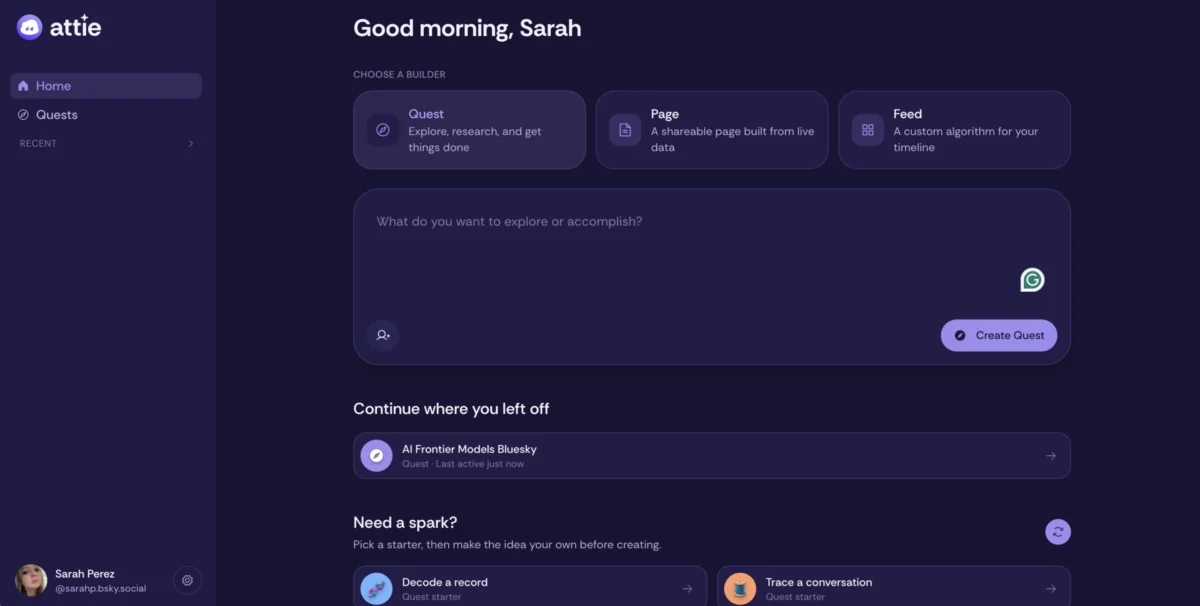
Bluesky is also actively developing new products and features to expand the utility of its ecosystem. Among these is Attie, an AI-powered research tool launched in July 2026, which is now evolving into an open social research platform. Attie aims to leverage the vast, open data available on the decentralized web, potentially offering users powerful insights and tools for discovery that go beyond traditional content feeds. This move could attract a different demographic of users, such as researchers, analysts, or even content creators looking for deeper engagement and understanding of online trends by providing sophisticated data analysis capabilities across the fediverse.
Furthermore, the company is investing in adding robust support for private data to the Bluesky protocol. This development is crucial for attracting a user base less interested in public discourse and more focused on private networking, secure communities, and confidential interactions. The ability to host private groups, encrypted communications, or even decentralized professional networks could unlock entirely new use cases for the AT Protocol, differentiating it from platforms primarily designed for public broadcasting. This strategic expansion acknowledges that not all social interactions need to be public and that privacy and control over data are increasingly valued features in the evolving digital landscape. Early indications suggest strong interest from niche communities and organizations seeking more secure and sovereign communication channels.
The Broader Social Media Landscape: X and Threads
Bluesky’s decline does not, however, suggest a simple return of users to X. Similarweb’s data indicates that X is also facing its own challenges in user engagement. X’s worldwide monthly active users on mobile were down approximately 3% year-over-year in June 2026, and its mobile daily active users dropped 7% in July to 123.7 million. Despite these declines, X remains a formidable force in the social media arena, boasting around 302 million monthly active users on its app as of June 2026, alongside a growing number of web visits, which were up 5.3% year-over-year in July to 4.7 billion. This suggests a complex dynamic where users are not necessarily returning to X but rather exploring other alternatives or reducing their overall engagement with "X-like" platforms, indicating a broader fragmentation of the social media market.

The true beneficiary of this shifting landscape appears to be Meta-owned Threads. While it’s unclear whether Threads is directly attracting former Bluesky users or a new demographic entirely, its growth trajectory is impressive. Threads’ daily active users surged by 21.3% year-over-year to 147 million in July 2026. Its website visits saw an even more dramatic increase, up 112% year-over-year to 471.6 million. Threads’ ability to leverage Meta’s vast existing user base, particularly Instagram’s, and its more familiar interface, has likely contributed to its rapid expansion, positioning it as a significant contender in the microblogging space. Its growth underscores the challenge for independent, decentralized platforms like Bluesky to compete with the scale and integration offered by tech giants, which can quickly onboard users and offer a comprehensive feature set.
The Future of Decentralized Social Networking
Bluesky’s journey reflects the inherent complexities and growing pains of building truly decentralized social infrastructure. While the immediate engagement numbers for its flagship app are concerning, the company’s pivot towards a protocol-first strategy, fostering an ecosystem of diverse applications, and investing in new features like Attie and private data support, indicates a long-term vision that extends beyond direct competition with X.
Industry experts observe that the "fediverse," or federated universe of interconnected social platforms, represents a significant paradigm shift, but one that requires patience and a different measure of success. "Measuring a decentralized protocol’s success solely by the MAU of its primary client app is akin to judging the internet by the traffic to a single website," commented Dr. Lena Hansen, a researcher specializing in decentralized technologies at the University of California, Berkeley. "The value of AT Protocol will be in the breadth and resilience of the ecosystem it enables, the innovation it fosters, and the true user ownership it delivers, even if those users are spread across many different applications. Bluesky’s stickiness rate of 29% in June, on par with Threads, for its core app users, demonstrates that a dedicated community remains, providing a strong foundation for the protocol’s continued development."
The current phase for Bluesky is less about winning a head-to-head battle with X or Threads, and more about proving the viability and utility of its underlying technology. With nearly 46 million registered users spread across the AT Protocol’s potential ecosystem, the challenge for Bluesky is to convert those registrations into meaningful, sustained engagement across its diverse offerings, demonstrating that decentralization can indeed offer a compelling and sustainable alternative to the centralized giants of social media. The coming years will reveal whether this strategic recalibration can solidify Bluesky’s place as a foundational layer for a more open and user-controlled digital future.

