
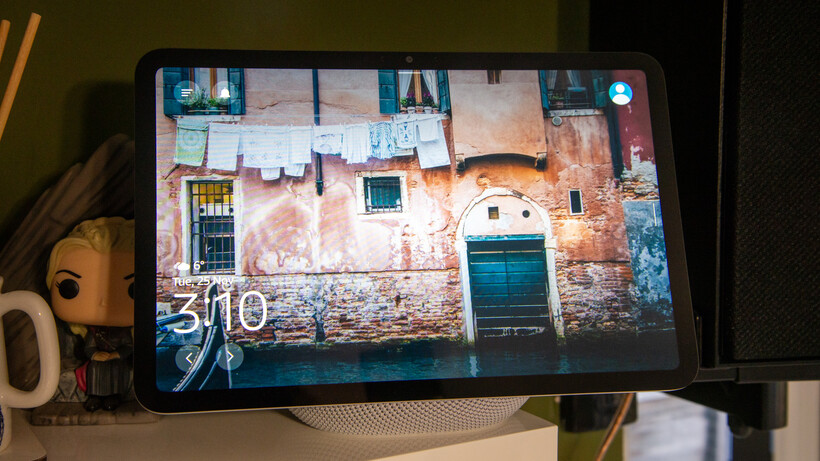
A comprehensive review of Amazon’s latest smart display reveals incremental upgrades, raising questions about its market position against its more affordable sibling.
The Amazon Echo Show 11, the latest iteration in Amazon’s line of smart displays, presents itself as a direct upgrade to the popular Echo Show 8, primarily distinguished by its larger, Full HD display. While this increased screen real estate offers a more immersive visual experience, the core functionalities and audio performance remain largely identical to its smaller counterpart, the Echo Show 8 (4th Generation). This raises a critical question for consumers: does the larger display justify the higher price point, or is the Echo Show 8 the more prudent choice for the majority of users? This in-depth analysis delves into the design, features, performance, and overall value proposition of the Echo Show 11, providing a clear picture of its strengths and weaknesses in the competitive smart display market.
Design and Evolution: A Familiar Footprint
The Echo Show 11 emerges as Amazon’s largest desktop smart display since the ambitious Echo Show 10, which debuted in 2021. The Echo Show 10 was notable for its innovative motorized stand, allowing the screen to dynamically swivel and track users, a feature that, while impressive, contributed significantly to its premium price. Recognizing that such advanced mechanics were not essential for all consumers, Amazon has opted for a more streamlined approach with the Echo Show 11.

The design philosophy of the Echo Show 11 mirrors that of the recent Echo Show 8. Both devices share an identical base and stand, a strategic manufacturing decision that likely streamlines production and offers consistency in aesthetic and functional design. This shared foundation means that color options and power input configurations are uniform across both models, simplifying the supply chain for Amazon. The primary differentiator, therefore, lies solely in the display size and resolution. The 11-inch model boasts a larger, higher-resolution screen, which significantly enhances the visual appeal. The design itself is aesthetically pleasing, with a thin screen elegantly suspended above the base, creating a sense of a floating display. This modern design language represents a departure from the more utilitarian, wedge-shaped designs of earlier Echo Show models, offering a more sophisticated presence in any room.
However, a minor point of contention for some users might be the fixed display angle. While the overall design is commendable, the lack of an adjustable screen tilt necessitates the purchase of an optional stand for users who require a more customized viewing angle. This could be perceived as a small oversight, particularly given the device’s larger screen size, which might be positioned at varying heights in different environments.
At the rear of the device, the minimalist approach continues with a single power input port, reflecting a clean and uncluttered aesthetic. Physical controls are strategically placed on the side of the screen, offering intuitive access to volume adjustment and a mute button. This mute button serves a dual purpose: it silences audio output and simultaneously deactivates the camera. Notably, the Echo Show 11, like the Echo Show 8, omits the physical camera slider that was present on some previous models. While the software-based mute offers functional privacy, the absence of a physical slider might leave some users with lingering concerns about visual privacy, as a physical barrier provided a more tangible assurance of the camera being disabled.

Core Features and Performance: Leveraging Alexa’s Ecosystem
Under the hood, the Amazon Echo Show 11 shares its internal architecture with the Echo Show 8, featuring the AZ3 processor equipped with an AI Accelerator. This hardware is optimized for Alexa’s capabilities, including the emerging Alexa+ GenAI assistant. However, it is crucial to note that the availability and functionality of Alexa+ are region-dependent. In territories where Alexa+ is not yet deployed, users will not experience the full potential of the GenAI features, a factor that could influence performance perceptions.
In regions where Alexa is fully functional, the Echo Show 11 demonstrates robust performance in responding to voice commands. The far-field microphone array is adept at capturing even soft utterances in moderately noisy environments, ensuring that user requests are registered accurately. Alexa, as a platform, performs its standard functions reliably, acting as a comprehensive smart home controller, information retrieval system, and media player.
While Alexa excels at general tasks such as controlling smart home devices and engaging in conversational exchanges, its limitations become apparent when seeking specific, external information. For instance, its database of local businesses, including restaurants, may not always be as up-to-date or comprehensive as dedicated mapping services like Google Maps. This highlights an ongoing challenge for voice assistants in maintaining the precision and breadth of real-world data.

The Full HD display on the Echo Show 11 significantly enhances the visual experience compared to the Echo Show 8. While the amount of information displayed remains consistent, the increased resolution makes text, images, and widgets appear sharper and more legible. By default, the screen cycles through a slideshow of personal photos or curated Amazon selections, offering a customizable ambient display. Users can also opt to display news headlines or recipe ideas, with the ability to hide unwanted sections through the settings menu.
A key feature that elevates the Echo Show 11’s utility in multi-user households is Visual ID. This technology leverages the device’s camera to recognize individual users. Upon recognition, the smart display can present personalized information, such as tailored calendar appointments, daily schedules, or relevant notifications, enhancing the user experience by providing context-specific content without explicit prompting.
The integration of voice commands with visual feedback is where the Echo Show 11 truly shines, offering what could be considered the most effective Alexa experience. For example, when querying the weather, the display not only provides the current conditions but also allows users to swipe through screens for detailed hourly forecasts and additional meteorological data. Similarly, controlling smart home devices is streamlined through an intuitive on-screen interface. Adjusting the brightness of lights, for instance, can be accomplished with a simple slider, offering a more immediate and visual control method than voice commands alone.

However, the smart home control interface is not without its nuances. While users can group devices for simultaneous control (e.g., adjusting the brightness of all office lights at once), more granular adjustments, such as individual color or temperature settings for smart bulbs, still require separate commands for each device. This can lead to a less streamlined experience for complex smart home setups.
The Echo Show 11 also supports live streaming from cameras, a feature particularly beneficial for Ring doorbell owners. These users benefit from thumbnail previews of their camera feeds, allowing for quick visual checks of their property. Answering doorbell calls directly through the smart display eliminates the need to reach for a smartphone, offering a convenient layer of security and accessibility.
Widgets provide a further avenue for quick access to information, such as upcoming calendar events or recently played songs on Spotify. While the inclusion of widgets is a positive step, the current selection is somewhat limited, and some widgets may not offer the full utility one might expect. For example, the smart home widget pulls devices from a global favorites list. A more granular approach, allowing users to customize widgets for specific rooms or Echo Show devices, would significantly enhance its practical application. Imagine having a smart home widget on the office Echo Show displaying only office-related devices, and a different set on the kitchen unit.

Advanced Smart Home Capabilities and Connectivity
The Echo Show 11 is equipped with a comprehensive smart home hub, boasting support for Zigbee, Thread, and full Matter compatibility. This broad compatibility ensures seamless integration with a vast array of smart home devices from various manufacturers, positioning the Echo Show 11 as a central control point for a connected home.
A standout feature is Omnisense, an advanced occupancy detection system that utilizes both the device’s camera and onboard sensors. Omnisense accurately identifies whether a room is occupied or empty, enabling highly precise routine triggers. This presence detection capability surpasses that of traditional motion sensors, allowing for more sophisticated automation, such as lights turning on only when a room is actively in use and turning off shortly after it’s vacated.
Furthermore, Omnisense powers Adaptive Content on the Echo Show 11. When a user is at a distance from the device, it defaults to displaying a slideshow or ambient content. As the user approaches, the screen dynamically shifts to interactive widgets and controls, providing immediate access to relevant information and functionalities. This intelligent adaptation enhances user engagement and streamlines interaction.

Multimedia and Display Quality: A Sharper View
The Echo Show 11 features a 2.8-inch woofer and dual full-range drivers within its base, delivering audio performance that is virtually identical to that of the Echo Show 8. This setup provides generally very good audio quality for a smart display of its size. Bass reproduction is robust, capable of handling bass-heavy tracks with a satisfying thump. While stereo separation is somewhat limited due to the close proximity of the drivers, the speakers still manage to produce a sense of movement in stereo recordings, making music and other audio content engaging.
The 11-inch, 1080p Full HD display offers a noticeable improvement in sharpness and detail compared to the Echo Show 8. While it does not support HDR content, the increased resolution makes visual elements crisper and more defined. Brightness and image uniformity are satisfactory, though blacks can appear slightly grey in darker scenes, a common limitation in LCD displays. For video playback, audio remains clear and impactful, effectively conveying the dynamics of action sequences.
Dedicated apps for streaming services like Netflix and Amazon Prime Video are available, providing a relatively seamless viewing experience. However, access to platforms such as Disney+ and YouTube is limited to the integrated web browser. While functional, this browser-based access may not offer the same level of user experience as dedicated applications. For a more comprehensive streaming platform integration, the Echo Show 15, with its full Fire TV platform, might be a more suitable option.

The built-in 13-megapixel webcam is equipped with auto-tracking and framing capabilities, ensuring that users remain centered during video calls. The image quality is good, primarily serving the purpose of video communication between Echo Show devices. While this feature is valuable for those who frequently engage in such calls, it may be underutilized by a significant portion of the user base who do not regularly conduct video calls on their smart displays.
Value Proposition and Conclusion: A Tale of Two Shows
The Amazon Echo Show 11 presents a clear proposition: it offers a larger, higher-resolution display compared to its predecessor, the Echo Show 8. This enhanced visual experience is undoubtedly appealing for users who prioritize screen size for activities like recipe viewing, video calls, or simply a more expansive ambient display. The design is modern and aesthetically pleasing, and the advanced smart home features, including comprehensive Matter support and Omnisense occupancy detection, are significant advantages.
However, the core functionalities, including the internal processing, Alexa’s performance, and audio output, are largely identical to the Echo Show 8. This parity in essential features means that the primary upgrade is the screen itself. For many consumers, the additional cost associated with the larger display may not translate into a proportionally greater benefit. The Echo Show 8, with its still-capable display and identical core performance, represents a more compelling value for money proposition for the majority of users.

In essence, the Echo Show 11 is a well-designed and capable smart display that excels in visual presentation and smart home integration. If the allure of a larger screen is paramount and the budget allows, it is a commendable choice. However, for those seeking the best balance of features, performance, and affordability, the Echo Show 8 remains the more sensible and value-driven option in Amazon’s smart display lineup. The decision ultimately hinges on whether the incremental upgrade in screen size justifies the premium price, or if the proven performance and cost-effectiveness of the Echo Show 8 are sufficient for most household needs.
