
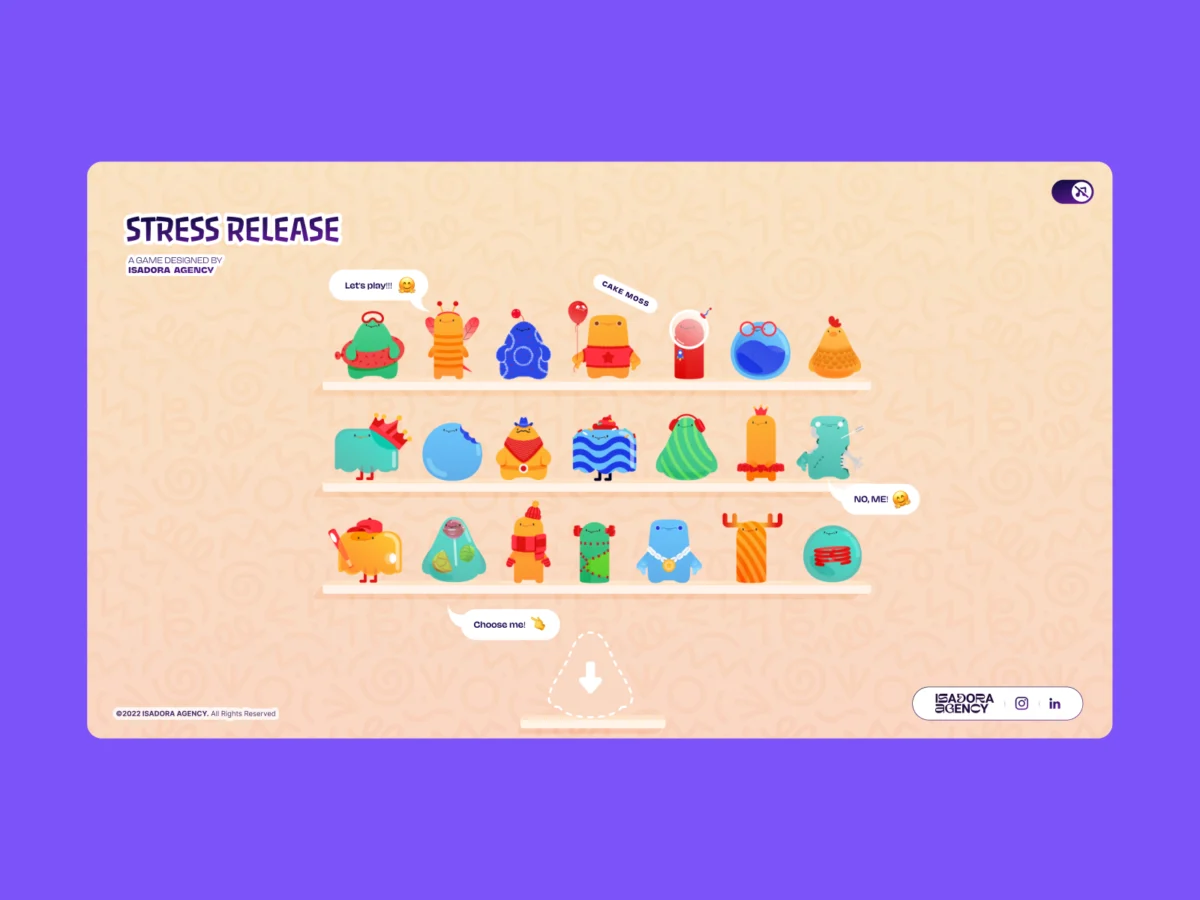
The digital landscape is currently witnessing a paradigm shift in how users interact with web interfaces, moving away from static layouts toward highly immersive, "tactile" environments. At the forefront of this evolution is the realization that technical architecture must be a servant to art direction, rather than a constraint upon it. In a comprehensive technical breakdown, Alexey Kopytin of Isadora Agency has detailed a revolutionary approach to building interactive web experiences that prioritize "intentional motion" over the automated simulations provided by traditional physics engines. By leveraging Lottie animations, DOM events, and distance-based mathematics, Kopytin’s team successfully developed a digital stress-relief toy that offers absolute control over the user experience without the overhead of complex WebGL solutions or third-party physics frameworks like Matter.js or Cannon.js.
The Shift from Plausible to Intentional Motion
For years, the industry standard for creating "bouncy" or "squishy" web interfaces has involved physics engines. These tools are designed to calculate "plausible motion"—movements that mimic the laws of gravity, friction, and inertia. However, the team at Isadora Agency, while developing their "Stress Release" project, discovered a fundamental friction point between algorithmic simulation and creative vision. The project, designed as a digital outlet for burnt-out creatives to smash, stretch, and distort animated characters, required a level of precision that a physics engine could not guarantee.
Kopytin argues that while physics engines produce motion that looks "correct" to a computer, they often fail to capture the "intentional motion" envisioned by animators. In the case of Stress Release, the animators had crafted bespoke JSON-based Lottie files with specific frame-by-frame sequences. For example, a "mega squeeze" reaction was not just a random distortion; it was a carefully timed 181-frame build-up followed by a specific release sequence. To honor this design, the development team opted for a deterministic architecture, ensuring that every user interaction triggered a specific, pre-designed animation segment rather than an approximation.
Technical Architecture: Mapping the Tactile Experience
The architectural foundation of the Stress Release project relies on three pillars: Lottie’s native API, standard DOM manipulation, and radial input mapping. By avoiding WebGL, the team kept the rendering layer accessible and responsive, using SVGs generated by the Lottie runtime.
Radial Input Mapping and Scoring Logic
To create a satisfying tactile feel, the team implemented a system of radial input mapping. This process begins by converting a user’s click or tap from global page coordinates into the local coordinate space of the character. Using the Pythagorean theorem ($a^2 + b^2 = c^2$), the system calculates the exact distance between the click point and the character’s center.

This single numerical value—the distance—becomes the primary driver for the entire interaction loop. It determines the scoring (with a "bullseye" yielding 100 points), the intensity of the visual feedback, and the precise placement of secondary animations, such as explosions. By repositioning the explosion Lottie animation to the exact vector coordinates of the click, the interface creates an immediate spatial link between user action and visual reaction. This creates the "I hit that" sensation that is vital for gamified interfaces.
Programmatic State Control
The interaction handling is managed through a "play order" system. Each character is assigned a set of animation segments defined by frame ranges, such as "idle," "light reaction," and "heavy reaction." When a click is detected, the code halts the current segment and jumps to the next frame range in the sequence. This deterministic control allows for complex narratives within the animation; for instance, a character might appear increasingly annoyed with each successive click until it reaches a "limit" and triggers a final "mega" state.
Chronology of Development: From Prototype to Production
The development of the Stress Release project followed a distinct timeline that reflects the broader challenges of modern creative development:

- Phase I: Physics Exploration (Weeks 1-2): The team initially attempted to use Matter.js to handle character distortions. While functional, the "plausible" physics often conflicted with the animators’ keyframes, leading to visual glitches and a loss of character personality.
- Phase II: The Pivot (Week 3): Recognizing the need for "intentional motion," Kopytin and his team scrapped the physics engine. They transitioned to a Lottie-centric model where the code acts as a conductor for pre-rendered assets.
- Phase III: Math Implementation (Weeks 4-5): The development of the radial scoring system and the coordinate remapping logic. This phase focused on ensuring the "feel" was right across different screen sizes.
- Phase IV: Optimization (Weeks 6-7): Addressing the performance costs of running 21 simultaneous Lottie animations. This involved implementing quality-toggling logic based on the user’s current view.
- Phase V: Deployment: The final product was launched as a responsive web application that maintains high-fidelity animation even on mid-range mobile devices.
Performance Engineering and Resource Management
One of the significant hurdles in moving away from a physics engine to a Lottie-based architecture is the impact on memory and load times. Lottie JSON files, while more efficient than traditional video formats, can become heavy when scaled across dozens of unique characters.
To mitigate this, the Isadora Agency team implemented a tiered quality system. On the "character shelf" screen, where 21 animations play simultaneously, the Lottie quality was set to 50%, and the playback speed was reduced to 60% to lower the number of frame calculations per second. Conversely, when a user selects a single character to interact with, the system boosts that specific animation to 100% quality. This dynamic resource allocation ensures a fluid 60-frames-per-second experience even on mobile hardware, where CPU and GPU constraints are most prevalent.
Furthermore, the use of CSS variables for responsive resizing allowed the team to bypass the complexities of scaling bounding boxes. By recalculating CSS custom properties on every window resize event, the Lottie SVGs scale naturally within their containers, preserving their internal state and animation progress without requiring a total re-render of the canvas.

Supporting Data: The Growth of Lottie in Modern UX
The decision to use Lottie is supported by broader industry trends. According to data from the LottieFiles platform, the library is now used by over 4 million developers and designers worldwide, including 90% of the Fortune 500. The primary driver for this adoption is the massive reduction in file size compared to traditional GIF or PNG sequences—often up to 600% smaller—while maintaining vector-perfect resolution.
In the context of tactile UX, studies in human-computer interaction (HCI) suggest that "latency to feedback" is the most critical metric for user satisfaction. By using DOM-based events and local math rather than waiting for a physics engine’s next tick, the Isadora team reduced interaction latency to nearly zero, satisfying the psychological need for immediate gratification in a gamified environment.
Industry Reactions and Broader Implications
The methodology proposed by Kopytin has sparked discussions among front-end architects regarding the "over-engineering" of simple interactions. Industry analysts suggest that the "Stress Release" project serves as a case study for "lean interactivity." By using basic geometry and native browser APIs, developers can achieve results that are often more stable and easier to maintain than those relying on heavy external libraries.

Designers have particularly lauded the approach for its "art-first" mentality. In many traditional development workflows, the designer’s work is handed off and "interpreted" by a physics engine, often losing the subtle nuances of timing and weight that the designer intended. Kopytin’s model ensures that the animator’s original vision is what the user ultimately sees on their screen.
Conclusion: A New Standard for Digital Tactility
The success of the Stress Release project demonstrates that building immersive web experiences does not always require the most complex technology available. Instead, it requires the right technology for the specific design goals. By prioritizing intentional motion and deterministic control, developers can create interfaces that feel physically present and emotionally resonant.
As web standards continue to evolve, the integration of Lottie and DOM-based math offers a viable path forward for creative agencies looking to push the boundaries of UI design. This approach not only honors the craft of the animator but also provides a robust, performant framework for the next generation of interactive storytelling. The move away from emergent simulation toward programmatic state control marks a significant milestone in the quest for a more tactile, human-centric internet.

