
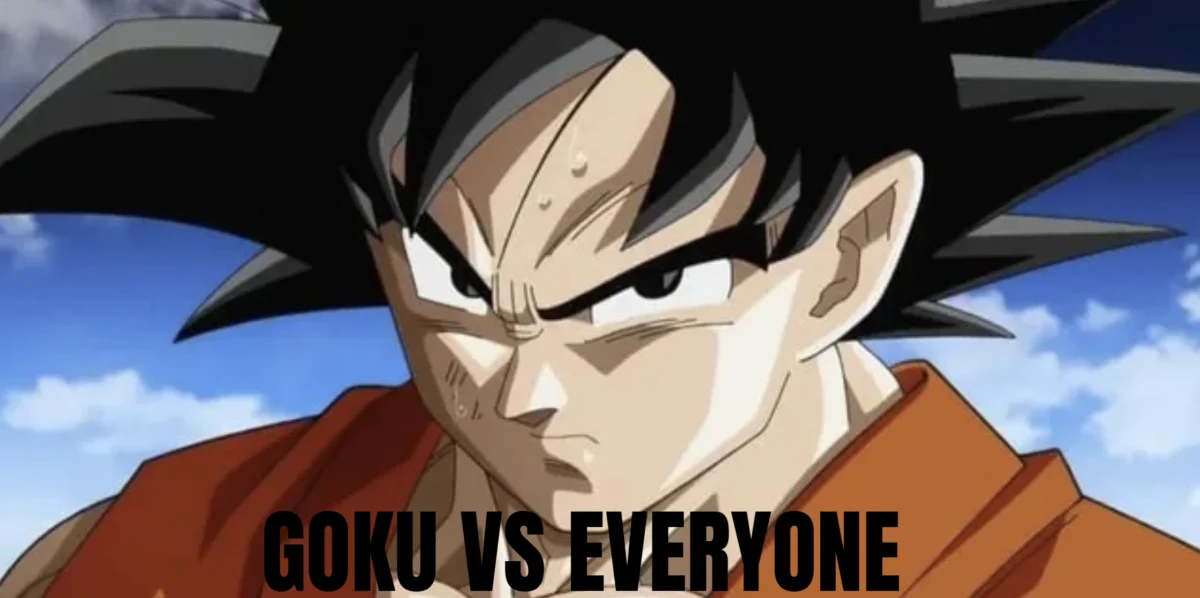
The digital landscape of the 21st century has been significantly shaped by a singular, persistent question that transcends language barriers, cultural boundaries, and medium constraints: "But can he beat Goku?" This phrase, which has evolved from a sincere fan debate into a pervasive internet meme, represents the "Goku VS" phenomenon—a cornerstone of modern "powerscaling" culture. For over three decades, Son Goku, the protagonist of Akira Toriyama’s seminal Dragon Ball franchise, has served as the universal benchmark for fictional strength. The practice of pitting Goku against other iconic characters, ranging from DC Comics’ Superman to more abstract entities like Madoka Kaname, has moved beyond simple hobbyist speculation to become a sophisticated subculture characterized by rigorous data analysis, competitive debate, and eventual satirical deconstruction.
The Foundation of a Cultural Benchmark
To understand the weight of the Goku VS phenomenon, one must first analyze the source material. Since his debut in 1984, Goku has personified the "shonen" archetype of perpetual growth. Unlike many Western superheroes who possess a fixed set of abilities, Goku’s narrative is defined by the constant breaking of limits. From his early days as a child martial artist to his eventual ascension to "Ultra Instinct"—a state of being that allows for autonomous movement and reaction—Goku’s power progression provides a nearly infinite well of data for fans to analyze.
This progression created a unique environment for comparison. In the late 1990s and early 2000s, as the internet became more accessible to global audiences, fans began utilizing message boards and Usenet groups to compare Goku’s feats against those of other fictional icons. Goku was not merely a character; he became a metric. His ability to destroy planets, move at faster-than-light speeds, and withstand universal-level attacks provided a "standard unit of measurement" in the burgeoning field of fictional combat analysis.
Chronology of a Phenomenon: From Print to Viral Memes
The formalization of the Goku VS debate can be traced through several distinct eras, each marked by a shift in media consumption and community interaction.
1. The Print Era (Late 1990s – 2002):
Before the dominance of social media, crossover debates were largely confined to fanzines and specialty publications. A pivotal moment occurred in October 2002, when Wizard Magazine published its 133rd issue. The magazine featured a high-profile "East vs. West" segment that pitted Goku against Superman. The article, which used a combination of character history and hypothetical combat logic, concluded that while Goku possessed superior martial arts prowess and energy projection, Superman’s near-invulnerability and solar-charged physiology would ultimately grant him the victory. This publication served as a catalyst, legitimizing the debate in the eyes of a broader audience and establishing the "Goku vs. Superman" matchup as the industry standard for cross-media rivalry.
2. The Forum and Early YouTube Era (2003 – 2012):
As the 2000s progressed, the debate migrated to platforms like GameFAQs, NeoGAF, and specialized wikis. This era saw the birth of "powerscaling"—a methodology where fans calculate a character’s strength based on "feats" (demonstrated actions) and "statements" (narrative claims). In 2011, the YouTube series Death Battle by ScrewAttack (now part of Rooster Teeth) brought high-production animation and research to the debate. Their first "Goku vs. Superman" episode remains one of the most influential pieces of fan media in history, garnering tens of millions of views and sparking intense controversy by ruling in favor of Superman based on the concept of his "limitless" potential.
3. The Memeification and Satirical Era (2013 – Present):
Following the conclusion of Dragon Ball Z and the subsequent launch of Dragon Ball Super, the power levels in the franchise reached astronomical heights. This led to a saturation of Goku in every online discussion regarding powerful characters. The ubiquity of the character resulted in the "But can he beat Goku?" catchphrase, which is now used ironically to derail discussions or poke fun at the perceived obsession of Dragon Ball fans. This era also introduced the "Goku Solos" sentiment, a shorthand for the belief that Goku could defeat entire universes of characters single-handedly.
Key Case Studies in Fictional Combat
The Goku VS phenomenon is best understood through its most prominent matchups, which highlight different aspects of power-scaling logic.
Goku vs. Superman: The Philosophical Clash
This remains the definitive matchup because it represents a clash of ideologies. Superman is often viewed as the "Immovable Object"—a character whose strength is as great as it needs to be to save the day. Goku is the "Unstoppable Force"—a character who exists to overcome any obstacle through training. The debate often centers on whether Goku’s ki-based attacks can bypass Superman’s invulnerability or if Superman’s Kryptonian physiology can withstand a "Spirit Bomb."
Goku vs. Saitama: Satire vs. Shonen
The rise of One-Punch Man introduced Saitama, a character designed as a satire of the very tropes Goku represents. Saitama’s narrative function is to win every fight with a single punch, regardless of the opponent’s strength. This created a unique conflict in the powerscaling community: does one respect the "narrative intent" (Saitama wins because that is the joke) or the "demonstrated feats" (Goku wins because his shown feats are mathematically superior)?
Goku vs. Madoka Kaname: Physicality vs. Conceptual Reality
In recent years, the community has pitted Goku against characters from genres outside of traditional battle manga. Madoka Kaname, from Puella Magi Madoka Magica, represents a "Conceptual" or "Outerversal" threat. In her ultimate form, she is a law of the universe rather than a physical combatant. These debates analyze whether raw physical power, even at a universal scale, can interact with a being that exists as an abstract concept.
Data and Community Impact
The scale of the Goku VS phenomenon is reflected in digital engagement metrics. On platforms like TikTok, hashtags related to #GokuVS and #Powerscaling consistently generate billions of views. Google Trends data shows that search interest for "Goku vs." spikes whenever a new powerful character is introduced in popular media, such as Omni-Man from Invincible or Gear 5 Luffy from One Piece.
The community has also developed a complex lexicon to facilitate these debates. Terms such as "Low Multiversal," "Speed Equalized," "No Limits Fallacy (NLF)," and "Bloodlusted" are standard in these discussions. This technical language demonstrates the level of dedication and analytical rigor fans apply to these hypothetical scenarios.
Official Responses and Industry Implications
While rights holders like Toei Animation and DC Comics rarely acknowledge these debates officially to avoid alienating fanbases, the influence of the "Goku VS" culture is visible in modern marketing. Crossover games like Jump Force or the appearance of Dragon Ball characters in Fortnite capitalize on the desire to see these matchups realized.
In a 2014 interview, the late Akira Toriyama noted that he never intended for power levels to be a definitive or consistent science, originally introducing "Scouters" in the series to show how unreliable such measurements could be. Ironically, this authorial intent has done little to deter the fans who view the deconstruction of these power levels as a form of literary and mathematical engagement.
Broader Impact: The Legacy of the VS Debate
The "Goku VS" phenomenon has fundamentally changed how fans engage with fiction. It has fostered a global community of amateur researchers who study physics, geometry, and narrative structure to support their arguments. However, it has also led to the rise of "toxic powerscaling," where debates devolve into harassment.
The shift toward the "Your Fave" meme—where users claim that non-combatant characters like Hello Kitty or Paddington Bear could defeat Goku—serves as a healthy cultural correction. It highlights the absurdity of comparing disparate fictional universes while acknowledging Goku’s permanent status as the "final boss" of the internet.
In conclusion, Goku VS is more than a series of hypothetical fights; it is a testament to the power of character legacy. Son Goku has become a modern myth, a figure so ingrained in the collective consciousness that he serves as the ultimate test for any hero that follows. Whether he wins or loses in these digital arenas is secondary to the fact that, decades later, the world is still asking the question. As long as new heroes are created, the specter of the Super Saiyan will remain, waiting to see if they can, indeed, beat Goku.

