
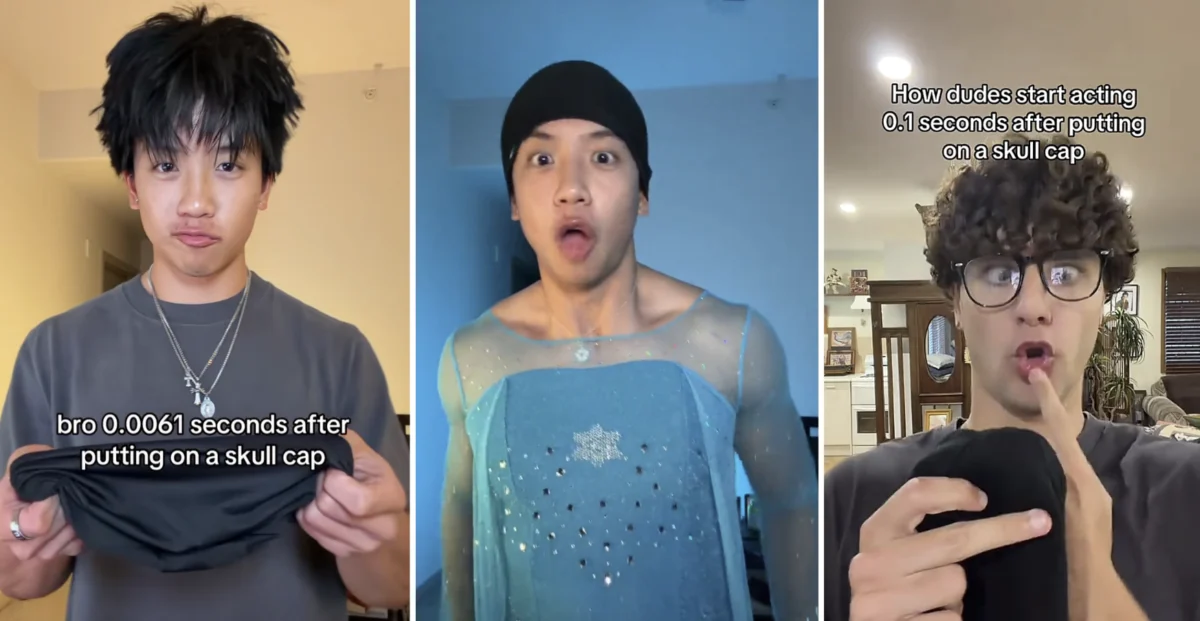
In the final quarter of 2026, a distinctive digital subculture emerged on the social media platform TikTok, centering on a garment traditionally reserved for high-performance athletics: the skull cap. Known formally as the Skull Cap Trend, this viral movement transitioned from a niche fashion choice to a widespread comedic and aesthetic trope. Characterized by dramatic "before-and-after" transformations, the trend utilizes a specific audiovisual template to depict a shift from an exaggeratedly awkward or "nerdy" appearance to a persona defined by heightened confidence and conventional attractiveness. By late October 2026, the trend had garnered hundreds of millions of aggregate views, signaling a shift in how Gen Z and Gen Alpha users leverage athletic wear to signal social status and digital "glow-ups."
The Skull Cap Trend relies on a highly structured format that rewards both comedic timing and physical performance. Participants typically begin their videos appearing intentionally disheveled, often wearing oversized glasses, messy hair, or plain clothing to emphasize a lack of traditional "coolness." This "before" segment is set to the introductory bars of Bryson Tiller’s verse from the 2017 DJ Khaled hit "Wild Thoughts," featuring Rihanna. As the song approaches a specific beat drop—precisely when Tiller’s lyrics transition into a more aggressive cadence—the creator undergoes a sudden "transition."
The "after" segment features the creator wearing a tight-fitting, usually black, skull cap. The cap, made of thin, breathable spandex or polyester, serves to frame the face, tucking away hair and emphasizing the wearer’s facial structure. To complete the transformation, creators often adopt an intense, brooding expression, frequently referred to in internet parlance as a "Chad-like" appearance. This includes squinting the eyes (often called "hunter eyes" in "looksmaxxing" circles) and clenching the jaw to create a more angular silhouette.
Chronology of a Viral Movement
The genesis of the Skull Cap Trend can be traced to mid-October 2026. Unlike many viral challenges that originate from a single celebrity or influencer, the skull cap meme appears to have developed organically through the platform’s algorithmic recommendation system. It built upon the foundations of previous "glow-up" trends, such as the "Lockjaw Trend" and various "mask-off" challenges that have cycled through TikTok since 2020.
On October 16, 2026, TikTok user @big_bobby6929 posted one of the earliest high-engagement examples of the trend. His video, which juxtaposed a self-deprecating "nerdy" persona with a skull-cap-clad "alpha" persona, served as a blueprint for the thousands of iterations that followed. Within eleven days, the post had amassed over 7.4 million views and nearly 300,000 likes, providing the necessary momentum for the trend to enter the mainstream.
By October 18, the trend reached a critical mass. User @antoniopieterss shared a version that significantly raised the bar for engagement, securing over 12.8 million views and 2.3 million likes in just over a week. This specific video highlighted the "satirical" nature of the trend, where the transformation is so dramatic that it borders on parody, yet remains rooted in the platform’s obsession with physical aesthetics.
The peak of the trend occurred between October 21 and October 23, 2026. During this window, major creators and diverse demographics began participating. On October 21, @grumpyleanneandmaitland utilized the format, demonstrating the trend’s reach beyond a singular "fitness" or "male" demographic, gaining 11.8 million views. Simultaneously, @_mc_chicken_lover posted a version that reached 11.3 million views, further cementing the black skull cap as the "must-have" prop for digital relevance in late 2026.
The Anatomy of the Accessory: From Utility to Aesthetic
The central element of the trend—the skull cap—is a piece of functional athletic equipment. Historically, these caps are designed to be worn under helmets in sports like American football, cycling, or hockey to wick away sweat and provide a layer of comfort. However, the 2026 trend repurposed the item as a symbol of "urban" or "street" masculinity.
The choice of a black skull cap is not incidental. In fashion psychology, the color black is often associated with authority, mystery, and sleekness. When tightly fitted to the head, the skull cap eliminates the "distraction" of hair, focusing the viewer’s attention entirely on the eyes and jawline. This aligns with the "looksmaxxing" subculture—an internet movement dedicated to maximizing one’s physical appearance through grooming, exercise, and "facial posture." By wearing the cap, creators are able to simulate a "cleaner" and more "disciplined" look that fits the current digital beauty standards for men.
Musical Significance and the "Wild Thoughts" Revival
The resurgence of DJ Khaled’s "Wild Thoughts" as the trend’s primary audio is a testament to TikTok’s ability to revitalize older tracks. The specific verse by Bryson Tiller provides the perfect rhythmic structure for a "reveal" video. The lyrics:
"And you know I’ma slaughter like I’m Jason / Bust it, why you got it on safety? / White girl wasted on brown liquor…"
The aggressive, confident delivery of Tiller’s lines complements the visual transition from "awkward" to "imposing." The "Jason" reference (alluding to the slasher icon Jason Voorhees) adds a layer of dark, masculine bravado that creators mirror in their facial expressions during the "after" segment. The use of this audio became so synonymous with the skull cap that by late October, simply hearing the first few notes of the song prompted users to expect a cap-based transformation.
Data and Engagement Metrics
The scale of the Skull Cap Trend is reflected in its digital footprint. Data from the latter half of October 2026 indicates that videos tagged with #skullcap and #trend saw an average engagement rate (likes-to-views ratio) of approximately 15-20%, which is significantly higher than the platform average of 4-7%.
| Creator | Date Posted | Views (Millions) | Likes (Millions) |
|---|---|---|---|
| @antoniopieterss | Oct 18, 2026 | 12.8 | 2.3 |
| @grumpyleanneandmaitland | Oct 21, 2026 | 11.8 | 1.7 |
| @_mc_chicken_lover | Oct 21, 2026 | 11.3 | 2.8 |
| @brodyjboling | Oct 23, 2026 | 9.3 | 1.5 |
| @big_bobby6929 | Oct 16, 2026 | 7.4 | 0.3 |
This data suggests that the trend was not merely being watched but was actively "liked" and shared, indicating high resonance with the audience’s sense of humor and aesthetic preferences.
Sociological and Psychological Analysis
Sociologists specializing in digital culture suggest that the Skull Cap Trend is a manifestation of "performative masculinity." By intentionally starting with a "nerdy" or "weak" appearance, creators are engaging in a form of self-deprecation that makes the subsequent "glow-up" feel more earned or impressive.
Dr. Helena Vossen, a researcher in adolescent media behavior, notes that these trends allow young people to experiment with different personas in a low-stakes environment. "The skull cap acts as a costume," Vossen explains. "It allows the user to step into a ‘hyper-masculine’ or ‘hyper-confident’ role that they might not feel comfortable inhabiting in their daily lives. The comedic ‘before’ segment provides a safety net—if the ‘confident’ look is mocked, the creator can claim it was all just a joke."
Furthermore, the trend highlights the "gamification" of beauty. By using a specific item (the cap) to achieve a specific result (the "Chad" look), TikTok users are treating physical attractiveness as a "level-up" that can be achieved through the right accessories and camera angles.
Economic and Retail Impact
The viral nature of the trend had immediate implications for the retail sector. Major athletic brands reported a surge in sales for basic skull caps and "durag-adjacent" headwear throughout October 2026. Online marketplaces such as Amazon and eBay saw a 45% increase in searches for "black athletic skull cap" during the third week of the month.
Small-scale retailers and dropshipping businesses also capitalized on the movement, rebranding basic polyester caps as "Trend-Ready Skull Caps" or "TikTok Glow-Up Caps." This illustrates the "TikTok-to-Checkout" pipeline, where a digital meme can directly influence global supply chain demand within a matter of days.
Broader Cultural Implications and Future Outlook
As with most TikTok trends, the Skull Cap Trend is expected to be ephemeral. By the end of October 2026, some creators were already posting videos with captions like "okay trends over," signaling that the format had reached its saturation point. However, the underlying themes of the trend—transformation, the use of athletic wear as a status symbol, and the obsession with facial structure—are likely to persist.
The trend also sparked a conversation regarding the fine line between satire and genuine vanity. While many users participated purely for comedic effect, others used the format to unironically showcase their fitness journeys or physical attributes. This duality is a hallmark of 2020s internet culture, where the ironic and the sincere are often indistinguishable.
In conclusion, the Skull Cap Trend of 2026 represents more than just a fleeting video challenge. It is a case study in how a utilitarian object can be recontextualized through music and social performance to create a powerful, albeit brief, cultural moment. As the digital landscape continues to evolve, the skull cap will likely be remembered as the defining accessory of the 2026 "glow-up" era, a symbol of the platform’s enduring power to dictate fashion, music, and social norms.

