
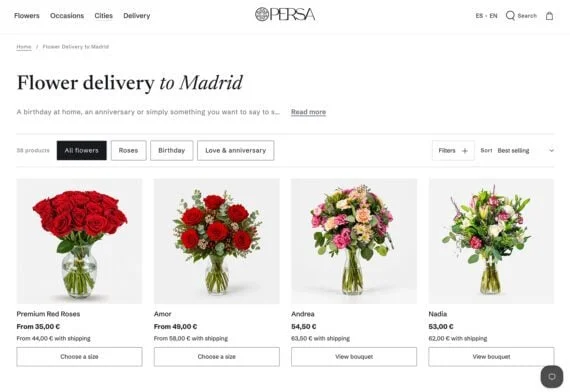
A family-owned florist in Spain has seen its online revenue significantly increase after meticulously tracking orders originating from ChatGPT, demonstrating a tangible return on investment from the burgeoning AI chatbot. Persa Flores, a well-established floral business, has revealed that approximately one in five of its online orders since September 2026 can be directly attributed to customers who discovered the company through the popular AI platform. This discovery has provided valuable, real-world data that complements ongoing industry discussions about the impact of artificial intelligence on e-commerce traffic and sales.
The insight comes from José Pérez Sánchez, who manages the online operations at Persa Flores. His analysis, detailed in a recent company publication, builds upon earlier articles that explored the complexities of measuring AI’s influence on online shopping. Pérez Sánchez’s investigation into his own business’s data highlights a critical challenge: identifying AI-referred shoppers requires a nuanced approach beyond simply examining standard referral traffic logs.
"Since September 2026, one in five of our online orders has come from someone who found us in ChatGPT," explained Pérez Sánchez via email, referencing articles such as "AI Shopping Metrics Considered" and "Mixed Reports on AI Ecommerce Traffic." His meticulous order-level attribution provides a concrete example of how AI is directly contributing to revenue streams, a crucial piece of information for businesses grappling with the evolving digital landscape.
The Elusive Referrer: Unmasking AI Traffic
A significant hurdle in quantifying AI’s impact on e-commerce sales lies in the technical intricacies of web analytics. Standard tracking methods often fail to capture the full journey of a customer, particularly when AI platforms are involved. Pérez Sánchez identified that while ChatGPT automatically tags outgoing links with utm_source=chatgpt.com, the traditional "referrer" data—the last URL a user visited before landing on a website—only captures this tag in about one in eight instances. This means that businesses solely relying on referrer data could be missing the vast majority of their AI-generated traffic.
Shopify, the e-commerce platform used by Persa Flores, records crucial data points for each customer transaction. This includes the customer’s first and last visit before making a purchase, the referring site, the landing page URL, and the date. Persa Flores’s strategy was to define an order as ChatGPT-driven if either the first or last recorded visit originated from ChatGPT or OpenAI. This method allowed them to overcome the limitations of referrer tracking.
The term "referrer" itself can be a point of confusion. In web analytics, it traditionally refers to the HTTP header information passed by a web browser, indicating the URL of the previous page. However, various factors can lead to this information being lost or obscured. These include browser privacy settings, website security policies, or even a protocol downgrade from HTTPS to HTTP. When this data is missing, analytics tools often categorize the traffic as "direct" or "unknown," effectively hiding the true source of the visit, as was the case with ChatGPT traffic for Persa Flores.

A Rapidly Flourishing Channel: Quantifying Growth
The impact of ChatGPT on Persa Flores’s online sales was not immediate but rather a rapidly accelerating trend. In July 2026, ChatGPT accounted for a modest 4% of the florist’s online orders and 2% of its online revenue. By August, these figures had jumped to 12% of orders and 11% of revenue. The most significant surge occurred in September, with ChatGPT driving 21% of online orders and 18% of revenue. By the end of October 2026 (up to the 27th), this share had climbed further to 23% of orders and an impressive 26% of revenue.
| Month | % of Orders | % of Revenue |
|---|---|---|
| July 2026 | 4% | 2% |
| August 2026 | 12% | 11% |
| September 2026 | 21% | 18% |
| October 2026 (to the 27th) | 23% | 26% |
| September-October 2026 | 22% | 22% |
| July-October 2026 | 16% | 15% |
While Pérez Sánchez did not disclose the raw order volumes, he confirmed that this growth in ChatGPT-attributed sales occurred simultaneously with an overall expansion of the company’s e-commerce business. This indicates that ChatGPT is not merely cannibalizing existing traffic but is actively contributing to new customer acquisition and increased sales volume.
Interestingly, this substantial growth largely preceded any deliberate optimization efforts by Persa Flores to improve its visibility within ChatGPT. The company only began implementing AI-specific optimization tactics in mid-October, after the significant increase in ChatGPT-driven orders had already been observed. This suggests that the inherent capabilities of the AI platform, coupled with effective website content, were sufficient to drive substantial traffic and sales.
Following the Order: Unveiling Customer Behavior
Beyond simply identifying the source of the traffic, Persa Flores delved deeper into the behavior of these AI-referred customers. A striking finding was that every single customer whose order was attributed to ChatGPT was a first-time buyer. Shopify’s data revealed no previous order history associated with their email addresses or customer accounts. This suggests that ChatGPT is proving to be a highly effective channel for acquiring entirely new customers for the business.
The majority of these new customers placed their orders within 24 hours of their initial recorded visit via ChatGPT. Furthermore, approximately half of these orders originated from payment sources outside of Spain, indicating that international customers are using ChatGPT to send flowers to recipients within the country. This expands the potential market reach for Persa Flores.
While the average order value for ChatGPT-referred customers was comparable to that of other online orders, Pérez Sánchez noted that the company’s current tracking capabilities do not allow for precise conversion rate comparisons between ChatGPT and other channels like Google. However, the order data provided a qualitative insight that traffic reports alone could not: ChatGPT is not only driving new customers but also opening up new pathways to purchase for them.
City Pages: A Familiar Tactic for a New Channel
A key element in Persa Flores’s success with ChatGPT lies in its well-established SEO strategy, particularly its use of city-specific landing pages. The data revealed that a significant 84% of ChatGPT customers initially landed on one of these city pages, a stark contrast to the approximately one-third of customers from Google who do the same.
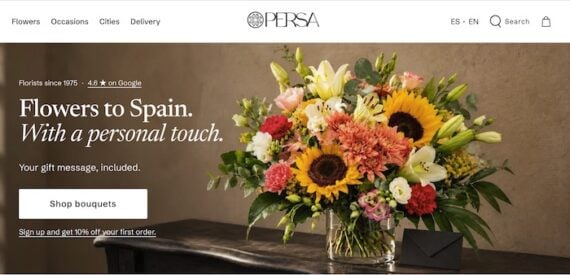
Persa Flores has long maintained a series of dedicated pages for various cities across Spain, such as Marbella, Madrid, Alicante, A Coruña, Gijón, and Segovia. These pages are designed to provide localized information for customers looking to send flowers to a specific destination. They detail what Persa Flores offers, showcase available bouquets, and clearly present delivery prices.
"When someone asks ChatGPT how to send flowers to a particular town, a page dedicated to exactly that is an easy answer to give," explained Pérez Sánchez. This aligns perfectly with how AI chatbots function: they aim to provide direct, relevant answers to user queries. The existence of these pre-existing, highly targeted landing pages allowed ChatGPT to seamlessly connect user intent with the most appropriate content on the Persa Flores website.
This strategy is not novel. Search engine optimization experts have long advocated for the creation of location- or intent-specific landing pages to better match user search queries than generic category or homepage links. What is groundbreaking here is the intermediary role of ChatGPT. The AI appears to be exceptionally adept at matching a user’s specific request with the most relevant page on a website, effectively acting as a sophisticated referral engine.
The fact that these city pages were in place before the surge in ChatGPT traffic suggests that traditional SEO best practices, when executed effectively, can have a significant positive impact on AI-driven shopping behavior. Businesses that have invested in creating robust, user-centric content, particularly for specific geographic locations or product categories, may find themselves well-positioned to benefit from the rise of AI-powered discovery.
The Future of AI Attribution in E-commerce
The experience of Persa Flores underscores a critical point for the e-commerce industry: accurately attributing sales to AI-driven channels requires moving beyond conventional analytics. The ability to track customer journeys at the order level, as Persa Flores has done, is essential for understanding the true value of platforms like ChatGPT.
As AI chatbots become increasingly integrated into consumer decision-making processes, businesses will need to adapt their tracking and attribution models. This might involve a combination of enhanced UTM tagging, analyzing user behavior beyond simple referral data, and potentially developing new metrics to capture the unique pathways that AI introduces.
The implications of Persa Flores’s findings are far-reaching. They suggest that AI is not merely a tool for content generation or customer service but a potent new channel for direct sales and customer acquisition. For businesses, this presents an opportunity to leverage AI not just as a technological enhancement but as a strategic component of their marketing and sales efforts. By understanding and effectively measuring the impact of AI, companies can unlock new avenues for growth and ensure they remain competitive in an increasingly intelligent marketplace. The blooming success of this Spanish florist serves as a compelling case study for how proactive data analysis can transform the potential of emerging technologies into tangible business results.

