
From the nascent stages of the internet, website developers recognized the fundamental need to organize and present site content logically. Early on, this manifested as comprehensive lists of links, often found in website footers or on dedicated pages, which served as navigational guides to a site’s core sections. These foundational tools, encompassing categories, company information, policy pages, and more, were collectively termed "sitemaps." This practice laid the groundwork for how users and, crucially, search engines would interact with the burgeoning web.
The evolution of the internet and its underlying technologies necessitated a more sophisticated approach to site indexing. In 2005, Google introduced a pivotal innovation: the XML sitemap. Built upon the Extensible Markup Language (XML), a robust text-based data-formatting standard developed in the 1990s, this new format offered site owners a structured way to submit a comprehensive list of their website’s URLs directly to search engines. The primary objective was to enhance the ability of search engine crawlers to discover, understand, and index all accessible pages on a website, thereby improving their visibility in search results. This marked a significant shift from the more visually oriented, user-centric HTML sitemaps that had been prevalent.
Over time, the industry began to distinguish between these two distinct but complementary tools, referring to them as "HTML sitemaps" and "XML sitemaps." While both serve the overarching goal of improving website discoverability and indexation, they operate through different mechanisms and cater to different primary audiences: search engine bots and human users, respectively. Despite their continued relevance, a common point of confusion among website owners, particularly in the e-commerce sector, persists regarding their distinct roles and optimal utilization. This guide aims to clarify these differences and provide actionable insights for online retailers seeking to maximize their search engine optimization (SEO) efforts.
The Fundamental Dichotomy: Discoverability vs. Navigation
The core difference between XML and HTML sitemaps lies in their primary function and the pathway they offer for website exploration. XML sitemaps are engineered to be machine-readable, acting as direct conduits for search engine crawlers. They provide search engines with a precise list of URLs, allowing bots to discover new or updated pages without the need to navigate through the website’s user interface. This direct access is crucial for efficient crawling. The subsequent decision by search engines to crawl and index these discovered pages is influenced by a complex interplay of factors, including a site’s "crawl budget" (the number of pages a search engine is willing to crawl within a given timeframe), its overall authority and trustworthiness, the relevance and originality of its content, the depth and breadth of its internal linking structure, and the presence of external backlinks. Essentially, an XML sitemap is a directive to search engines, indicating "these are the pages I want you to know about."
In contrast, HTML sitemaps are designed with human users in mind, though they can also indirectly benefit search engine crawling. Unlike XML sitemaps, HTML sitemaps do not offer a direct backdoor for crawlers to bypass the website’s navigation. Instead, search engine bots must land on the website itself and follow the links within the HTML sitemap, typically accessed via internal links from other parts of the site. This makes them a more traditional, user-friendly method of site navigation.
The impact of HTML sitemaps on SEO is a subject of ongoing discussion among search engine optimization professionals. However, many practitioners, including industry experts, believe that HTML sitemaps can play a beneficial role in the indexing process. By revealing the internal links to every page on a site, they can help search engines gain a more comprehensive understanding of the website’s structure. When strategically placed, such as in the website’s footer, HTML sitemaps can effectively distribute "internal link equity" to the listed pages. This can be particularly useful in mitigating the "Crawled, currently not indexed" status often observed in Google Search Console, a metric indicating that Google has found a page but has not yet indexed it for search results. This suggests that HTML sitemaps can act as a supportive signal for indexation by ensuring that important pages are more readily discoverable through internal linking.
Synergistic Utilization: The Power of Both
The prevailing consensus among SEO experts is that employing both HTML and XML sitemaps offers the most comprehensive approach to enhancing search engine discoverability, crawling, and indexing, especially for websites with a substantial number of pages. While they serve distinct primary purposes, their combined effect can be synergistic. An XML sitemap acts as a precise instruction manual for search engine bots, ensuring they are aware of every URL that warrants attention. Simultaneously, an HTML sitemap provides a user-friendly map for human visitors and can reinforce the discoverability of pages for crawlers that land on the site.
However, it is critical to understand that neither type of sitemap is a panacea for poor website architecture. The foundation of strong organic search visibility rests upon a website that is inherently fast, well-structured, and possesses a robust internal linking strategy. A natural website hierarchy that prioritizes important pages is paramount. Sitemaps are supplementary tools that enhance the effectiveness of a well-designed website, rather than replacements for fundamental SEO principles.
In situations where a website undergoes a significant restructuring, and the final internal linking strategy is still being implemented, temporary HTML sitemaps can be a valuable interim measure. They can help maintain discoverability during this transitional phase, ensuring that search engines continue to find and index content. Nevertheless, they should not be considered a permanent substitute for a meticulously planned and executed internal linking architecture.
The nuanced perspective on HTML sitemaps has even seen a shift from some prominent figures within search engine development. In a recent episode of the "Search Off the Record" podcast, John Mueller, a long-standing figure at Google and a frequent commentator on search matters, acknowledged the potential benefits of HTML sitemaps. He noted that they "would help crawling because from this place we can find all the links." This statement suggests a growing recognition of the value HTML sitemaps can offer in facilitating the crawling process by providing a centralized point for discovering a multitude of links.
Construction and Implementation: Dynamic vs. Static
The construction and update mechanisms of XML and HTML sitemaps also differ significantly, reflecting their distinct roles. XML sitemaps are inherently dynamic. They are designed to be continually updated, reflecting the latest additions of new pages, product listings, and content modifications. An effective XML sitemap should enumerate every URL that a site owner wishes to have indexed by search engines. This dynamism ensures that search engines are promptly informed of any changes or additions to the website’s content.

Conversely, HTML sitemaps are typically static in their construction and content. They tend to feature the most important or flagship pages of a website, serving as a curated overview rather than an exhaustive list of every single URL. This approach aligns with their primary function as a navigational aid for users, guiding them towards key sections and significant content.
Mueller further elaborated on these distinctions during the aforementioned podcast episode, offering a practical example relevant to e-commerce: "If you have an ecommerce site, you wouldn’t list all of your products in an HTML sitemap file. You would list the categories so people can go to the right place, then pick out the product individually." This highlights how HTML sitemaps are best utilized for broad navigation and guiding users to overarching sections, while XML sitemaps are suited for the granular listing of all indexable product pages.
The implementation of XML sitemaps is often integrated into the functionality of modern Content Management Systems (CMS) and e-commerce platforms. Many of these systems automatically generate and update XML sitemaps. Website owners should consult the documentation specific to their CMS or platform to locate the URL(s) of their XML sitemap. Once identified, it is crucial to submit these URLs to essential webmaster tools, such as Google Search Console and Bing Webmaster Tools. This submission process formally informs search engines about the existence and location of the XML sitemap, facilitating their crawling efforts.
To ensure the accuracy and effectiveness of XML sitemaps, specialized web crawler tools can be employed. Services like Screaming Frog’s SEO Spider can analyze XML sitemaps to identify potential issues such as broken links (404 errors), URLs that are marked as "noindex" but are present in the sitemap, or other technical glitches that might hinder proper indexation. Regularly auditing XML sitemaps using such tools is a proactive measure to maintain optimal SEO performance.
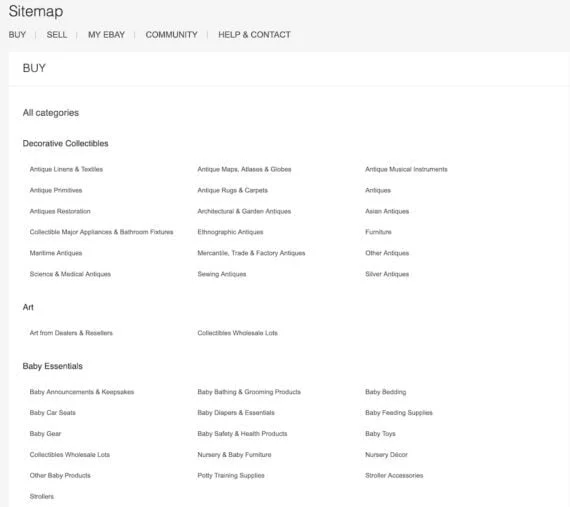
HTML sitemaps, on the other hand, are built with a dual audience in mind: both web crawlers and human users. Their construction is driven by a site owner’s strategic prioritization of pages. A prime example of an effective HTML sitemap can be observed on eBay’s website (pages.ebay.com/sitemap.html). This sitemap strategically links to main categories and their respective subcategories. The intended audience is clearly human users who are browsing for specific product categories, seeking help pages, or engaging with community discussions. The visual layout and hierarchical organization of eBay’s HTML sitemap effectively guides users through its vast product inventory, demonstrating how this type of sitemap can enhance user experience and indirectly support SEO by making content more accessible.
Broader Implications for E-commerce
The strategic implementation of both HTML and XML sitemaps holds significant implications for e-commerce businesses striving for online visibility. For large online retailers with extensive product catalogs and numerous category pages, the ability to efficiently guide both search engines and customers is paramount.
XML Sitemaps for E-commerce:
- Comprehensive Indexation: For e-commerce sites, an XML sitemap is indispensable for ensuring that every product page, category page, informational page (e.g., about us, contact us), and blog post is discoverable by search engines. This is particularly critical for new product launches or during promotional periods when rapid indexation is desired.
- Handling Dynamic Content: E-commerce sites often feature dynamic pricing, stock availability, and product variations. XML sitemaps can be configured to include specific attributes, such as the last modified date, which signals to search engines when content has been updated, encouraging them to recrawl and re-index more frequently.
- Improved Crawl Efficiency: By providing a direct list of URLs, XML sitemaps help search engine bots prioritize their crawling efforts on the most important pages of an e-commerce site, potentially improving the efficiency of their crawl budget allocation.
HTML Sitemaps for E-commerce:
- Enhanced User Navigation: An HTML sitemap serves as a valuable navigational tool for customers, especially those who may not be using specific search queries. It allows them to browse through the site’s structure, discover new product categories, and find relevant information, thereby improving user experience and potentially increasing conversion rates.
- Assisting New Users: For users new to an e-commerce platform, an HTML sitemap can provide a clear overview of the types of products and services offered, acting as a digital storefront directory.
- Supporting Internal Linking: As mentioned, HTML sitemaps can help distribute link equity throughout the site, reinforcing the importance of various pages and helping to ensure that even less prominently linked pages have a pathway for discovery.
The Interplay and Long-Term Strategy:
The adoption of a dual sitemap strategy allows e-commerce businesses to leverage the strengths of both approaches. The XML sitemap acts as the technical backbone for search engine indexing, ensuring that the vast amount of product data is accessible. The HTML sitemap complements this by providing a user-centric layer of navigation, enhancing the customer journey and indirectly supporting SEO efforts.
A robust website hierarchy, characterized by logical categorization and effective internal linking, remains the bedrock of any successful e-commerce SEO strategy. Sitemaps are powerful supporting tools that amplify the effectiveness of this underlying structure. For instance, an e-commerce site that has meticulously organized its product categories and subcategories within its HTML sitemap will not only provide a better user experience but also offer clear signals to search engines about the thematic relevance of its pages.
The ongoing evolution of search engine algorithms means that staying informed about best practices is crucial. While the fundamental principles of discoverability and user experience remain constant, the methods by which search engines interpret and utilize website structures continue to advance. Therefore, a proactive approach to sitemap management, coupled with a deep understanding of website architecture and user behavior, is essential for e-commerce businesses aiming to achieve sustained organic search success in the competitive online marketplace. By recognizing and implementing the distinct yet complementary roles of HTML and XML sitemaps, online retailers can build a more discoverable, user-friendly, and ultimately more profitable digital presence.

