
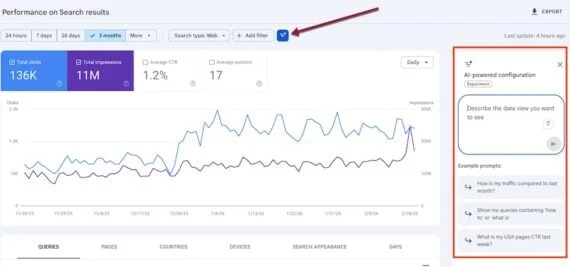
Google Search Console has officially rolled out its much-anticipated AI-powered analysis feature, a significant enhancement to its existing tools for website owners and SEO professionals. Previously accessible only to a select group of beta testers, this new functionality, integrated within the "Performance > Search results" tab, allows users to leverage generative AI-like prompts to gain deeper insights into their site’s organic search performance. This move signifies Google’s commitment to integrating artificial intelligence into its core webmaster tools, aiming to democratize sophisticated data analysis for a broader audience.
The feature, which became publicly available last week, represents a paradigm shift from traditional, pre-defined filters. Instead of navigating through a static list of options, users can now interact with the platform using natural language queries, similar to how one would engage with a conversational AI. This approach promises to make complex data exploration more intuitive and accessible, potentially empowering businesses of all sizes to better understand their online visibility and search engine strategies.
Evolution of Search Console: A Timeline of AI Integration
The introduction of AI-powered analysis in Search Console is the culmination of Google’s ongoing efforts to enhance its suite of tools for webmasters. While specific dates for the internal beta phase are not publicly disclosed, the public release marks a significant milestone. This development follows Google’s broader integration of AI across its product ecosystem, from Search Generative Experience (SGE) to advancements in Google Analytics. The move suggests a strategic direction towards making AI a foundational element in how users interact with and understand their digital presence.
Early iterations of Search Console provided basic metrics like clicks, impressions, and average position. Over time, Google introduced more granular filtering capabilities, allowing users to segment data by device, country, date, and specific queries. However, these filters often required a degree of technical proficiency and familiarity with SEO terminology. The new AI feature aims to bridge this gap by translating user intent into actionable data queries, effectively lowering the barrier to entry for sophisticated analysis.
Unlocking Deeper Insights: Query Analysis and Intent Identification
The core of the new AI feature lies in its ability to interpret user prompts and translate them into precise data filters. This is achieved through the generation of regular expressions (regex), a powerful tool for pattern matching in text. While the underlying mechanism is technical, the user experience is designed to be straightforward.

For instance, instead of manually searching for queries indicating informational intent, a user can simply prompt, "Show queries with informational intent." The AI then generates a regex that captures common patterns associated with such searches. An example provided by early users demonstrates this:
- Prompt: "Show queries with informational intent."
- AI-generated Regex:
(what|how|why|guide|tutorial|explain|definition|example|best way to|steps to|tips for|reasons why|benefits of|difference between)
Once generated, users can "Apply" this regex to filter their performance data, revealing queries that align with informational search behavior. This allows for a more nuanced understanding of what users are seeking when they encounter a website. This is crucial for content strategists aiming to align their offerings with user needs.
Similarly, for product research, a prompt like "Show product research queries" yields a regex designed to capture terms used by consumers in the decision-making process:
- Prompt: "Show product research queries."
- AI-generated Regex:
(best|review|compare|vs|price|buy|alternatives|guide|recommendations|features|specs|cost|discount|deal|sale|where to buy|how to choose|top rated|pros and cons)
By analyzing these queries, businesses can identify opportunities to optimize product pages, create comparison content, and address common customer concerns, ultimately driving conversions. The ability to dynamically generate these filters based on natural language is a significant leap forward, enabling faster and more intuitive data exploration.
Brand Visibility and Traffic Fluctuations: Advanced Applications
The AI analysis extends beyond query categorization to encompass brand-related searches and the identification of traffic anomalies. Understanding brand search volume is critical for assessing brand awareness and customer loyalty. The AI can now assist in isolating these branded queries.
- Prompt: "Show branded queries."
- AI-generated Regex (example):
(brandname|brand name)
While the specific regex will adapt to the actual brand name entered, the principle remains: it helps users quickly segment traffic originating from direct searches for their brand. This is invaluable for measuring the effectiveness of marketing campaigns and overall brand building efforts.
Furthermore, the feature can help pinpoint sudden shifts in organic traffic, a critical concern for any online business. By enabling users to query traffic changes, Search Console can assist in diagnosing potential issues or identifying successful trends.
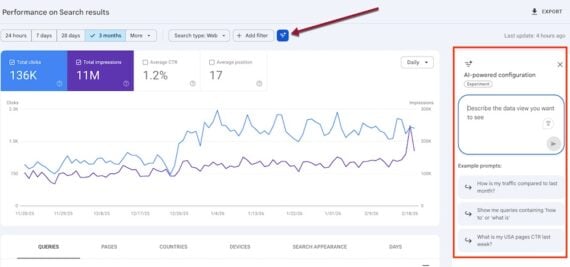
- Prompt (example for traffic drop): "Show queries that had a significant drop in clicks last week."
- AI-generated Regex (hypothetical): The AI would analyze historical data to identify patterns indicative of a decline and generate a regex to isolate those specific queries or date ranges.
This capability allows for proactive issue resolution. If a website experiences a sudden drop in traffic for key terms, the AI can help pinpoint the exact queries affected, enabling SEO teams to investigate potential causes such as algorithm updates, competitor activity, or on-page SEO issues.
Global Reach: Country-Specific Performance Analysis
For businesses operating on an international scale, understanding performance across different geographic regions is paramount. The AI analysis now facilitates country-specific evaluations of organic search visibility.
- Prompt (example for country-specific analysis): "Show queries driving traffic from the UK."
- AI-generated Regex (hypothetical): The AI would likely leverage internal country codes or common country-related search patterns to filter data for the United Kingdom.
This granular view allows for tailored SEO strategies for each target market. For example, a company might discover that certain product keywords perform exceptionally well in one country but poorly in another, necessitating localized content and optimization efforts.
The ability to combine these country-specific analyses with traffic change reports further enhances diagnostic capabilities.
- Prompt (example for traffic changes in a specific country): "Analyze traffic changes for queries in Canada over the past month."
- AI-generated Regex (hypothetical): This would combine geographic filtering with temporal analysis to identify trends specific to the Canadian market.
Limitations and Future Potential
Despite its advancements, the new AI analysis feature in Google Search Console is not without its limitations. The article highlights that "inexperienced users do not typically know what to ask, while seasoned pros can go directly to the prebuilt filters." This suggests that while the AI simplifies the process, a foundational understanding of search engine optimization principles and data interpretation remains beneficial.
A more significant constraint is the AI’s current operational scope. It primarily works with filters that are already available within the "Performance reports." This means it cannot process requests for data points that are not directly exposed through these existing filters. For example, the article notes that the AI cannot respond to prompts for queries with an average position greater than 2, indicating room for improvement. This limitation means that users cannot yet leverage the AI to explore more complex analytical scenarios that extend beyond the current report structure.
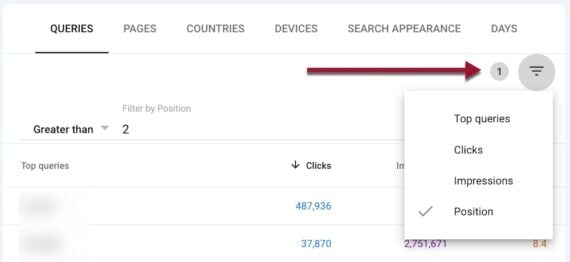
The image accompanying this limitation shows a default Performance report allowing filtering only on position 1. This visual reinforces the point that the AI’s power is currently tethered to the existing reporting framework. Future iterations may see the AI’s capabilities expand to integrate with a wider array of metrics and potentially even correlate data with other Google products like Google Analytics 4, offering a more holistic view of user behavior and site performance.
Broader Implications for SEO and Digital Marketing
The integration of generative AI into Google Search Console signals a broader trend towards AI-driven analytics in the digital marketing landscape. This move by Google could:
- Democratize Advanced SEO: By simplifying data exploration, the feature may empower smaller businesses and less technical users to gain valuable insights that were previously the domain of specialized SEO professionals.
- Increase Efficiency: For experienced SEOs, the AI can act as a powerful assistant, automating the creation of complex regex patterns and freeing up time for strategic analysis and implementation.
- Shift Focus to Strategic Questioning: The emphasis on natural language prompts encourages users to think critically about the questions they want to answer about their search performance, fostering a more strategic approach to SEO.
- Drive Content Strategy Innovation: By making it easier to understand user intent behind search queries, businesses can develop more targeted and effective content strategies that directly address audience needs.
- Influence Tool Development: This feature may inspire other SEO tool providers to incorporate similar AI-driven conversational interfaces, leading to a more intuitive and user-friendly ecosystem of digital marketing tools.
However, the current limitations underscore the importance of human expertise. While AI can provide insights, interpreting those insights within the broader context of business goals, market trends, and user psychology still requires human intelligence and experience. The AI is a tool to augment, not replace, the strategic thinking of SEO professionals.
Conclusion
Google Search Console’s new AI-powered analysis feature represents a significant step forward in making complex organic search data more accessible and actionable. By enabling users to interact with performance metrics using natural language prompts, Google is lowering the barrier to entry for sophisticated analysis and empowering a wider range of website owners to optimize their online presence. While the feature has current limitations, its potential to revolutionize how businesses understand their search performance is undeniable. As AI continues to evolve, we can anticipate even more powerful and integrated analytical capabilities within Google’s suite of webmaster tools, further shaping the future of digital marketing and SEO. The ongoing development and refinement of such features will be critical in helping businesses navigate the ever-changing landscape of online search.

