
The landscape of online retail is undergoing a profound transformation, marked by a strategic collaboration between e-commerce giant Shopify and web development platform Vercel. At Vercel’s Ship 26 conference, held in San Francisco on October 15th, Shopify CEO Tobi Lütke and Vercel CEO Guillermo Rauch unveiled a vision for the future of "agentic e-commerce," a paradigm shift where artificial intelligence plays a central role in the shopping experience. This ambitious endeavor is underpinned by the release of Shopify’s comprehensively rebuilt Hydrogen software development kit (SDK) and Vercel’s innovative, AI-enabled open-source storefront template, aptly named Vercel Shop. This partnership signifies a crucial step towards creating online shopping environments that are not only intuitive and engaging for human consumers but also readily accessible and functional for AI agents.
The collaboration, publicly announced at the Ship 26 event, represents a significant evolution of the ongoing relationship between the two technology leaders. It builds upon their previous joint announcement on June 30th, which detailed the foundational work on rebuilding Shopify’s Hydrogen platform. The revamped Hydrogen SDK is designed to empower developers with a suite of reusable tools and components, enabling them to construct dynamic and high-performance Shopify storefronts across a spectrum of JavaScript frameworks and runtimes. This flexibility is critical in an era where developers require the agility to tailor user experiences without being constrained by rigid architectural limitations.
A Deeper Dive into Hydrogen and Vercel Shop
At its core, the rebuilt Hydrogen SDK aims to streamline the complex process of e-commerce development. It achieves this by abstracting common functionalities into shared, pre-built tools. Developers can leverage these established modules, allowing them to concentrate their efforts on crafting the unique shopper journey and brand experience, rather than reinventing fundamental e-commerce mechanics. This modular approach not only accelerates development cycles but also promotes consistency and maintainability across diverse storefronts.
Complementing Hydrogen’s developer-centric tools, Vercel Shop offers a tangible manifestation of this vision: a customizable, open-source storefront template. What sets Vercel Shop apart is its inherent design for both human and AI interaction. It incorporates structured product information that is easily interpretable by AI agents, alongside a suite of shopping functionalities. This means that not only can a human browse and purchase products through a familiar visual interface, but an AI can also navigate the product catalog, understand product attributes, and even initiate purchases on behalf of a user, all without needing to parse complex visual layouts or human-readable text.
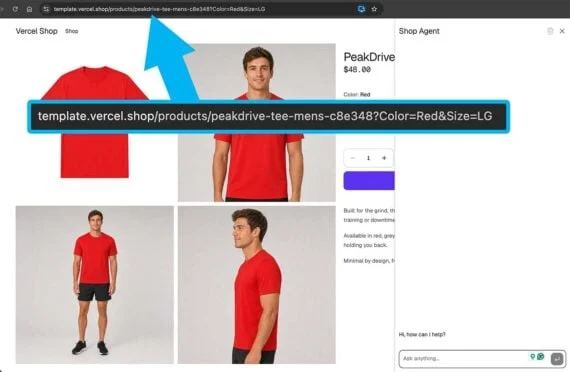
The Vercel Shop template, demonstrated at the conference, showcases a standard e-commerce product page for a men’s tee. Notably, the URL itself provides a glimpse into the structured data, with parameters indicating the selected color and size (e.g., ?Color=Red&Size=LG). This level of machine-readable information is fundamental for AI agents to effectively interact with the store. On the right side of the displayed product page, a "Shop Agent" chat panel is visible, indicating the presence of an AI assistant ready to engage. This dual capability – catering to human browsing and AI-driven interactions – is a cornerstone of the partnership.
The Genesis of Agentic E-commerce
The concept of "agentic e-commerce" represents a significant departure from traditional online shopping. Instead of solely relying on human users to navigate websites and make purchasing decisions, this new paradigm envisions AI agents acting as intermediaries. These agents can be programmed to understand user preferences, search for products based on specific criteria, compare prices, manage shopping carts, and even complete transactions, all under the user’s direction.
This evolution is driven by several factors, including the rapid advancements in artificial intelligence, particularly in natural language processing and large language models (LLMs). As AI becomes more sophisticated, its ability to understand context, process information, and perform complex tasks increases exponentially. For e-commerce, this translates into opportunities for hyper-personalized shopping experiences, automated customer support, and more efficient procurement processes, especially for businesses.
Shopify’s Role in Empowering Developers
Tobi Lütke, CEO of Shopify, articulated the company’s long-standing commitment to empowering merchants and developers. He emphasized Shopify’s philosophy of providing robust foundational infrastructure, allowing creators to build innovative experiences on top of it. "Checkouts are ridiculously hard to get right," Lütke stated at the conference. "It’s one of those pieces of software that actually does need 20 years of tinkering with. And Shopify has always been very open, and so we invite people to remix pieces from our checkout just as much as you want. Basically taking all the infrastructure that Shopify built, and you can build whatever you want with it."
This sentiment underscores Shopify’s strategy: to provide the secure, scalable, and reliable backbone for e-commerce transactions, while encouraging developers to innovate in the areas of customer engagement, product discovery, and user interface design. The rebuilt Hydrogen SDK is a testament to this approach, offering developers pre-built, reusable components for common e-commerce functions, such as product catalog management, inventory tracking, and cart operations. This allows developers to focus their creative energies on building unique shopper journeys, integrating with third-party services, and implementing advanced features that differentiate their brands.
The integration of Hydrogen with various JavaScript frameworks like React, Next.js, and Remix further broadens its appeal. Developers can now choose the framework that best suits their project’s needs and their team’s expertise, while still benefiting from Shopify’s robust e-commerce capabilities. This flexibility is crucial for enterprises and independent developers alike, who seek to build custom storefronts that are both performant and visually appealing.
Vercel Shop: A Bridge Between Humans and AI
Vercel Shop, the open-source template, serves as a practical implementation of the agentic e-commerce vision. It demonstrates how the structured product data and AI-friendly architecture can be leveraged to create a seamless shopping experience. The template offers a customizable storefront that can be adapted to various brand aesthetics and functionalities.
Crucially, Vercel Shop is designed with two distinct AI-driven experiences in mind: external agents and an integrated store assistant.
External AI Agents: Shopping on Behalf of Humans
For external AI agents, Vercel Shop provides an API-first approach to product information and shopping tools. This means that an AI, whether it’s a personal shopping assistant or a corporate procurement bot, can interact with the store’s data and functionalities programmatically.

Imagine an AI agent tasked with finding a specific item, such as a black jacket in a particular size and material. Instead of having to scrape web pages, interpret HTML, or rely on visual recognition, the agent can directly access structured product data. This data includes details about the product’s attributes, availability, pricing, and variants. The agent can then use this information to search, filter, compare, and add items to a cart.
This capability is transformative for business-to-business (B2B) e-commerce, where automated procurement can significantly reduce operational costs and improve efficiency. It also opens up new possibilities for consumer applications that act as personal shopping concierges, helping users find the best deals or manage their shopping lists. The ability for an external agent to interact with a merchant’s domain directly, without the need for complex integrations or data mapping, represents a significant leap forward in interoperability.
The Integrated Store Assistant: Enhancing Human Shopping
The second AI-powered experience within Vercel Shop is an optional, integrated shopping assistant. This AI, accessible through a chat interface directly on the storefront, is designed to enhance the human shopping experience. It functions much like virtual assistants from major retailers, such as Walmart’s Sparky or Amazon’s Alexa for Shopping.
This assistant can help human shoppers in various ways:
- Product Discovery: Users can ask natural language questions to find products, such as "Show me red running shoes for women" or "I’m looking for a comfortable sofa under $1000."
- Navigating Variants: The assistant can guide users through product options, such as different sizes, colors, or configurations.
- Answering Queries: It can provide information about store policies, shipping details, return procedures, and product specifications.
- Cart Management: Users can ask the assistant to add or remove items from their cart, change quantities, or even suggest complementary products.
A key aspect of this integrated assistant is its seamless integration with the Shopify cart. Any modifications made by the human shopper through the visual interface are reflected in the cart, and conversely, any changes requested through the AI assistant are updated in the same cart. This unified cart experience ensures consistency and prevents confusion.
It is important to note that Shopify has implemented safeguards to ensure a secure and controlled shopping experience. The assistant, while capable of managing cart contents, cannot initiate orders or process payments. These critical steps remain within the familiar and secure checkout flow, where users are prompted to confirm their purchase and provide payment information. This approach balances the convenience of AI assistance with the necessity of human oversight for financial transactions.
Enabling the Assistant: Developer Configuration
The AI shopping assistant is not enabled by default. Developers who wish to incorporate this feature into their storefronts must explicitly enable it. This process involves configuring access to Vercel’s AI Gateway, which provides the underlying AI capabilities. Developers also have the flexibility to customize the guidance the assistant offers and how it presents product information, allowing for brand-specific interactions and a tailored user experience.
Vercel’s own merchandise store serves as a live demonstration of the Vercel Shop template and its integrated shopping assistant, offering a practical example for developers and businesses to explore.
Broader Implications and Future Outlook
The collaboration between Shopify and Vercel has significant implications for the future of e-commerce. By providing tools that cater to both human and AI interactions, they are laying the groundwork for a more intelligent and automated retail environment.
Data and Accessibility: The emphasis on structured, agent-readable product data is crucial. As AI agents become more prevalent, the ability to access and process product information programmatically will be a key differentiator for online retailers. This structured data approach not only benefits AI but can also improve SEO and the overall accessibility of online stores.
Personalization at Scale: Agentic e-commerce promises a new level of personalization. AI agents can learn individual user preferences, shopping habits, and even emotional states to curate highly tailored product recommendations and shopping experiences. This could lead to increased customer loyalty and higher conversion rates.
Operational Efficiency: For businesses, especially those with large product catalogs or complex B2B sales processes, AI agents can automate many time-consuming tasks. This includes lead qualification, order processing, and inventory management, freeing up human resources for more strategic activities.
The Evolving Role of the Human Shopper: While AI agents will undoubtedly take on more responsibilities, the human role in e-commerce will likely evolve rather than diminish. Humans will continue to be the ultimate decision-makers, setting preferences for their AI agents and overseeing transactions. The focus will shift towards creating richer, more engaging, and more intuitive experiences where humans and AI collaborate to achieve desired outcomes.
Market Context and Competitive Landscape: The e-commerce platform market is highly competitive, with players constantly innovating to attract developers and merchants. Shopify’s move to embrace agentic e-commerce positions it as a forward-thinking platform, capable of supporting the next generation of online retail. Vercel, by providing the development infrastructure and open-source templates, is enabling this innovation and solidifying its role as a key enabler of modern web applications.
The success of this collaboration will depend on the adoption of Hydrogen by developers and the willingness of merchants to leverage Vercel Shop and its AI capabilities. However, the fundamental shift towards agentic e-commerce is undeniable, and the partnership between Shopify and Vercel is a significant step in shaping this future. As AI continues to advance, the lines between human and machine-driven shopping will blur, leading to a more efficient, personalized, and intelligent retail ecosystem. The implications extend beyond simple purchasing, potentially influencing how products are discovered, how brands engage with consumers, and how businesses operate in the digital economy.

