
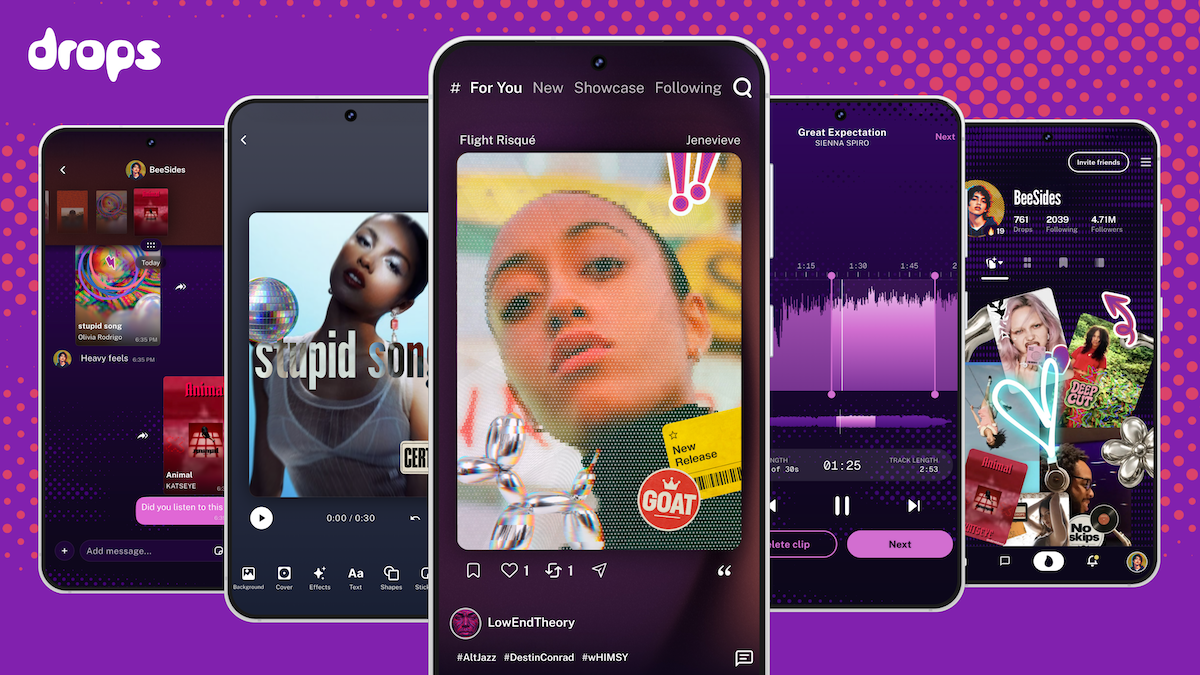
A new paradigm in music discovery has emerged with the launch of Drops, an innovative application developed by Harman, a Samsung subsidiary, that re-imagines the discovery experience by borrowing the highly addictive, endless vertical-scrolling format popularized by TikTok. However, instead of short-form video content, users of Drops navigate through brief audio clips of songs, accompanied by rich visual and lyrical context, in a deliberate effort to foster organic musical encounters and reignite the social aspect of finding new artists. Launched on Monday, the app represents a strategic move by Harman to carve out a distinct niche in the increasingly crowded digital music landscape, focusing on curated moments and human connection over pure algorithmic recommendation.
The Core Mechanism: A Curated Audio Feed
Drops, now available on both iOS and Android platforms within the United States, presents users with 10- to 30-second snippets of songs. Each "Drop" is a carefully selected segment designed to capture a listener’s attention, whether through a compelling lyric, an infectious hook, or a distinctive beat. These audio excerpts are complemented by a rich array of visual information, including synchronized lyrics, official album artwork, licensed artist photographs, and user-generated captions. This multi-sensory approach aims to provide just enough context and intrigue to compel users to explore further, offering a more immersive experience than simple audio previews. The interface is intuitively designed, featuring familiar tabs such as "For You," "New," "Showcase," and "Following," alongside relevant and trending hashtags, enabling users to navigate both personalized content and broader trends.
The app’s design philosophy directly addresses a common frustration in contemporary music discovery: the difficulty of sharing specific, impactful moments within a song. Clare Hunter, General Manager of Drops, articulated this sentiment, stating, "You send a friend a song and say, ‘You have to hear this.’ Then you end up texting, ‘Skip to 1:47, that’s the best part.’ The part that hits usually isn’t the first few seconds, and there wasn’t a good way to share just that moment." Drops is engineered to facilitate precisely this kind of granular sharing, allowing users to highlight and transmit the emotional peaks of a track.
Reclaiming the Social Fabric of Music Discovery
The driving vision behind Drops is a conscious effort to return to a more communal and personal method of music discovery, reminiscent of pre-algorithm eras. Before the omnipresence of sophisticated recommendation engines across virtually every digital platform, individuals primarily discovered new music through trusted social networks—friends, community radio, specialized music blogs, or dedicated online forums. Drops endeavors to recreate this authentic, human-centric discovery process. Hunter underscored this philosophy with a nostalgic anecdote: "I used to spend hours making mixtapes for my friends, picking the songs, the order, and decorating the cover. Drops is the version of that I always wanted." This analogy speaks to a desire for intentional curation and shared passion, contrasting sharply with the often passive consumption driven by current algorithmic feeds.
The app’s social functionalities are robust, reflecting this emphasis. Users can "like," "comment," "repost," and "share" tracks, fostering direct engagement around musical content. A unique feature allows users to save tracks to personalized collections dubbed "Droplists," effectively digital mixtapes for the modern age. Furthermore, the platform supports direct messaging, enabling users to send songs directly to other profiles and engage in private conversations about their latest finds, thereby replicating the intimate exchange of musical recommendations that once defined friendship circles. This deliberate focus on social interaction positions Drops not just as a discovery tool, but as a community-building platform centered around shared musical taste.
Harman’s Strategic Play and the Roon Acquisition
The development of Drops is deeply rooted in Harman’s broader strategic initiatives within the audio technology sector. As a subsidiary of Samsung, Harman occupies a pivotal position in the global audio market, known for its extensive portfolio of audio brands, including JBL, Harman Kardon, Mark Levinson, and Infinity. The ideation for Drops gained significant momentum following Harman’s acquisition of Roon, a highly acclaimed music management software company, in 2023. Roon is renowned for its audiophile-grade playback experience and its sophisticated approach to organizing and enhancing digital music collections across multiple devices and rooms.
The Roon acquisition provided Harman with critical insights into user engagement with vast music libraries and the desire for high-fidelity audio experiences. While Roon focuses on personal music management for enthusiasts, Drops aims for broader appeal, leveraging Harman’s expertise in audio delivery and user experience design to create an accessible, social-first discovery platform. This synergy suggests a comprehensive strategy by Harman and Samsung to address various facets of the music consumption journey, from premium playback to casual discovery, thereby expanding their ecosystem and influence within the digital entertainment space.
The Evolving Landscape of Music Discovery: From Radio Waves to Digital Algorithms
Understanding Drops’ potential impact requires a brief retrospective on the evolution of music discovery. For much of the 20th century, radio served as the primary arbiter of popular music, with DJs and programmers acting as gatekeepers. The advent of television brought MTV, transforming music into a visual medium and introducing artists to global audiences through music videos. The late 1990s and early 2000s saw the rise of peer-to-peer file-sharing services like Napster, which, despite their controversial legal status, democratized access and fundamentally altered how music was shared and discovered, bypassing traditional industry channels.

The digital age ushered in online communities, music blogs (like Pitchfork and Stereogum), and eventually, digital storefronts like iTunes. The mid-2000s marked the explosion of streaming services such as Pandora and Spotify, which revolutionized consumption patterns by offering vast libraries on demand. These platforms heavily leaned on sophisticated algorithms, initially for radio-like stations and later for personalized recommendations, daily mixes, and curated playlists. While incredibly efficient, these algorithms often operate as black boxes, leading to a sense of passive consumption where discovery is driven by opaque data rather than active exploration or human endorsement.
The "TikTok Effect" and the Quest for Algorithmic Antidotes
In recent years, social media platforms, particularly TikTok, have emerged as arguably the most powerful new music discovery engines. Short, viral video clips featuring snippets of songs have propelled unknown artists to global fame and resurrected older tracks, fundamentally reshaping chart performance and artist careers. TikTok’s algorithm is exceptionally adept at identifying engaging content and disseminating it rapidly, creating cultural moments around specific sounds.
However, the "TikTok effect" also presents challenges. While effective for virality, the focus is often on fleeting trends and soundbites, not necessarily on deeper artistic engagement. Moreover, the sheer volume of content can lead to "algorithmic fatigue," where users feel overwhelmed by an endless stream of recommendations that, while personalized, can sometimes feel repetitive or lack genuine serendipity. This creates an opening for platforms like Drops, which aim to harness the engaging, short-form format but re-center the experience on pure music discovery and social interaction. By distilling the essence of TikTok’s scrollable feed into a music-specific application, Drops hopes to offer a more focused and intentional alternative to the often chaotic, multi-faceted content streams of general social media.
Monetization, Artist Compensation, and Industry Partnerships
A critical aspect distinguishing Drops from many nascent platforms is its commitment to ethical engagement with the music industry. Harman explicitly states that Drops pays rights holders and accurately reports plays back to its partners. This is a crucial differentiator in an ecosystem where artist compensation and intellectual property rights are often contentious issues. The app has secured partnerships with major music labels and distributors, including Universal Music Group, Beggars Group, Empire, Symphonic Distribution, and UnitedMasters. This broad support from key industry players signals Drops’ legitimacy and its intention to be a responsible participant in the music economy.
Furthermore, Drops is not designed to replace existing music streaming subscriptions but rather to complement them. When users discover a song they love, the app offers seamless integrations with major streaming services such as Apple Music, Qobuz, and TIDAL. This allows users to jump directly from the snippet in Drops to the full version of the song on their preferred connected streaming platform. Importantly, plays on Drops count towards streams on those services, contributing to artist royalties and chart performance. This cooperative model benefits artists by providing an additional discovery funnel, labels by offering new promotional avenues, and users by streamlining the transition from discovery to full consumption without forcing a platform change.
A Stance on Authenticity: No Generative AI
In an era increasingly permeated by generative artificial intelligence, Drops takes a clear and deliberate stance: it does not utilize generative AI for either audio or visual content. Songs appear as they were originally released, featuring official album artwork and licensed artist photography. This commitment to authenticity is a significant point of appeal, particularly as concerns grow about the proliferation of AI-generated music, "deepfake" visuals, and synthetic content that can blur the lines between human creativity and machine output. By guaranteeing that the content users encounter on Drops is genuine artistic expression, the app positions itself as a sanctuary for authentic music discovery, likely resonating strongly with users who value integrity and originality in the arts.
Market Positioning and Future Outlook
Drops’ initial launch is strategically invite-only, with U.S. users currently able to join a waitlist. This phased rollout allows Harman to manage user growth, gather critical feedback, and refine the platform based on early adopter experiences. The invite-only model can also generate a sense of exclusivity and anticipation, fostering early community engagement.
The success of Drops will depend on several factors: its ability to consistently curate engaging music snippets, the effectiveness of its social features in fostering genuine connection, and its capacity to convert casual listeners into dedicated users who integrate the app into their daily music routine. In a market dominated by giants like Spotify and Apple Music, and with TikTok serving as a ubiquitous discovery engine, Drops faces the challenge of carving out a distinct and indispensable role. However, its focused approach on short-form audio, commitment to social discovery, ethical industry practices, and clear stance against generative AI present a compelling value proposition that could resonate with a significant segment of music lovers seeking a more curated, authentic, and human-powered way to find their next favorite artist. As the digital music landscape continues to evolve, Drops represents an intriguing attempt to blend modern interface design with a timeless desire for shared musical experience.

