
For years, digital marketers navigating the Google Ads ecosystem have grappled with a significant limitation: the all-or-nothing approach to channel targeting. This rigidity, particularly within campaign types like Performance Max, has meant advertisers had minimal granular control over where their ads appeared. Performance Max campaigns, by design, aim for broad reach, distributing ads across Google Search, Discover, Gmail, Maps, YouTube, and the Display Network. Similarly, traditional Search campaigns offered a binary choice for Search partners: either include them entirely or exclude them, with no middle ground. This lack of flexibility often led to frustration, as valuable ad spend could be allocated to channels yielding suboptimal results, making precise budget allocation and performance optimization a complex challenge. However, a recent development from Google aims to fundamentally alter this landscape, providing advertisers with a much-desired layer of control.
In a significant announcement made last month, Google introduced a new feature designed to address these long-standing advertiser concerns: "channel prioritization." This innovative tool empowers advertisers to assign either a "High" or "Low" priority to individual ad channels within their campaigns. This shift marks a pivotal moment in Google Ads’ evolution, moving away from the rigid, one-size-fits-all approach to channel management towards a more nuanced and advertiser-centric model. The introduction of this feature reflects a growing demand from the advertising community for greater transparency and control over ad spend, particularly in complex, automated campaign types.
The Mechanics of Channel Prioritization
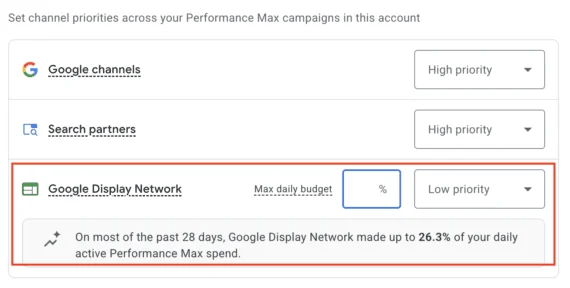
The implementation of channel prioritization allows advertisers to influence the weight given to specific channels within their campaigns. When an advertiser designates a channel as "Low priority," Google Ads will provide data on the channel’s 28-day spend percentage. For instance, a screenshot shared by Google demonstrated that within a Performance Max campaign, the Display Network accounted for 26.3% of the total spend over a 28-day period. While this figure offers a snapshot of allocation, it alone doesn’t inherently dictate whether this level of spend is desirable or requires adjustment.

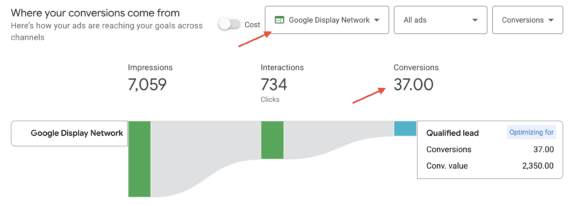
To gain deeper insights into channel performance, advertisers can now leverage the "Insights and reports" section, specifically the channel performance report. This report provides crucial bottom-line conversion data, enabling advertisers to assess the effectiveness of each channel in relation to its allocated spend. In the example provided, the overall campaign achieved 77 conversions. Of these, 37 were attributed to the Display Network, representing 48.1% of the total conversions (37 conversions / 77 total conversions) for 26.3% of the campaign’s expenditure. This analysis reveals that the Display Network, in this particular scenario, was a highly efficient channel, generating a disproportionately high number of conversions relative to its share of the ad spend. Such data-driven insights are instrumental in making informed decisions about channel prioritization.
Based on such comparative performance metrics, an advertiser can then categorize a channel as "High priority" or "Low priority." For channels deemed less effective or those where spend needs to be capped, advertisers can further refine their strategy by setting a maximum daily spend percentage for "Low priority" channels. This granular control allows for a more strategic allocation of budget, ensuring that campaigns are not only broad in reach but also efficient in their execution.
Strategic Implementation and Account-Level Control
Channel prioritization can be implemented at two key levels: account-wide or on a per-campaign basis. This flexibility caters to a wide spectrum of advertisers, from small businesses managing a few campaigns to large enterprises overseeing extensive advertising portfolios. For instance, an advertiser could opt to set all "Google channels" – a grouping that encompasses Search, Display, YouTube, Discover, and Gmail – to "Low priority" for their Performance Max campaigns if they wish to significantly reduce spend on these broad placements.
For accounts with a limited number of campaigns, applying settings at the account level might be the most straightforward approach. However, for organizations managing a multitude of campaigns, each with unique objectives and performance characteristics, prioritizing channels for each individual campaign becomes a more strategic and impactful option. This allows for highly tailored campaign management, aligning ad spend precisely with performance goals across diverse marketing initiatives.
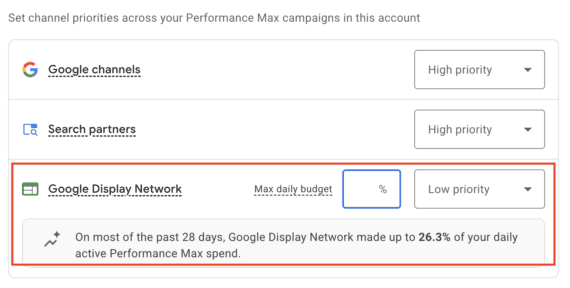
The potential applications of this new feature are extensive. One particular area of interest for many advertisers, including this author, is the management of Search partners. Historically, Search campaigns offered a simple on/off switch for Search partners. Many advertisers, myself included, have observed that Search partners can sometimes deliver unqualified traffic, leading to wasted ad spend. While the previous option was to either accept this or turn them off entirely, channel prioritization opens up a new testing ground. Advertisers can now assign Search partners a "Low priority" and set a maximum daily spend percentage. This allows for a controlled experiment, enabling testing of Search partners with a significantly reduced budget, providing valuable data without risking substantial financial outlay. This nuanced approach to testing and optimization is a significant step forward.
Limitations and Future Outlook
Despite the considerable advantages offered by channel prioritization, the feature is not without its limitations. A primary concern is the grouping of "Google channels." This category consolidates Search, Display, YouTube, Discover, and Gmail into a single entity for prioritization purposes. While Google allows advertisers to assign a single priority level to this entire group, each of these channels often exhibits distinct performance characteristics and user engagement patterns.
For example, a campaign might perform exceptionally well on Google Search, driving high-quality leads, while its performance on Google Maps could be significantly weaker. Under the current channel prioritization framework, there is no provision to set unique priority levels for each of these distinct channels. This means an advertiser cannot, for instance, assign "High priority" to Search while simultaneously assigning "Low priority" to Maps within the same campaign. This limitation reintroduces a form of the original "all-or-nothing" restriction, albeit with a reduced number of grouped channels. The ability to differentiate priority at a more granular level for each of these five channels would represent a further enhancement to the feature.
Furthermore, the true effectiveness of "Low priority" channels and the strictness with which Google Ads adheres to the set maximum daily spend percentages remain areas for observation. While the intention is clear – to reduce spend on less effective channels – the actual implementation and the degree to which these limits are respected will be crucial for advertisers to monitor. As this feature is still relatively new, ongoing performance analysis and user feedback will likely inform future iterations and refinements from Google. The success of channel prioritization will ultimately be measured by its ability to empower advertisers to achieve better ROI through more precise control over their ad placements across the vast Google advertising network.
Background and Context
The introduction of channel prioritization comes at a time when automated campaign management, particularly with Performance Max, has become increasingly prevalent. Performance Max, launched in November 2021, was designed to simplify campaign management by automating bidding, targeting, and creative delivery across all of Google’s channels. While it offered convenience and potential for broad reach, it also sparked debate within the digital marketing community regarding the perceived loss of control over ad placement. Advertisers expressed concerns about the "black box" nature of some automated systems, where understanding and influencing specific channel performance became challenging.
The growing sophistication of AI and machine learning in advertising has enabled platforms like Google Ads to offer highly automated solutions. However, this automation has also amplified the demand for transparency and control, as advertisers seek to ensure their investments are aligned with strategic business objectives. The channel prioritization feature appears to be Google’s response to this evolving advertiser sentiment, aiming to strike a balance between the power of automation and the necessity of advertiser oversight. This move signals Google’s commitment to refining its automated solutions to better meet the diverse needs of its advertising partners.
Broader Impact and Implications
The implications of channel prioritization extend beyond individual campaign optimization. For advertisers, it offers the potential for more efficient budget allocation, improved return on ad spend (ROAS), and a deeper understanding of channel performance dynamics. By having the ability to steer spend towards more profitable channels and away from less effective ones, businesses can maximize their marketing impact. This feature could be particularly beneficial for advertisers with limited budgets, allowing them to make every dollar count by focusing on placements that demonstrably drive conversions.
For Google, this development could lead to increased advertiser confidence and retention. By addressing a key pain point, Google is demonstrating its responsiveness to advertiser feedback, which can foster stronger relationships with its client base. It also allows for more sophisticated data collection and analysis, as advertisers gain the tools to experiment and provide feedback on channel performance, ultimately contributing to the ongoing improvement of Google’s advertising algorithms. The long-term success of channel prioritization will depend on its effectiveness in practice and Google’s willingness to further refine its capabilities, potentially by unbundling the "Google channels" grouping in future updates. The initial rollout, however, represents a significant stride towards a more flexible and advertiser-controlled Google Ads environment.

