

The landscape of e-commerce is undergoing a profound transformation, marked by an ascendant culture that champions artificial intelligence (AI) and automation. This shift is not merely about adopting new technologies; it is fostering an environment of experimentation and proactive problem-solving, reminiscent of the industry’s nascent, innovative spirit. This burgeoning "test-and-see" attitude is leading to a renaissance of do-it-yourself (DIY) projects, empowering teams to directly address operational challenges and unlock new efficiencies.
The Accelerating AI Trend: Data Points to a Cultural Shift
A confluence of recent studies and industry reports underscores this emergent trend towards a more engaged, DIY approach within e-commerce businesses. A significant 2025 LinkedIn study, titled "Work Change Report," revealed that a remarkable 80% of C-suite executives perceive AI adoption as critically important for fostering a more innovative workplace culture. This sentiment is echoed by employees themselves; Gartner reported in December 2025 that a substantial 65% of the workforce expressed excitement about utilizing AI in their professional capacities. These figures collectively signal a broad acceptance and anticipation for AI’s integration into daily work routines, moving beyond theoretical discussions to practical application.
This trend can be understood as a convergence of three key strategic priorities for modern businesses: the imperative to innovate and stay competitive, the growing demand for operational efficiency, and the increasing accessibility of powerful AI and automation tools that democratize technological solutions. As legacy systems and manual processes become increasingly insufficient in the face of rapid market changes, businesses are actively seeking agile and adaptable solutions.
Echoes of the Past: The "Old Is New Again" Phenomenon in E-commerce

The current embrace of DIY solutions within e-commerce carries a distinct echo of the industry’s early days. In its formative years, e-commerce businesses often relied on entrepreneurial ingenuity and a willingness to build custom solutions to overcome limitations and seize opportunities. Today, this spirit is being rekindled, albeit with far more sophisticated tools.
A compelling illustration of this phenomenon involves a business based in the northwestern United States. This company took a proactive approach by providing nearly every employee with premium access to leading AI platforms such as OpenAI and Gemini, alongside a robust workflow automation tool, n8n. The management actively encouraged staff to leverage these resources for tackling operational problems.
Upon reviewing the initiatives undertaken, it became evident that employees had successfully developed a straightforward, n8n-driven tool designed to monitor competitor pricing. This solution, while relatively basic in its architecture, demonstrated significant problem-solving prowess. The workflow was configured to systematically gather pricing data from various sources, employ an AI agent to cross-reference this information against the company’s internal data, and then compile the results into a weekly update in a Google Sheet. This aggregated data was subsequently fed into a pivot table, enabling the marketing team to efficiently identify price fluctuations and market shifts.
This approach bears a striking resemblance to technological solutions that were cutting-edge a decade prior. An article published in 2015, titled "Monitor Competitor Prices with Python and Scrapy," detailed a simplified price-checking mechanism developed by a regional retailer. While that earlier solution was less expensive and possessed fewer functionalities, it served the same fundamental purpose: solving a business problem through custom development. The current wave of AI and automation tools allows for the replication and enhancement of such solutions with greater ease and accessibility, even for individuals without extensive programming backgrounds.
The Power of DIY: Democratizing Automation and Innovation
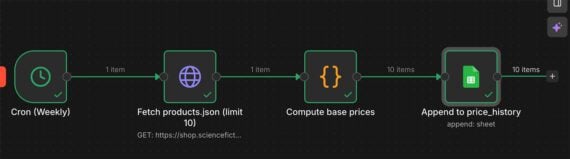
The core of this evolving trend lies in the increasing accessibility of powerful automation platforms like n8n. In its most distilled form, the price-checking workflow described earlier can be implemented with minimal technical expertise. A streamlined version might involve as few as four fundamental steps: defining a trigger, fetching the necessary data, processing that data (potentially with AI assistance), and storing or acting upon the results.

The illustration of the n8n workflow, which visually depicts a weekly cron trigger fetching a products.json file via API, computing base prices, and appending results to a Google Sheets "price_history" sheet, showcases the modular and transparent nature of these tools. The status checkmarks indicating successful steps further highlight the user-friendly design that empowers individuals to build and monitor their own automated processes.
Remarkably, the creation of such workflows is becoming even more accessible. Merchants may soon find that they do not need to manually assemble these automation sequences. Generative AI tools are increasingly capable of producing n8n-importable JSON files directly from simple, descriptive prompts. This means an employee could articulate their need – for instance, "create a workflow that checks our competitor’s prices for these five products every Monday and logs them in a Google Sheet" – and the AI could generate the foundational workflow structure, significantly reducing the technical barrier to entry.
Cultivating a Culture of Empowerment and Problem-Solving
The true significance of the competitor price-monitoring example extends far beyond the technical sophistication of the workflow itself. Its profound impact lies in the cultural shift it fosters within organizations. The fact that a member of the marketing team, possessing minimal formal programming experience, could conceptualize and build a problem-solving automation solution is a testament to this new paradigm.
While it is plausible that a dedicated developer might later refine the workflow or optimize the underlying code, the critical takeaway is the reduction of friction between identifying an operational challenge and implementing a tangible solution. This proactive, empowered approach is fundamentally reshaping how businesses tackle everyday issues.
The DIY attitude that propelled early e-commerce entrepreneurs to success is being reborn, armed with a powerful new arsenal of AI and automation technologies. By cultivating an "automation-first" mindset, teams can move beyond relying solely on off-the-shelf solutions or lengthy development cycles. Instead, they can build custom workflows tailored to their specific needs, such as:
- Personalized Customer Journeys: Automating the delivery of targeted content and offers based on individual customer behavior and preferences.
- Dynamic Inventory Management: Creating systems that automatically reorder stock or flag low inventory levels based on real-time sales data and predictive analytics.
- Streamlined Order Fulfillment: Developing automated processes for order processing, shipping label generation, and carrier selection to expedite delivery times.
- Enhanced Customer Support: Implementing AI-powered chatbots that can handle common inquiries, freeing up human agents for more complex issues, and automating ticket routing based on issue severity.
- Automated Marketing Campaign Optimization: Building workflows that continuously monitor campaign performance, adjust ad spend, and A/B test creative elements for maximum impact.
A Multifaceted Opportunity: Convergence of Needs and Resources
This growing DIY trend represents a significant opportunity, arising from the convergence of AI and workflow automation needs with accessible technologies. Businesses are increasingly recognizing that to remain competitive, they must embrace these tools. Executives are keenly aware of the need for robust competitive protection and enhanced operational agility. Simultaneously, employees are motivated by the prospect of improving their efficiency, acquiring new valuable skills, and contributing more directly to their company’s success.
Furthermore, the prevailing economic climate, often characterized by budget constraints, limits the availability of extensive software purchases and large-scale development projects. The DIY approach, leveraging existing subscriptions to AI tools and affordable automation platforms, offers a cost-effective pathway to achieving desired outcomes. This democratization of technology allows businesses of all sizes to innovate and adapt without requiring massive capital investments, leveling the playing field and fostering a more dynamic and responsive e-commerce ecosystem. The future of e-commerce innovation appears to be in the hands of those who are empowered to build, test, and iterate.

