
The digital health landscape is currently undergoing a structural transformation as product designers shift from utility-focused interfaces to empathy-centred frameworks. This evolution comes at a critical juncture; according to recent data from the World Health Organization (WHO), over one billion people globally are living with mental health conditions, while existing services remain under-resourced and difficult to access. As digital interventions become a primary point of contact for individuals seeking support, the industry is recognizing that traditional user experience (UX) metrics—such as time-on-page or click-through rates—are often insufficient, and in some cases detrimental, when applied to mental health contexts.
Designing for mental health requires a fundamental acknowledgment of user vulnerability. When a user engages with a mental health application, they are often in a state of heightened emotional distress or reduced cognitive capacity. Industry analysts note that standard UX patterns, such as high-frequency notifications or "shaming" mechanics used to maintain daily streaks, can exacerbate anxiety rather than alleviate it. Consequently, a new framework is emerging that prioritizes trust, emotional safety, and humane engagement over aggressive growth metrics.
The Evolution of Digital Mental Health Interventions
The trajectory of digital mental health has moved through several distinct phases over the past two decades. In the early 2010s, the market was dominated by basic mood trackers and digitized versions of clinical worksheets. By 2015, the "mindfulness boom" saw the rise of massive meditation platforms that popularized subscription-based wellness. However, by 2024, the market reached a saturation point with approximately 20,000 mental health-related apps available to consumers.
This saturation has led to a "trust deficit." Recent studies indicate that a significant percentage of users abandon mental health apps within the first week due to clinical-feeling interfaces, intrusive data requests, or paywalls that appear at moments of acute need. The current era of design, therefore, focuses on "Empathy-Centred UX," an approach that treats the user’s emotional state not as a secondary context, but as the primary environment in which the product operates.
Pillar I: Onboarding as a Supportive Conversation
In the standard software development lifecycle, onboarding is typically viewed as a functional checklist designed to maximize user conversion. In an empathy-centred framework, however, onboarding is redefined as the "first supportive conversation." For a user seeking help, the initial minutes of interaction determine whether the app is perceived as a clinical tool or a trusted companion.
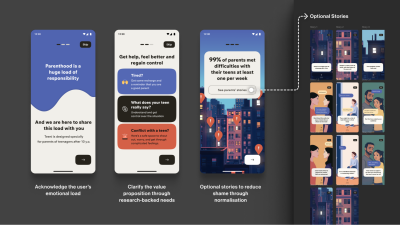
Case studies in the field, such as the development of the parenting support app Teeni, demonstrate the efficacy of this shift. Rather than beginning with a barrage of data entry fields, the interface utilizes narrative-driven "relief moments." By presenting users with brief, animated stories that normalize common struggles—such as the stress of managing a teenager’s emotional volatility—the app validates the user’s experience before asking for information.
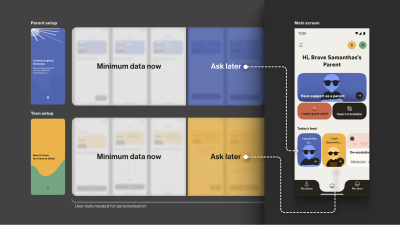
This approach incorporates "Progressive Profiling," a strategy where data collection is distributed across the user’s journey. On the first run, only essential data (such as the child’s age) is gathered. More sensitive or complex details are requested only after the user has received a tangible "dose of relief," such as a helpful tip or a calming exercise. This reduces the cognitive load on the user and builds a foundation of reciprocal trust.
Pillar II: The Sensory-Driven Emotional Interface
A critical challenge in mental health UX is accounting for the reduced cognitive capacity associated with anxiety and depression. Clinical research suggests that high levels of stress can impair attention spans and the speed of information processing. Traditional "clean" design—characterized by bright white backgrounds and high-contrast primary colors—can feel jarring or "too happy" for users experiencing a depressive episode.
To address this, designers are adopting "low-stimulus" visual languages. This involves:
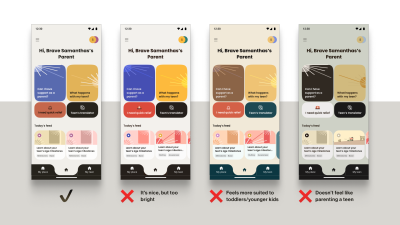
- Earth-Toned Palettes: Utilizing non-neon, grounding colors that minimize visual arousal.
- Scannable Content: Dividing text into small, digestible fragments to accommodate shortened attention spans.
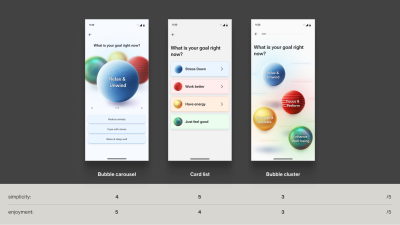
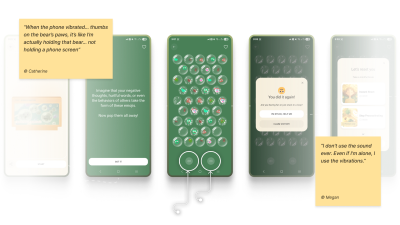
- Sensory Grounding: Integrating haptic feedback and micro-interactions, such as a "bubble-wrap" popping mechanic, which provides kinetic relief and helps ground the user in the present moment.
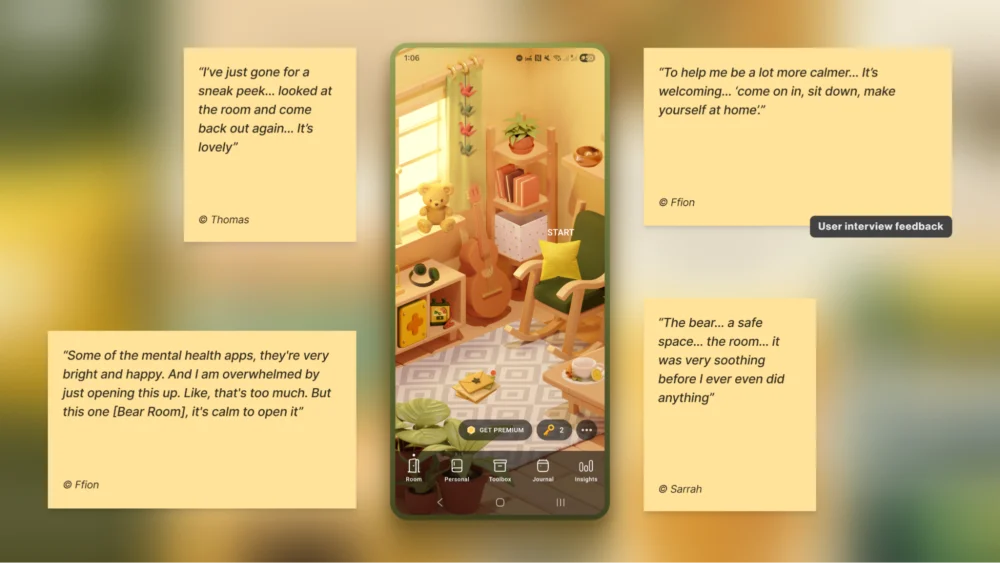
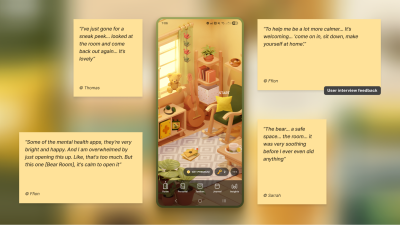
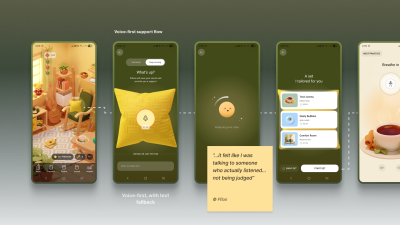
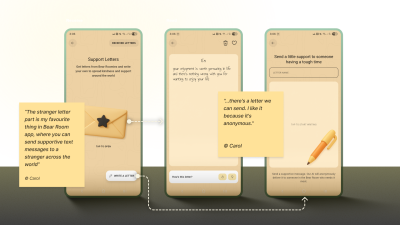
The "Bear Room" application serves as a primary example of this "digital safe space" philosophy. User interviews conducted during its development revealed that participants found standard wellness apps "alienating." In response, the interface was designed as a "cosy room," allowing users to interact with digital objects like picture frames or letters. By allowing users to customize these objects with their own photos or messages, the framework leverages the "IKEA effect"—a psychological phenomenon where individuals value products more highly when they have played a role in their creation. This fosters a sense of psychological ownership and safety.
Furthermore, the integration of voice-first interfaces is becoming a standard for accessibility in high-stress moments. When a user is too overwhelmed to type, a prominent microphone option allows for "affect labeling"—the act of putting feelings into words—which has been scientifically shown to reduce emotional intensity.
Pillar III: Ethical Retention and the Compassionate Economy
The most significant ethical dilemma in mental health tech is the conflict between business sustainability and user wellbeing. Traditional gamification—using streaks and points to drive daily logins—can induce shame in users who miss a day, potentially causing them to abandon their progress entirely.
The empathy-centred framework replaces punitive retention with "compassionate loops." One innovative solution is the "Key Economy" model. In this system, users are not punished for missing days. Instead, they might earn "keys" for logging in every few days—a rhythm that acknowledges the non-linear nature of mental health recovery. These keys are used to unlock advanced content or decorative items, but they never gate essential "SOS" coping tools, which remain free and accessible at all times.
A groundbreaking aspect of this model is the "gift economy" mechanic, currently being explored in several peer-support platforms. Users can choose to "gift" their earned keys to others in the community. This transforms retention from a self-focused chore into an act of altruism, fostering a culture of mutual support. By moving the motivation from "maintaining a streak" to "helping the community," apps can maintain high engagement without compromising the user’s mental health.
Supporting Data and Industry Analysis
The shift toward empathy-centred design is supported by emerging data on digital health efficacy. A 2024 study on app engagement found that:
- Retention Rates: Apps using progressive profiling and low-stimulus design saw a 30% higher retention rate over 90 days compared to those using standard clinical onboarding.
- User Trust: Transparency regarding data processing—specifically concise, "human-readable" privacy notices before voice recording—increased user opt-in rates by 45%.
- Crisis Management: Features like the "Teenager Translator" in the Teeni app, which provide immediate de-escalation scripts during moments of conflict, were rated as the "most valuable" by 82% of users, indicating that utility in crisis is a stronger driver of loyalty than gamification.
Industry experts suggest that as AI becomes more integrated into these platforms, the need for empathetic guardrails will only increase. AI can provide tailored psychoeducational content in real-time, but without an empathy-centred UX, it risks appearing cold or "uncanny."
Chronology of Framework Implementation
For organizations looking to adopt this framework, the implementation typically follows a structured timeline:
- Phase 1: Research & Empathy Mapping (Months 1-2): Identifying the specific "vulnerability triggers" within the target audience.
- Phase 2: Visual & Sensory Audit (Months 3-4): Redesigning the interface to meet WCAG 2.2 accessibility standards and adopting a low-arousal color palette.
- Phase 3: Narrative Onboarding Development (Months 5-6): Replacing data-heavy forms with supportive storytelling and progressive profiling.
- Phase 4: Ethical Loop Integration (Months 7-8): Transitioning from traditional gamification to compassionate retention mechanics like the "Key Economy."
- Phase 5: Evaluation & Metric Shifting (Ongoing): Moving success metrics from "time-spent" to "emotional relief delivered."
Broader Impact and Implications
The implications of an Empathy-Centred UX Framework extend beyond the mental health sector. As digital fatigue grows, the principles of digital safety, low-stimulus design, and ethical retention are likely to influence broader software categories, from educational tools to social media.
By prioritizing trust over engagement, designers are not only creating more effective health interventions but are also setting a new standard for the ethical treatment of users in the digital age. The ultimate success of a mental health app is not measured by how long a user stays on the screen, but by how effectively the app empowers the user to return to their offline life with a sense of calm and resilience. In this context, trust is not just a "nice to have" feature—it is the fundamental metric of success. This paradigm shift ensures that technology serves as a bridge to wellness rather than another source of digital stress.

