

The ecommerce landscape is witnessing a profound shift, characterized by a burgeoning embrace of artificial intelligence (AI) and automation. This adoption is not merely about implementing new technologies; it’s fostering a culture of experimentation and problem-solving that echoes the industry’s pioneering spirit from its nascent stages. This evolving environment is giving rise to a modern "do-it-yourself" (DIY) movement, where businesses and their employees are empowered to tackle challenges through readily available tools and a proactive, test-and-see attitude. This phenomenon is reshaping how businesses operate, innovate, and remain competitive in an increasingly dynamic digital marketplace.
The AI Imperative: Driving Innovation and Employee Engagement
The burgeoning trend towards an AI- and automation-centric culture is substantiated by a growing body of research and industry reports. A seminal 2025 LinkedIn study, titled the "Work Change Report," revealed a compelling statistic: a staggering 80% of C-suite executives believe that AI adoption is crucial for fostering a more innovative workplace culture. This sentiment underscores a top-down recognition of AI’s potential to unlock new avenues of creativity and efficiency.
Complementing this executive outlook, Gartner’s December 2025 "HR Survey" indicated that 65% of employees express excitement about integrating AI into their daily work. This dual perspective – from leadership recognizing strategic importance and employees anticipating tangible benefits – highlights a powerful convergence of priorities. Businesses are increasingly seeing AI not just as a tool for optimization but as a catalyst for transforming their operational DNA. This convergence is driven by a confluence of three key factors: the persistent need for competitive differentiation, the growing employee desire for enhanced efficiency and skill development, and the economic realities that necessitate cost-effective solutions, often limiting extensive third-party software investments or large-scale custom development projects.

From Code to No-Code: The Resurgence of the "Maker" Mentality
The current wave of AI-driven DIY innovation in ecommerce can be vividly illustrated through real-world examples. One such instance involves a retail business based in the northwestern United States that took a proactive approach by equipping nearly all its employees with premium access to leading AI platforms like OpenAI and Gemini, alongside the versatile workflow automation tool n8n. This strategic decision was coupled with a management directive that actively encouraged employees to leverage these tools for problem-solving.
Upon reviewing the initiatives undertaken by the staff, a particularly insightful example emerged: the development of a straightforward n8n-driven tool designed to monitor competitor pricing. This project, initiated by a marketing team member with limited prior programming experience, exemplifies the new DIY spirit. The tool was designed to autonomously gather pricing data from competitor websites, employ an AI agent to compare these figures against the company’s internal data, and systematically populate this information into a Google Sheet on a weekly basis. The resulting data, organized within a pivot table, provided the marketing team with crucial insights into market dynamics and pricing adjustments.
This initiative bears a striking resemblance to innovative solutions developed years prior. In a 2015 article published on PracticalEcommerce, titled "Monitor Competitor Prices with Python and Scrapy," a similar, albeit more technically complex, price-checking mechanism was described. That earlier solution involved custom Python scripting and the Scrapy framework to achieve a comparable outcome for a regional retailer. While effective, it required specialized coding skills and a deeper understanding of web scraping. The contemporary n8n-based approach, in contrast, achieves a similar functional objective with significantly reduced technical barriers, demonstrating how advancements in automation tools have democratized sophisticated problem-solving.
The Simplified Workflow: Automation Without Complex Coding
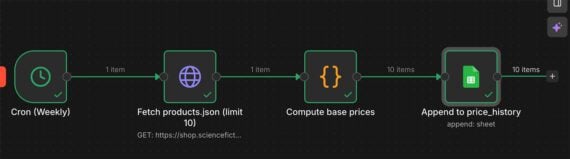
The core of this revitalized DIY approach lies in the accessibility of modern automation platforms. The competitor price-monitoring workflow, for instance, can be distilled into a remarkably simple, four-step process that may not even necessitate the full capabilities of advanced AI for its basic function. This simplified workflow underscores the power of low-code and no-code solutions in empowering a broader range of employees.

The typical workflow might involve the following sequence of operations:
- Scheduled Trigger: The process would initiate automatically, often on a weekly basis, utilizing a cron trigger within n8n to ensure consistent execution.
- Data Acquisition: The system would then fetch the necessary competitor pricing data. This could involve API calls to publicly available data sources or scraping specific competitor websites, depending on data accessibility and terms of service.
- Data Processing and Comparison: The retrieved data would be processed to extract relevant pricing information. This stage might involve basic data cleaning and standardization. For a more advanced iteration, AI agents could be employed here to analyze nuances in pricing, such as promotional offers or bundled deals.
- Data Storage and Reporting: The processed pricing data would be appended to a designated Google Sheets "price_history" tab, creating a chronological record. This structured data then serves as the foundation for subsequent analysis, such as generating pivot tables for trend identification.
The ease with which such workflows can be constructed is further amplified by the capabilities of generative AI. Merchants may not need to manually assemble these workflows at all. Generative AI tools can now produce n8n-importable JSON files directly from simple, natural language prompts. For example, a prompt like "Create an n8n workflow that checks competitor prices for product X every Monday and logs them to a Google Sheet" could yield a functional workflow configuration, dramatically lowering the barrier to entry for automation development. This capability democratizes the creation of custom solutions, allowing businesses to rapidly prototype and deploy tools tailored to their specific needs.
Fostering a Culture of Empowerment and Agility
The true significance of the price-monitoring example, and countless others like it, extends far beyond the specific functionality of the workflow itself. It lies in the cultural shift it embodies. The creation of a problem-solving automation by a marketing team member, possessing minimal formal programming expertise, is a testament to the power of an empowered workforce. This "maker" mentality, where individuals are encouraged and equipped to build solutions, fundamentally reduces the friction between operational challenges and their resolutions.
This reinvigoration of the DIY spirit is a direct echo of the early days of ecommerce. Visionary entrepreneurs, unburdened by established corporate structures and vast resources, often relied on their ingenuity and a willingness to experiment to build their businesses. Today, with the advent of accessible AI and automation tools, that same spirit is being rekindled within established organizations.
An "automate-first" and AI-integrated culture empowers teams to move beyond off-the-shelf solutions and develop bespoke workflows that precisely address their unique operational bottlenecks. This could manifest in a variety of custom solutions, including:
- Personalized Customer Service Bots: Developing AI-powered chatbots that can handle a wider range of customer inquiries with greater personalization and efficiency, freeing up human agents for more complex issues.
- Dynamic Inventory Management: Creating automated systems that predict demand more accurately, optimize stock levels across multiple channels, and trigger reorder points based on real-time sales data and predictive analytics.
- Streamlined Marketing Campaign Management: Automating the creation and deployment of personalized marketing messages, segmenting customer lists based on AI-driven insights, and tracking campaign performance with greater granularity.
- Enhanced Fraud Detection: Building AI models that can analyze transaction patterns in real-time to identify and flag suspicious activities, thereby reducing financial losses and protecting customer data.
- Automated Content Generation and Optimization: Utilizing AI to assist in generating product descriptions, social media posts, and email copy, and then using automation to optimize their delivery based on audience engagement metrics.
Navigating the Opportunity Landscape
The current DIY trend represents a significant opportunity for businesses across the ecommerce spectrum. It signifies a critical juncture where the demand for AI and automation capabilities converges with practical business needs and resource constraints. Executives are actively seeking ways to enhance their competitive edge, often through strategies that provide a protective moat against market disruption. Employees, in turn, are motivated by the prospect of increasing their efficiency, acquiring new, in-demand skills, and contributing more meaningfully to their organizations.
Simultaneously, budget limitations often preclude large-scale investments in proprietary software or extensive custom development projects. This is where the DIY movement, powered by accessible AI and automation tools, becomes particularly attractive. It offers a path to innovation that is both cost-effective and highly adaptable. By empowering their internal teams to build and iterate on solutions, businesses can achieve significant operational improvements without the prohibitive costs associated with traditional development cycles.
This shift is not merely a technological upgrade; it represents a fundamental evolution in how businesses approach problem-solving and innovation. The renewed emphasis on DIY, fueled by AI and automation, is democratizing the development of critical business tools, fostering a more agile and resilient ecommerce ecosystem. As this trend matures, businesses that successfully cultivate an AI and automation-first culture are likely to gain a substantial competitive advantage, demonstrating that in the modern digital economy, the most potent innovations often come from within.

