
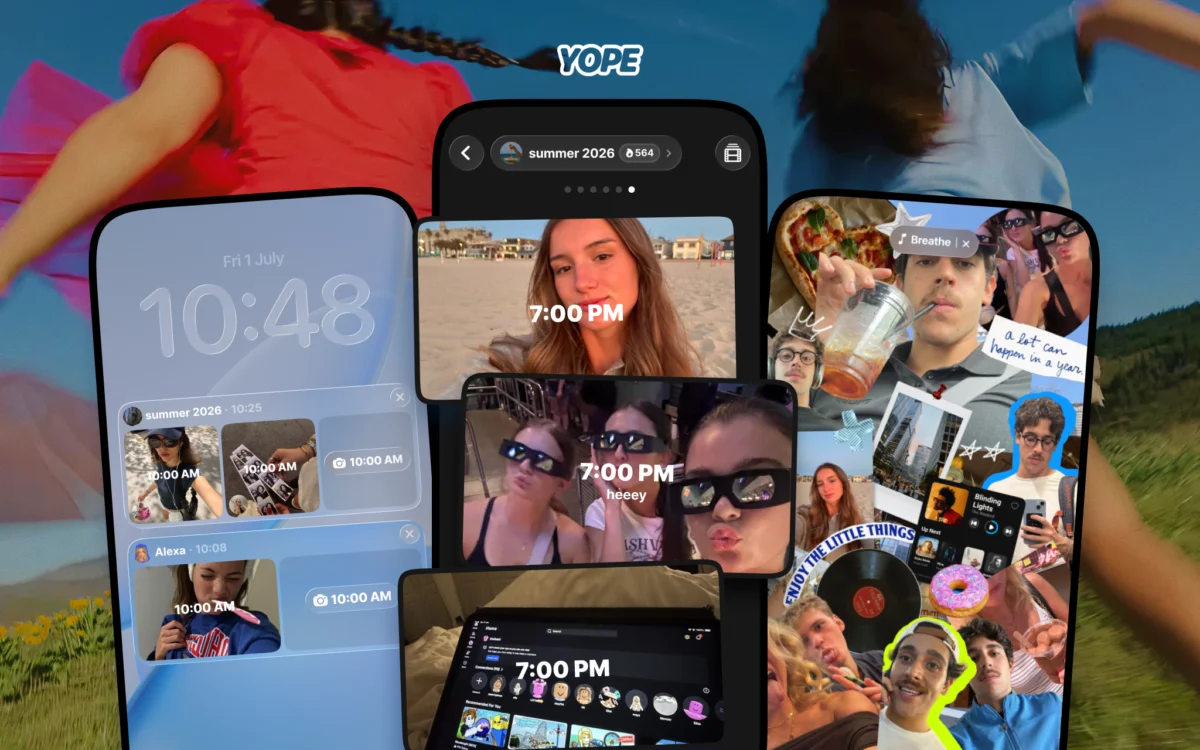
In a significant move challenging the established paradigms of digital connection, Yope, an emerging social media startup, has successfully closed a $12.3 million funding round led by Northzone. This investment underscores a growing investor appetite for platforms that prioritize privacy, eschew algorithmic manipulation, and offer an ad-free experience, marking a potential shift in the evolution of online social interaction. Yope aims to redefine the landscape dominated by tech behemoths such as Meta (Facebook, Instagram), TikTok, and Snapchat, by centering its offering on what it terms "micro communities"—intimate, private groups for friends and family to share, interact, and eventually, play games.
The Evolution of Social Media and the Quest for Authenticity
The trajectory of social media has been a dynamic one, transforming from rudimentary platforms designed for simple connectivity into sophisticated, large-scale entertainment engines. Early iterations, like MySpace and the nascent Facebook, emphasized personal profiles and friend networks. However, over the past decade, the focus has dramatically shifted towards engagement metrics, influencer economies, and algorithm-driven content feeds, often at the expense of genuine human connection and user privacy. This evolution has led to a widespread sense of dissatisfaction among users, particularly younger demographics, who feel pressured to curate idealized online personas or contend with an overwhelming influx of advertising and irrelevant content.
Data from various market research firms consistently indicates a growing concern among social media users regarding privacy, data exploitation, and the mental health implications of constant exposure to algorithmically amplified content. A 2023 Pew Research Center study, for instance, revealed that a significant percentage of teens report feeling overwhelmed by drama on social media and pressured to present themselves in a certain way. This sentiment has fueled a demand for more authentic, private, and controlled online spaces, leading many to seek solace in "dark social" channels like encrypted messaging apps or creating "finsta" (fake Instagram) accounts to share candid moments with a select few. Yope positions itself squarely within this emerging desire for genuine connection, offering a stark contrast to the public-by-default, attention-economy models prevalent today.

Yope’s Distinctive Approach: Privacy, Micro-Communities, and AI Integration
At the core of Yope’s proposition are several key differentiators. Firstly, accounts are private by default, ensuring that users control who sees their content. Secondly, and perhaps most crucially, the platform operates without an algorithmic feed. This means users see content from their friends and family in a chronological or intentional manner, free from the manipulative recommendations that often dictate engagement on other platforms. This deliberate omission of algorithms is designed to foster a more organic and less addictive user experience.
Monetization on Yope also diverges significantly from the industry standard. Eschewing the advertising-based model that underpins most major social networks, Yope is developing a premium, subscription-based experience tailored for "power users." This model aligns the platform’s incentives directly with user satisfaction and privacy, rather than with ad impressions or data collection.
Bahram Ismailau, Yope’s London-based co-founder and CEO, explains that the genesis of this unique approach stemmed from extensive market research. The team conducted over 100,000 interviews, augmented by AI tools, to deeply understand the social networking habits and frustrations of young people globally. Their findings highlighted a significant trend: approximately 30% of young users were already maintaining "photo dump" or "spam" accounts—secondary, private profiles where they could share more authentic, uncurated content with a smaller, trusted circle of real-life friends. Furthermore, many individuals had largely abandoned public sharing, opting instead for direct messaging to maintain connections.
"Young people don’t have any place to self-express if they are not ready to be an influencer," Ismailau articulated in an interview. "Yet teens still want to do so; they just want more privacy. We found this big opportunity to create a new space for young people to be social. We called it Yope, and it’s an AI-native social platform for young people and the next generation."

AI as an Enhancer, Not a Creator
A critical distinction in Yope’s strategy is its application of artificial intelligence. Ismailau clarifies that Yope does not advocate for AI-generated content. Instead, the platform leverages AI as a tool to enhance connections and facilitate real-world interactions. This includes the development of AI-powered mini-games that friends can play together within the app, a feature expected to launch within the coming month. Beyond in-app entertainment, Yope envisions AI assisting users in meeting up offline—for example, by suggesting and helping to book tickets for events, or identifying local venues to watch a sports game together. This integration aims to bridge the digital and physical worlds, fostering deeper relationships beyond screen interactions.
The user experience on Yope is designed for personalization and intimacy. Users create profiles by sharing photos, which can be transformed into cut-out stickers. Rather than conventional albums, photos are presented in a dynamic, collage-like arrangement on a user’s "wall," reminiscent of the highly customizable profiles once popularized by MySpace. This echoes a nostalgic desire for personal digital spaces that reflect individual personalities. Future updates will allow users to further customize their space with interests, favorite music, selected mini-games, and custom colors and wallpapers.
The app incorporates several familiar social media features, including in-app messaging, AI-created "recaps" of top moments, and lock screen widgets that display friends’ photos, ensuring a sense of familiarity while introducing novel elements. The onboarding process is meticulously designed to guide users through setting up features, granting necessary permissions, and encouraging the immediate addition of real-life connections to initiate private chats.
Traction and Investor Confidence

Despite its relatively quiet development over the past two years (following two prior strategic pivots), Yope has demonstrated impressive user acquisition and engagement metrics. The platform currently boasts nearly 15 million registered users. These users collectively share between 10 million and 20 million pieces of content weekly, a figure corrected from an earlier daily estimate, encompassing individual photos, videos, and stickers. These statistics point to robust and consistent usage. Ismailau reports that over 50% of Yope’s users open the app at least five days per week, qualifying them as highly engaged "power users."
Intriguingly, Yope’s appeal extends beyond its core young demographic. Approximately 20% of its active user base comprises older family members who have been invited to join the app by their younger relatives. This intergenerational adoption hints at the platform’s potential to bridge demographic divides by facilitating private, family-oriented communication.
This strong traction naturally drew the attention of investors. Northzone, a venture capital firm with a notable history of backing successful consumer applications like Spotify and Klarna, proactively approached Yope. The $12.3 million Series A funding round was led by Northzone, with additional participation from Inovo, Redseed, and Geek Ventures. This latest infusion brings Yope’s total funding to $20 million, signaling significant investor confidence in its vision.
Pär-Jörgen Pärson, a partner at Northzone, articulated the firm’s enthusiasm: "Yope is a fresh, empowering and safe take on social media where the users are in full control of their experience in contrast to the predatory practices of Meta, TikTok or X. We are very excited to partner with Bahram, Paul [Rudkouski, co-founder] and their team to build the service far beyond the current millions of users and half a billion moments shared."
Broader Implications and Future Outlook

Yope’s emergence and successful funding round carry significant implications for the broader social media landscape. It represents a tangible challenge to the long-standing dominance of ad-driven, algorithm-centric platforms, suggesting a potential paradigm shift towards privacy-first, user-controlled experiences. If Yope can sustain its growth and user engagement, it could validate the viability of a subscription-based model in social networking, demonstrating that users are willing to pay for a higher quality, more private, and less intrusive online environment.
The emphasis on "micro communities" could also influence how other platforms evolve, potentially prompting established players to offer more robust private group functionalities or even spin off dedicated private-sharing apps. The integration of AI not for content creation but for connection enhancement and real-world utility also presents a novel direction for technological application in social platforms, moving beyond mere engagement optimization.
However, Yope faces the inherent challenges of scaling a private social network. Maintaining an intimate, uncommercialized experience while growing a user base of millions requires careful navigation. The success of its subscription model will depend on delivering compelling premium features that justify the cost, enticing users away from free alternatives. Furthermore, competing with the network effects of entrenched giants, where "everyone else is already there," remains a formidable hurdle.
Looking ahead, the new funding will be strategically deployed to further product development, expand Yope’s growing team (currently around 35 individuals), and establish a physical office in the United States, indicating ambitious plans for global expansion and market penetration. Yope’s journey will be a closely watched experiment in whether a return to the foundational principles of genuine connection and user autonomy can carve out a substantial niche in a digital world increasingly fatigued by the demands of public performance and algorithmic oversight.
Yope is currently available for free download on both iOS and Android platforms, inviting users to experience what its founders believe is the future of online connection.

