
The burgeoning field of generative artificial intelligence (AI), spearheaded by platforms like ChatGPT and Claude, has rapidly reshaped digital interaction. Launched nearly four years ago and a few months later respectively, these AI models have become integral to how users seek information and generate content. However, a significant data gap has persisted regarding the specific prompts users input and the precise methodologies these platforms employ to generate responses. Until recently, insights into these interactions were largely inferred from traditional search query data. The landscape of AI transparency has begun to shift, with Google Search Console now offering a critical window into generative AI interactions through its indexing of AI-driven prompts as search queries.
For an extended period, the precise nature of user engagement with generative AI remained largely opaque. While the widespread adoption of tools like ChatGPT and Claude was evident, the specifics of what users were asking and how the AI interpreted these requests were not readily available. Search engine optimization (SEO) professionals and digital marketers have relied on aggregated search data, attempting to extrapolate patterns from broad query metrics. This has presented a significant challenge, as the nuances of conversational AI interactions differ considerably from the keyword-driven queries typical of traditional search engines. The ability to understand the intent, detail, and iterative nature of AI prompts is crucial for optimizing content and understanding user behavior in this evolving digital ecosystem.
A notable exception in the realm of AI transparency has been Microsoft’s Bing. Bing has taken steps to report the "Grounding Queries" that drive its "fan out" responses, offering a glimpse into its AI’s operational logic. This move by Bing highlighted the industry’s growing need for more granular data on AI interactions. However, it also underscored the limitations of relying on a single platform for such critical insights, leaving many in the SEO community eager for similar visibility from other major players.
The recent revelations concerning Google Search Console mark a significant development. It has become apparent that Google’s AI Mode, integrated into its search experience, actively records both initial and follow-up prompts from users as search queries. This discovery emerged from observations by SEO professionals who noticed unusual query patterns within their Search Console data.
The Catalyst for Discovery: A LinkedIn Exchange
The crucial insight into Google’s recording of AI prompts was largely facilitated by an exchange on LinkedIn involving Anastasia Kourou, SEO Manager at Relevance Digital Agency in Greece. Kourou flagged a peculiar observation in her Google Search Console data: the presence of queries that bore a striking resemblance to conversational AI prompts. These included short, seemingly incomplete queries such as "yes" and "yes, pricing." Such entries were anomalous within the context of traditional search queries, which typically exhibit more descriptive and specific language.
Intrigued and seeking clarification, Kourou directly engaged John Mueller, a prominent figure in Google’s search quality team, on LinkedIn. She posed a direct question about why Search Console was listing these genAI-like prompts as search queries. Mueller’s response was pivotal, confirming that these indeed represented follow-up prompts from users interacting with Google’s AI Mode. This official confirmation validated the suspicions of many in the SEO community and opened up new avenues for understanding user behavior within AI-driven search environments.

Mueller’s confirmation provided the much-needed evidence that Google Search Console, traditionally a tool for analyzing organic search performance, was now also capturing valuable data related to generative AI interactions. This has profound implications for how SEO strategies are developed and executed in an era increasingly influenced by AI.
Identifying AI-Driven Prompts in Search Console
The ability to identify these AI-driven prompts within the vast dataset of Search Console is now a key objective for SEO professionals. While Google does not explicitly label these queries as "AI prompts," their characteristics often make them distinguishable. The primary method for uncovering these interactions involves leveraging the advanced filtering capabilities of Search Console, particularly the use of regular expressions (regex).
Leveraging Regular Expressions for Prompt Detection
Search Console’s "Performance" report allows users to add filters to refine their data. By selecting "Query" and then choosing "Custom (regex)," users can input specific patterns to identify queries that exhibit characteristics of AI prompts.
A foundational regex pattern recommended for this purpose is:
([^" “]*s)10,?
This regex is designed to identify queries that are exceptionally long. By looking for a sequence of at least ten words or word-like elements separated by spaces, it effectively filters out shorter, more traditional search queries. The rationale is that conversational AI prompts are often more verbose and descriptive than typical search engine queries. These extended queries can resemble natural language questions or instructions, indicative of a user interacting with a conversational AI.
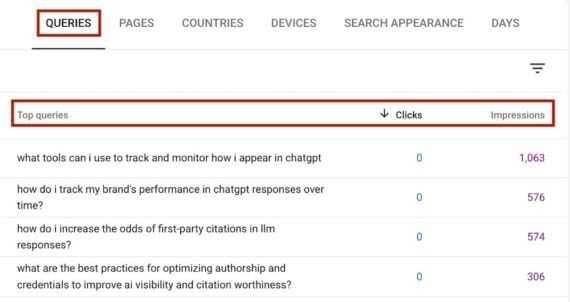
When this regex is applied, Search Console can reveal a list of long, conversational search terms. The accompanying image in the original article (though not directly reproducible here, it’s described) illustrates this by showing queries such as "what tools can I use to track and monitor how I appear in chatgpt." These queries are characterized by their length, their detailed nature, and their focus on specific AI-related functionalities, often resulting in zero clicks despite high impressions, suggesting a non-traditional user journey.
Advanced Regex for Follow-Up Prompts
Recognizing that AI interactions are often iterative, SEO strategist Jean-Christophe Chouinard, an SEO strategist at Tripadvisor, has proposed a more sophisticated regex. This advanced pattern aims to capture not only initial detailed prompts but also the shorter, more conversational follow-up prompts that are characteristic of AI Mode interactions. These follow-up prompts might include simple affirmations or requests for elaboration, such as "yes, please" or "tell me more." The development of such refined regex patterns is an ongoing process, driven by the community’s efforts to adapt to this new data landscape.
The Role of External Tools and API Access
While Search Console’s front-end interface offers powerful filtering options, the Search Console API provides access to even more granular data. For SEO professionals and agencies without in-house development resources, third-party tools offer a bridge to harness this enhanced data. These tools can connect to the Search Console API, providing access to more comprehensive datasets and advanced analytical features that are not available in the standard interface.
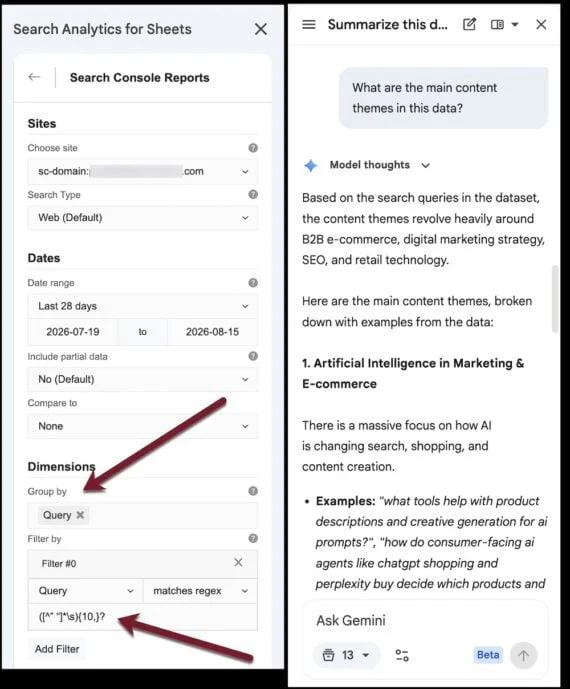
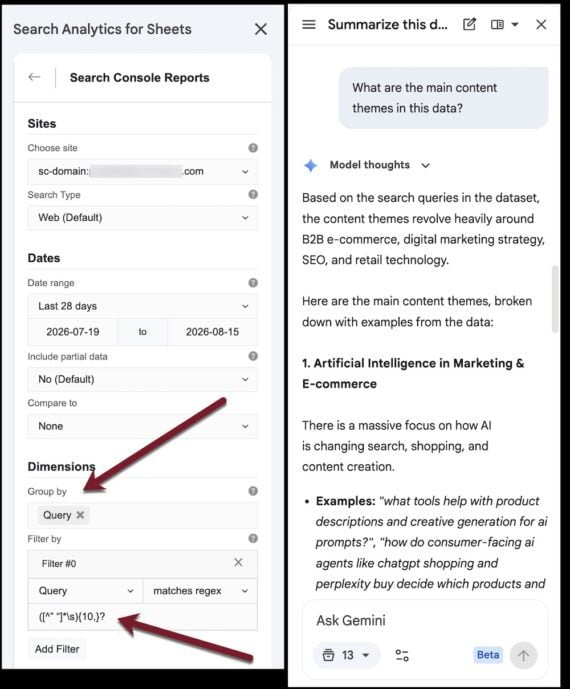
The advantage of these external tools lies in their ability to present complex data in a more accessible format, often with built-in features for filtering, analysis, and export. For instance, tools like "Search Analytics for Sheets" allow users to export their Search Console data directly into Google Sheets, where more advanced manipulation and analysis can be performed. This includes the ability to apply regex filters to identify long queries or other specific patterns indicative of AI prompts.
The image associated with this section (again, described) depicts the sidebar of "Search Analytics for Sheets," illustrating how it can be used to filter Search Console queries by length using regex. Crucially, it also shows a Gemini panel summarizing the resulting query data into content themes. This integration highlights the potential for using AI tools to analyze the output of AI interactions, creating a meta-analysis loop.
A potential downside of using third-party tools is the necessity of sharing confidential Search Console data with external platforms. However, for many, the benefits of enhanced data access, advanced analytical features, and streamlined export capabilities outweigh this concern, especially when utilizing reputable and free tools.
Analyzing and Applying the Data for Optimization
The presence of AI-driven prompts in Search Console data presents a new frontier for SEO optimization. While Search Console doesn’t explicitly label these queries, their linguistic characteristics often provide clear indicators. These prompts are typically characterized by their detail, specificity, and conversational tone, setting them apart from traditional, keyword-focused search queries.
One observation is that some long queries may exhibit a high number of impressions with very few clicks. This phenomenon could be attributed to prompt-tracking software, which might be analyzing content in response to AI queries, rather than direct human interaction. However, even this data is valuable. It can reveal what competitors or AI monitoring tools are interested in, providing insights into emerging trends and areas of focus within the AI landscape.
The core challenge lies in interpreting and applying this data effectively. AI prompts are often unique and do not fit neatly into predefined categories or metrics used for traditional SEO. This necessitates a shift in analytical approaches.
Strategic Implications and Future Outlook
The implications of Google Search Console capturing AI prompts are far-reaching. For SEO professionals, this data provides an unprecedented opportunity to:
- Understand User Intent: By analyzing the detailed language of AI prompts, marketers can gain a deeper understanding of what users are truly looking for when engaging with AI. This can inform content creation, ensuring that it directly addresses the complex questions and nuanced requests being made.
- Optimize for Conversational Search: The rise of AI-driven search necessitates a move towards more conversational and natural language content. Identifying AI prompts allows for the creation of content that directly answers these longer, more descriptive queries.
- Benchmark Against Competitors: The data on AI prompts, even if indirectly gathered through competitor monitoring, can highlight areas where competitors are focusing their AI optimization efforts. This can inform competitive analysis and strategy development.
- Identify Emerging Content Gaps: By observing the types of questions users are posing to AI, businesses can identify new content opportunities and address unmet information needs.
- Refine AI Model Interactions: For platforms and developers, understanding user prompts is crucial for improving the accuracy, relevance, and helpfulness of AI responses. The data from Search Console can serve as valuable feedback for AI model training and fine-tuning.
The evolving nature of generative AI means that the tools and techniques for analyzing its impact will continue to develop. The discovery of AI prompts within Google Search Console represents a significant step forward in demystifying these powerful technologies and integrating them into broader digital marketing strategies. As AI continues to mature and become more deeply embedded in user workflows, the ability to understand and leverage prompt data will become an indispensable skill for navigating the future of online information and interaction. The ongoing efforts to refine regex patterns and explore external tools underscore the proactive approach the SEO community is taking to adapt to this rapidly changing technological landscape. The integration of AI into search is no longer a hypothetical future; it is a present reality, and the data within tools like Google Search Console is becoming a critical resource for understanding its impact.

