
The rapid evolution of artificial intelligence (AI) within advertising platforms, particularly Google Ads, presents both unprecedented opportunities and significant challenges for marketers. While AI’s capacity to refine audience targeting, enhance campaign performance, and unlock new avenues for customer acquisition is widely acknowledged, a critical aspect often overlooked is the strategic imperative of defining what the AI should avoid. This nuanced approach, moving beyond traditional keyword exclusions to encompass intent-driven exclusions, is becoming paramount in an increasingly sophisticated digital advertising landscape.
Historically, advertisers relied on a straightforward mechanism to steer ad delivery: negative keywords and placement exclusions. These tools allowed for the explicit instruction of platforms like Google not to display advertisements in response to specific search queries or on certain websites. For instance, a retailer selling premium, handcrafted leather goods might add "cheap" as a negative keyword to prevent their ads from appearing when a user’s search query included terms like "cheap leather bags." Similarly, a travel agency specializing in luxury vacations could exclude travel blogs that focus on budget backpacking to avoid misaligned ad placements. This method, while effective in its time, operated on a superficial level, directly matching or excluding predefined terms.
However, the sophisticated algorithms powering modern search engines have transcended simple keyword matching. User intent, the underlying motivation behind a search query, has become the driving force behind ad delivery. An advertiser might meticulously build a comprehensive list of negative keywords related to "inexpensive" or "discounted" products. Yet, this approach falls short when faced with the subtle complexities of user intent. A consumer seeking a budget-friendly laptop case might not explicitly use terms like "cheap" or "affordable." Instead, they might search for "laptop cases" with the implicit goal of finding a low-cost option. In such scenarios, a purely keyword-based exclusion strategy would fail to identify and filter out these misaligned searchers, leading to wasted ad spend and suboptimal conversion rates. The challenge, therefore, shifts from telling AI what words to avoid to instructing it who to avoid, based on inferred intent.
The Strategic Role of Text Guidelines and Asset Optimization
To address this evolving landscape, Google Ads has introduced advanced features that empower advertisers to provide more sophisticated guidance to its AI. Among the most impactful are text guidelines and asset optimizations, particularly within Performance Max and AI Max Search campaigns. These features act as crucial guardrails for Google’s AI, which dynamically generates ad copy and determines landing page destinations. By offering these explicit instructions, advertisers can more precisely shape the AI’s understanding of their target audience and, critically, their non-target audience.
Consider an advertiser specializing in high-quality, premium laptop cases. Their product line might be limited to a few meticulously crafted models, designed for discerning consumers willing to invest in durability and aesthetic appeal. In this scenario, the advertiser’s objective is not to attract bargain hunters. By leveraging text guidelines, they can train the AI to prioritize prospects who demonstrate a willingness to spend more for superior quality. This might involve specifying terms or phrases that the AI should associate with their brand, such as "premium materials," "artisanal craftsmanship," or "long-lasting investment." Conversely, and perhaps more importantly, they can instruct the AI to avoid targeting users who exhibit indicators of seeking lower-priced alternatives. This could involve excluding terms like "cheap," "budget," "discount," or even phrases that imply a focus on bulk purchasing or low-cost options.
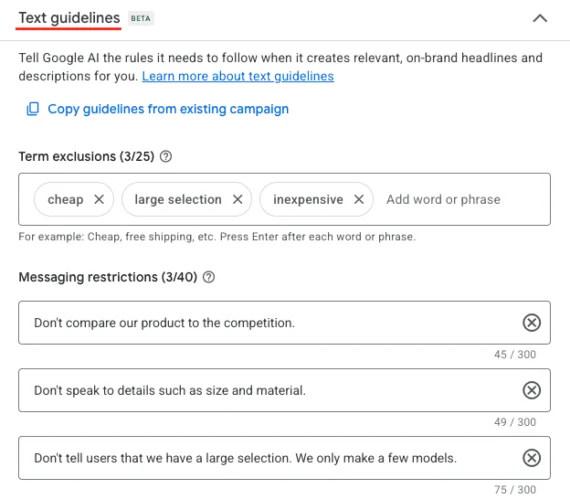
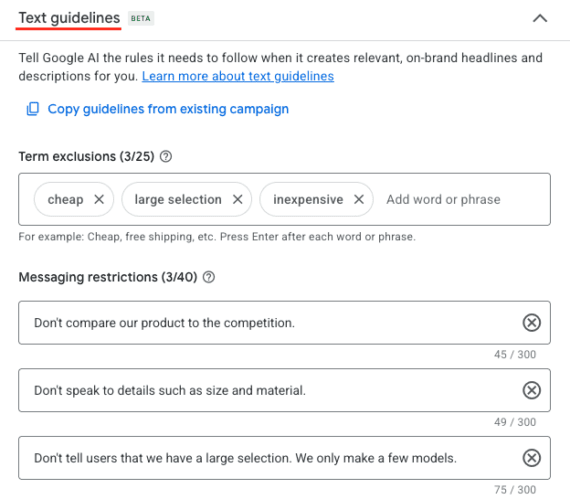
The visual representation of these text guidelines within the Google Ads interface underscores their importance. For example, an advertiser might input exclusions like "cheap," "large selection," and "inexpensive" into the term exclusion settings. Furthermore, they can implement messaging restrictions, such as "Don’t compare our product to the competition," to ensure the AI crafts brand-centric messaging. This granular control allows advertisers to communicate their brand positioning and target customer profile directly to the AI, ensuring that ad campaigns are aligned with overarching business objectives. The implication is a more efficient allocation of advertising budgets, focusing on audiences that are more likely to convert and contribute to higher-value sales.
Asset optimization complements text guidelines by offering further control over ad creation. Within Performance Max campaigns, advertisers can choose to disable automated image and video enhancements, thereby maintaining greater creative control. More significantly, asset optimization facilitates text and URL exclusions within both Performance Max and AI Max campaigns. URL exclusions, for instance, enable advertisers to specify landing pages that the AI should not direct traffic to. This is invaluable for preventing misaligned traffic. An advertiser selling premium merchandise might exclude their "clearance" or "sale" pages from being targeted by their main brand campaigns, ensuring that users searching for general product terms are directed to full-price product pages, not discounted items that might dilute brand perception or lead to lower average order values.
Unlocking Precision with Automated Assets and Account-Level Controls
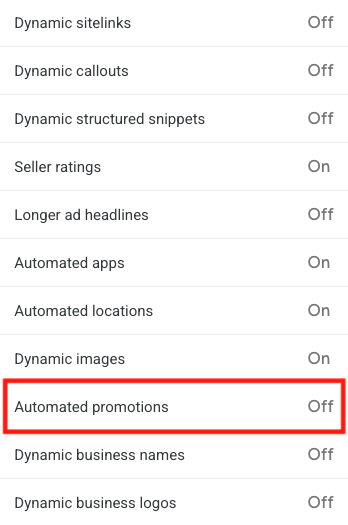
Deep within the Google Ads interface lies a feature with substantial, yet often underestimated, potential: "Account-level automated assets." This functionality, while sometimes difficult to locate, empowers Google’s AI to dynamically populate various components of an ad, including sitelinks, callouts, images, and more. Recent enhancements have seen the introduction of automated promotions, wherein Google can automatically highlight discounted items sourced directly from an advertiser’s website.
The accessibility of these account-level automated assets is typically found within the "Advanced settings" section of an advertiser’s account. Here, users can review the status of various automated asset types, including automated promotions. For instance, an advertiser might find that automated promotions are currently turned off, allowing them to manually control which promotional offers are highlighted. This level of control is critical for maintaining brand consistency and ensuring that automated features align with specific marketing strategies.
The implications of unchecked automated assets can be far-reaching. Google’s AI can, without explicit advertiser intervention, automate the use of an advertiser’s brand name and logos. While this can potentially increase ad visibility, it also carries the risk of inaccurate branding if not carefully managed. If an advertiser’s primary goal is to cultivate a specific brand image, allowing the AI to freely incorporate its own generated assets without oversight could lead to unintended brand dilution or misrepresentation. Therefore, advertisers are strongly advised to regularly review these account-level settings and disable any automated asset functions that do not align with their brand guidelines or campaign objectives.
To ascertain which assets have been added by Google’s AI, advertisers can navigate to the "Assets" section in the left-hand navigation menu and then filter the view by selecting "Added by: Google AI." This transparency allows advertisers to audit the AI’s contributions and make informed decisions about which automated assets to keep active and which to disable. This proactive management is essential for ensuring that AI-driven optimizations enhance, rather than detract from, the advertiser’s strategic goals.
The Double-Edged Sword of Optimized Targeting and Audience Expansion
Beyond ad creation and keyword management, Google Ads offers features designed to broaden campaign reach, such as optimized targeting and audience expansion. In standard Search campaigns, for example, advertisers are often presented with the option to extend their reach to Google Search Partners and the Display Network, in addition to Google Search. Similarly, campaign types like Demand Gen and Video campaigns inherently incorporate optimized targeting and audience expansion functionalities, unless advertisers actively choose to disable them.
These options, at first glance, appear highly beneficial, promising increased visibility and potentially a larger pool of prospective customers. However, they also present a potential pitfall: the risk of diverting advertising budget away from meticulously defined and preferred audiences. Optimized targeting, for instance, allows Google’s AI to identify and target users who are likely to convert, even if they haven’t explicitly searched for the advertiser’s products or services or demonstrated clear intent through their browsing history. While this can uncover new customer segments, it can also lead to the AI pursuing less qualified leads if the AI’s understanding of "likely to convert" is not sufficiently aligned with the advertiser’s definition of a high-value customer.
The recommendation for advertisers in this regard is to exercise caution. It is often advisable to allow campaigns to run for a sufficient period, gathering robust conversion data, before enabling these broader targeting options. This initial data-gathering phase allows the AI to learn from the advertiser’s existing customer base and refine its understanding of who represents a valuable conversion. Once this foundation is established, advertisers can then strategically enable optimized targeting and audience expansion, confident that the AI has a more accurate model to work with. In essence, the principle is to "train the AI first" by providing it with a clear understanding of successful conversions before granting it the autonomy to explore wider audiences.
The visual cues within the Google Ads interface, such as the "Optimized targeting" setting, often highlight the potential benefits, noting that ads might achieve a significant increase in conversions. However, this statistic alone should not dictate the decision to enable the feature. A more prudent approach involves a phased implementation, starting with well-defined targeting and gradually introducing broader options as campaign performance solidifies and the AI’s predictive capabilities become more refined.
Implications for the Future of Digital Advertising
The increasing sophistication of AI in advertising platforms like Google Ads necessitates a parallel evolution in advertiser strategy. The traditional reliance on keyword exclusions is no longer sufficient in an environment where user intent is the primary driver of ad delivery. Instead, advertisers must embrace a more holistic approach, leveraging features such as text guidelines, asset optimization, and careful management of automated assets to sculpt the AI’s understanding of their brand and target audience.
The ability to instruct AI who to avoid, based on inferred intent and strategic objectives, marks a significant maturation in digital advertising. This granular control allows for a more precise allocation of advertising spend, reducing waste and improving the efficiency of campaigns. Furthermore, it empowers advertisers to maintain brand integrity and communicate their unique value propositions effectively, even as automated systems play an increasingly central role in ad creation and delivery.
As Google and other platforms continue to integrate AI into their advertising ecosystems, the importance of advertiser education and strategic implementation will only grow. The future of successful digital advertising lies not in resisting AI, but in understanding its capabilities and limitations, and in actively guiding its application to achieve optimal business outcomes. This includes a continuous process of learning, adapting, and refining strategies to harness the full potential of AI while mitigating its inherent risks. The ability to effectively "train the AI" will likely become a key differentiator for advertisers seeking to thrive in the competitive digital landscape of tomorrow.

