
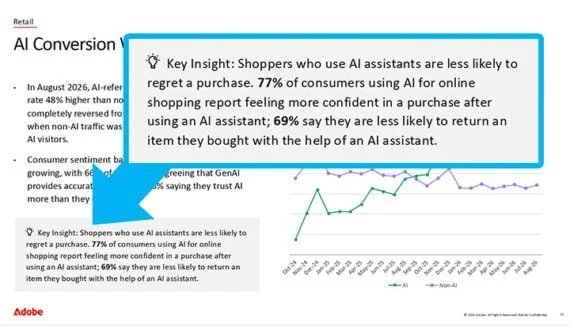
Early indicators from a comprehensive study by Adobe suggest a transformative shift in the e-commerce landscape, with artificial intelligence (AI) playing a pivotal role in drastically lowering product return rates, a persistent and significant cost for online retailers. The findings, embedded within Adobe’s August 2026 "AI Traffic Trends Report," offer a compelling glimpse into a future where AI-assisted shopping not only drives higher conversion rates but also fosters greater consumer confidence and satisfaction, ultimately leading to fewer unwanted items being sent back.
The Adobe report, a deep dive into the digital behavior of online shoppers, draws upon an immense dataset comprising over one trillion visits to U.S. retail websites and an analysis of 100 million Stock Keeping Units (SKUs). This robust data foundation is further bolstered by a July 2026 survey of 5,000 U.S. consumers, providing crucial qualitative insights into their evolving interactions with AI in the shopping journey. While the report spans 59 pages, the implications for product returns, a critical operational challenge, are highlighted in a focused section, underscoring its emerging importance.
The AI Advantage: Informed Consumers, Fewer Returns
The survey data reveals a striking correlation between the use of AI in online shopping and a reduced propensity to return purchased items. A substantial 69% of respondents who had utilized AI tools for their online purchases reported a decreased likelihood of returning an item bought with AI assistance. This figure is particularly significant when juxtaposed with the finding that 77% of these same users felt more confident about their purchase decisions after engaging with an AI shopping assistant. This dual impact – increased confidence and decreased returns – suggests a powerful synergy that could reshape e-commerce profitability.
The underlying mechanism behind this phenomenon appears to be AI’s enhanced ability to inform and guide consumers. Before the widespread integration of AI, shoppers often embarked on lengthy, multi-site expeditions to meticulously compare product features, dimensions, compatibility, read reviews, and scrutinize pricing. This process, while thorough, was also time-consuming and could still leave room for post-purchase disappointment. In 2026, AI assistants are increasingly capable of undertaking much of this rigorous research on behalf of the consumer.
A prime example of this capability is Meta’s Muse, an AI assistant that leverages its own virtual web browsers to explore dozens of e-commerce sites. By the time Muse presents a recommendation, the consumer, through the AI’s research, has often already narrowed down their choices and resolved much of their initial uncertainty. This pre-purchase clarity is instrumental in setting accurate expectations, a key factor in preventing returns.
Driving E-commerce Growth: Conversions and Revenue Per Visit
Beyond the reduction in returns, the Adobe report also illuminates the immediate commercial benefits of AI-referred traffic. In July 2026, Adobe’s data indicated that retail visitors originating from AI platforms demonstrated a remarkable 60% higher conversion rate compared to those arriving from non-AI sources. Furthermore, these AI-referred consumers generated an impressive 53% more revenue per visit. This surge in both conversion and average revenue per visit underscores AI’s potent ability to connect the right products with the right consumers, driving top-line growth for retailers.
This elevated performance can be attributed to the AI’s role as an intelligent intermediary. By processing vast amounts of product information and understanding individual consumer preferences, AI can effectively pre-qualify leads, ensuring that the shoppers reaching a merchant’s website are already well-aligned with the available offerings. This eliminates much of the friction and guesswork often associated with traditional online browsing.
The Crucial Role of Comprehensive Product Information
The success of AI-aided shopping, particularly in its ability to inform consumers and reduce uncertainty, hinges critically on the quality and availability of product information. For e-commerce merchants, this insight transcends the mere generation of AI traffic. It emphasizes the imperative of maintaining meticulously detailed, accurate, and extensive product data. This includes, but is not limited to:
- Specifications and Dimensions: Precise technical details and physical measurements are vital for ensuring product suitability.
- Compatibility Details: Information on how a product interacts with other items or systems is crucial for complex purchases.
- Variants: Clear distinctions between different sizes, colors, materials, and configurations.
- Delivery Estimates: Transparent and accurate timelines for shipping and delivery.
- Reviews and Ratings: Aggregated customer feedback provides social proof and practical insights.
- Frequently Asked Questions (FAQs): Addressing common queries preemptively.
- Comparisons: Tools that allow consumers to easily compare similar products side-by-side.
When AI assistants are equipped with this comprehensive data, they can more effectively assess whether a product genuinely meets a shopper’s specific needs and expectations before making a recommendation. This proactive approach to information dissemination is the bedrock upon which confident purchasing decisions are built, thereby mitigating the likelihood of post-purchase regret.

A Glimpse into the Future of Retail Operations
While it is still early days to definitively quantify the long-term impact of AI-aided shopping on overall e-commerce return rates, the current evidence presents a compelling case for significant reduction. The logic is straightforward: consumers who are better informed and more confident in their purchasing decisions are inherently more likely to keep the items they buy.
The potential benefits extend beyond a reduction in the logistical complexities and financial drain associated with processing returns. Fewer returns can translate into:
- Reduced Operational Costs: Lower expenses related to shipping, inspection, restocking, and potential depreciation of returned goods.
- Improved Inventory Management: More predictable stock levels and reduced need for buffer inventory to account for returns.
- Enhanced Customer Loyalty: A positive shopping experience, characterized by receiving the right product the first time, fosters trust and encourages repeat business.
- Environmental Benefits: A decrease in the carbon footprint associated with transporting returned goods.
Broader Industry Context and Anticipated Responses
The findings from Adobe’s report emerge at a time when the e-commerce industry is intensely focused on leveraging AI to optimize every facet of the customer journey. Major players are investing heavily in AI capabilities, from personalized recommendations and intelligent search to automated customer service and sophisticated logistics.
Industry analysts have long recognized product returns as a significant drain on e-commerce profitability. Estimates have varied, but it is widely understood that returns can account for anywhere from 20% to 40% of online sales, with significant associated costs. The prospect of AI mitigating this challenge is therefore of immense strategic importance.
It is reasonable to anticipate that e-commerce platforms and technology providers will accelerate their development and deployment of AI-powered shopping tools. Merchants who have historically struggled with high return rates may find AI assistance to be a particularly attractive proposition. This could lead to increased demand for AI-driven product information management systems and enhanced integration of AI assistants into existing e-commerce platforms.
Moreover, the trend could foster greater collaboration between AI developers and retailers. As AI tools become more sophisticated, the feedback loop between consumer behavior, AI performance, and product data quality will become even more critical. Retailers may need to invest more in enriching their product data repositories to ensure AI assistants can function at their optimal capacity.
The Evolving Role of AI in Consumer Decision-Making
The Adobe report’s findings underscore a broader shift in how consumers interact with technology during their purchasing journeys. AI is transitioning from a novel feature to an integral component of the decision-making process. For consumers, this means a move towards more efficient, informed, and ultimately, more satisfying shopping experiences.
The implications for the retail sector are profound. Businesses that embrace AI and invest in the foundational elements required for its success – such as high-quality product data – are likely to gain a significant competitive advantage. They will not only benefit from increased sales and revenue but also from the considerable cost savings and improved customer loyalty that a reduction in product returns can bring.
As AI technology continues to mature and its applications in e-commerce expand, the "AI Traffic Trends Report" serves as a crucial early indicator of a seismic shift. The ability of AI to empower consumers with confidence and accuracy, thereby curbing the costly tide of product returns, positions it as a key driver of future e-commerce success. The focus for retailers must now shift to optimizing their product information and integrating AI solutions that can effectively harness this transformative potential.

