
The European Union has finalized the operational framework for its landmark AI Act, establishing a definitive deadline of August 2, 2026, for companies to implement mandatory labeling for artificial intelligence-generated content. This regulation, primarily encapsulated in Article 50 of the Act, represents the world’s most comprehensive effort to date to mitigate the risks of digital deception, deepfakes, and the erosion of public trust in information ecosystems. While initial industry reactions suggested a period of "regulatory panic" regarding potential fines, a closer analysis of the guidelines reveals a targeted approach focused on high-stakes content and public interest, rather than a blanket ban on all AI-assisted creativity. The mandate carries significant extraterritorial weight, affecting any entity worldwide that provides AI systems or deploys AI-generated content accessible to citizens within the EU’s 27 member states.
The Core Mandate: Defining the Scope of Transparency
At the heart of the new guidelines is the principle of "clear and distinguishable" recognition. The European Commission asserts that any person exposed to AI-generated content must be able to recognize it as such immediately. According to Article 50(4) of the AI Act, the labeling requirement is not universal but is strictly enforced across four primary categories. First, deepfakes—defined as manipulated audio, visual, or video content that resembles existing persons, objects, or events and could falsely appear authentic—must be explicitly disclosed. Second, AI systems intended to interact directly with natural persons, such as sophisticated chatbots or digital avatars, must inform the user of their non-human nature.
Third, AI-generated text published with the intent to inform the public on matters of public interest must be labeled. This includes content touching upon health, safety, the environment, fundamental rights, the economy, and political processes. Finally, realistic AI-generated images or audio that depict scenes resembling real-world entities must carry a disclosure. The legal burden of this compliance falls upon both "providers"—those who develop the AI technology—and "deployers"—the organizations that use these tools to generate and publish content. This dual-layered accountability ensures that a company cannot bypass the law simply by licensing a third-party AI tool.

Chronology of Implementation: The Road to 2026
The AI Act’s journey from a legislative proposal to a global compliance standard has followed a meticulous timeline designed to allow industry players to adapt to the new technological reality. The Act officially entered into force on August 1, 2024. However, the European Commission opted for a staggered implementation period to prioritize the most significant risks.
By February 2025, the EU will enforce bans on "prohibited AI practices," which include systems that engage in cognitive behavioral manipulation or untargeted scraping of facial images for biometric recognition. In August 2025, rules concerning General-Purpose AI (GPAI) models, such as Large Language Models (LLMs), will take effect, requiring developers to provide technical documentation and summaries of training data. The August 2, 2026, deadline marks the final major milestone, where the transparency obligations for content labeling and the full suite of requirements for "high-risk" AI systems—those used in critical infrastructure, education, and law enforcement—become legally binding. Organizations failing to meet these deadlines face a tiered penalty structure, with the most severe infractions carrying fines of up to €35 million or 7% of total global annual turnover, whichever is higher.

Beyond the Sparkle: The Evolution of AI Interface Design
For the past several years, the "sparkle" icon (✨) has served as the de facto industry standard for signaling AI-powered features in software interfaces. However, the European Commission’s recent "Code of Practice" suggests that such symbols are likely insufficient under the new legal framework. The primary criticism of the sparkle icon is its ambiguity; it is frequently used to denote "premium" features, "magic" edits, or general "newness," rather than specifically identifying the origin of the content.
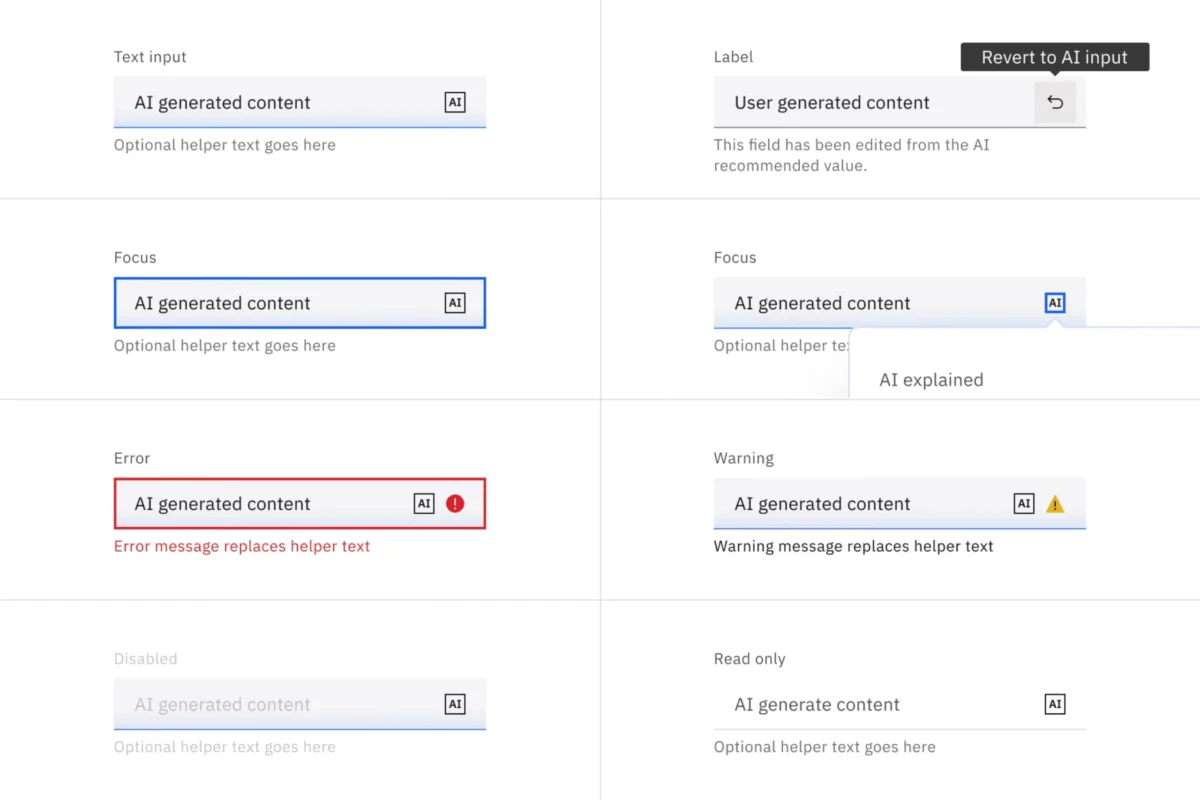
To provide clarity, the Commission has released an official EU AI icon set. This set includes three distinct variants: one for general AI systems, one for fully AI-generated content, and one for content that has been partially modified by AI. These icons are designed to be paired with plain-language labels, such as "AI-generated" or "Synthetically modified," ensuring accessibility for all users, including those utilizing assistive technologies. The guidelines emphasize that a label must not be "hidden in the footer" or "transient." It must persist even when the content is downloaded or reshared on social media platforms, necessitating the use of robust metadata standards like C2PA (Coalition for Content Provenance and Authenticity).

The "Human-in-the-Loop" Exception and Editorial Responsibility
One of the most critical nuances of the EU’s transparency rules is the distinction between AI-assisted work and AI-generated content. The disclosure obligation is waived in scenarios where a human has exercised substantive editorial control. The European Commission clarifies that "assistive" edits—such as grammar correction, spellchecking, basic color grading, or formatting—do not trigger the labeling requirement.
However, the threshold for "substantive" editing is high. A human simply "skimming" an AI-generated article before clicking "publish" does not constitute an editorial review. For content to be exempt, a named individual or entity must take full editorial responsibility for the output, effectively standing behind the veracity and quality of the work as if they had authored it themselves. This creates a clear legal incentive for companies to maintain human oversight in their creative pipelines. In contrast, automated summaries, composite imagery created from prompts, and substantive rewrites where the AI provides the primary creative or factual structure will almost always require a label.

Supporting Data: The Crisis of Trust and Misinformation
The push for these regulations is supported by a growing body of data regarding the impact of synthetic media on public discourse. A 2023 study by the Reuters Institute for the Study of Journalism found that nearly 50% of respondents in major global markets expressed concern about the difficulty of distinguishing between real and AI-generated news. Furthermore, research from the Center for Countering Digital Hate (CCDH) demonstrated that AI image generators could be prompted to create election-related misinformation in 41% of test cases, highlighting the potential for AI to be weaponized during democratic processes.
The EU’s move also addresses the "Dead Internet Theory"—the concern that the web is becoming saturated with low-quality, AI-generated "slop" that displaces human-to-human interaction. By requiring labels, the EU aims to preserve the value of human-created content and provide consumers with the agency to choose their information sources. From an economic perspective, the European Commission estimates that the AI Act will provide a stable legal framework that actually encourages investment by reducing uncertainty, projecting that the EU’s AI market could grow to over €200 billion by 2030.

Official Responses and the "Brussels Effect"
The global tech industry has reacted to the EU mandate with a mixture of cautious cooperation and logistical concern. Major players such as Microsoft, Google, and Meta have already begun integrating watermarking and metadata tools into their generative AI products. For example, Google’s SynthID and Meta’s "Made with AI" labels are early iterations of the transparency the EU is now mandating. However, industry trade groups have raised concerns about the technical difficulty of ensuring labels remain attached to content as it traverses the "open web."
Legal experts often refer to this phenomenon as the "Brussels Effect," where EU regulations become the global default because it is more efficient for multinational corporations to adopt a single, high standard than to manage a fragmented patchwork of regional rules. Similar to the General Data Protection Regulation (GDPR), the AI Act’s transparency rules are expected to influence legislative efforts in the United States, where several states, including California and Texas, have already introduced their own AI disclosure bills targeting deepfakes and political advertising.

Analysis of Broader Implications
The implementation of Article 50 will fundamentally alter the user experience of the internet. As we approach 2026, the digital landscape will likely shift toward a "verified by default" model. For designers and developers, this means moving beyond aesthetic choices to ethical ones. The challenge lies in creating disclosures that are informative without being intrusive—maintaining the "flow" of an application while ensuring legal compliance.
Furthermore, the mandate will likely catalyze the development of new verification technologies. We can expect a surge in "authenticity-as-a-service" platforms that help companies track the provenance of their digital assets. While some critics argue that these rules may stifle innovation or burden small-to-medium enterprises (SMEs) with compliance costs, the long-term benefit is the creation of a "trust layer" for the internet. In an era where "seeing is no longer believing," the EU’s transparency mandate provides the necessary friction to slow the spread of synthetic deception, ensuring that while AI may sparkle, it does not deceive.

Conclusion
The EU AI Act’s transparency obligations represent a maturing of the artificial intelligence industry. By moving away from the "move fast and break things" ethos of the early LLM boom, the regulation establishes a framework where innovation is balanced with the fundamental right to know when one is interacting with a machine. As the August 2, 2026, deadline nears, the global tech community must prioritize the integration of these transparency standards, recognizing that the cost of a label is far lower than the cost of a permanent loss in public trust. This regulation does not signal the end of AI-powered creativity; rather, it marks the beginning of an era of responsible, disclosed, and human-verified digital content.

