
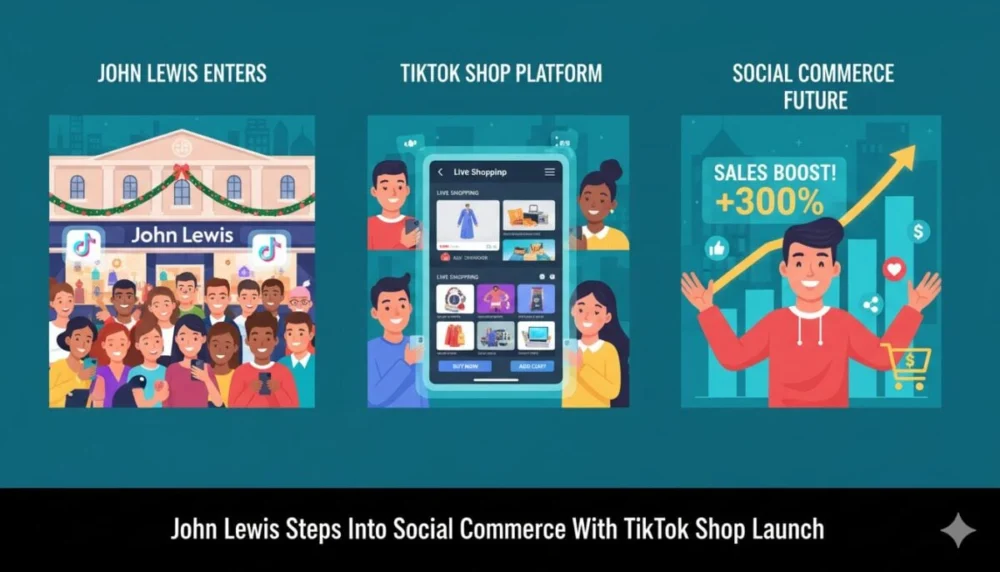
Britain’s venerable department store, John Lewis, renowned for its century-long legacy of trust and quality, is embarking on a significant digital transformation, highlighted by a 90-day pilot store launch on TikTok Shop. This strategic move, part of a broader £800 million multi-year investment, signifies a profound adaptation by a legacy retailer to the rapidly evolving landscape of discovery-driven shopping, artificial intelligence integration, and expedited fulfillment. The initiative positions John Lewis at the forefront of a retail paradigm shift, aiming to meet consumers wherever inspiration strikes, from social media feeds to AI-powered conversational platforms.
The Pivot to Social Commerce: John Lewis on TikTok Shop
In an unprecedented move for the employee-owned retailer, John Lewis has inaugurated a 90-day pilot store on TikTok Shop, enabling customers to browse and purchase products directly within the popular social media application. This venture marks a bold departure from traditional retail models, signaling John Lewis’s commitment to engaging with a new generation of consumers who increasingly discover products through dynamic content, creator endorsements, and algorithm-driven recommendations. The decision to partner with TikTok, a platform known for its short-form video content and burgeoning e-commerce capabilities, underscores a recognition that the shopping journey is no longer confined to physical stores or dedicated e-commerce websites.
The pilot’s timing is strategic, coinciding with the crucial run-up to Mother’s Day in the UK, a period known for high consumer spending on gifts. This focus allows John Lewis to test the waters with high-demand, high-engagement categories. The curated selection for TikTok Shop primarily features beauty and gifting products from premium brands such as Jo Malone London, Augustinus Bader, and Estée Lauder. Notably, the final release of the retailer’s highly popular Mother’s Day Beauty Box, a limited-edition bundle that typically sells out swiftly during seasonal promotions, is a prominent offering on the platform.
TikTok Shop’s Ascendance: A New Retail Frontier
The embrace of TikTok Shop by a retailer of John Lewis’s stature is a powerful testament to the platform’s meteoric rise as a viable commerce channel. Once primarily perceived as a marketing tool, TikTok has rapidly evolved into a full-fledged shopping destination. Recent data from the Influencer Marketing Hub’s TikTok Marketing Report reveals that 51.9% of marketing teams now actively sell through TikTok Shop, highlighting its rapid mainstream adoption. Globally, social commerce is projected to reach trillions of dollars in market value within the next few years, driven by platforms like TikTok, Instagram, and Facebook, which are blurring the lines between entertainment, community, and purchasing.
This shift is particularly resonant with younger demographics, notably Gen Z and younger millennials, who spend significant amounts of time on social media. For these consumers, product discovery is an organic process, often initiated by seeing an item featured by an influencer, a friend, or an algorithm that understands their preferences. By integrating directly into this ecosystem, John Lewis is not just advertising; it is creating a direct transactional path within the discovery environment, significantly reducing friction in the customer journey. The beauty sector, with its inherent suitability for visual demonstrations, tutorials, and influencer-led content, has proven to be a particularly effective entry point for brands exploring social commerce, making John Lewis’s initial product selection a logical and strategic choice.
A Multi-Year Digital Overhaul: The £800 Million Transformation
The TikTok Shop pilot is not an isolated experiment but an integral component of John Lewis’s ambitious £800 million multi-year transformation program. This comprehensive strategy is designed to modernize the retailer’s operations and enhance its customer engagement across all touchpoints. A central pillar of this transformation is the expansion of product discovery channels beyond John Lewis’s traditional website and physical stores, recognizing that consumers’ pathways to purchase are increasingly fragmented and diverse.
To facilitate this expansive digital strategy, John Lewis has extended its partnership with commercetools, an AI-first digital commerce platform. This collaboration aims to provide the technological backbone necessary to ensure that John Lewis products can be seamlessly discovered and purchased wherever consumers seek inspiration. This includes not only social media applications but also emerging platforms such as AI assistants and a variety of third-party marketplaces. The underlying philosophy is to create an ‘anywhere commerce’ ecosystem, making John Lewis’s extensive product catalog accessible and transactional across a multitude of digital environments.
Embracing Artificial Intelligence for Enhanced Discovery
Parallel to its foray into social commerce, John Lewis is making substantial investments in AI-powered shopping experiences. The retailer’s plans include making its product catalog discoverable through leading AI platforms like ChatGPT and Google Gemini. This forward-thinking approach anticipates a future where consumers increasingly turn to conversational AI tools for product recommendations, gift ideas, and personalized shopping assistance.
According to Dom McBrien, Chief Digital and Omnichannel Officer at John Lewis, this strategy directly addresses evolving consumer behavior. He noted that customers are already leveraging AI-powered applications to find products they like, and the next logical step is to enable direct purchases within these AI environments, thereby streamlining the shopping journey. Over time, the goal is to reduce the friction between inspiration and transaction, allowing a customer asking an AI for "sustainable home decor ideas" or "a unique birthday gift for a friend" to not only receive John Lewis suggestions but also complete the purchase without leaving the AI interface. This move signifies a proactive stance in an era where AI is rapidly becoming a pivotal interface for information retrieval and decision-making, including retail choices.
The Urgency of Speed: Expanding into On-Demand Delivery
Beyond digital discovery, John Lewis is also addressing the growing consumer demand for immediacy in product fulfillment. Later this month, the retailer will significantly expand its presence in the on-demand retail sector through an enhanced partnership with Uber Eats. This collaboration will enable customers in specific delivery catchment areas near John Lewis stores in Stratford, Kingston, Cambridge, and Liverpool to order from a selection of approximately 3,000 products. This curated range spans home goods, beauty items, and technology, with deliveries expected to arrive within a remarkably swift 45 minutes.
This expansion builds upon a successful smaller trial conducted last year, demonstrating John Lewis’s commitment to adapting its logistics to meet modern customer expectations for rapid delivery, particularly in urban environments. The quick commerce market has seen explosive growth, driven by changing lifestyles and the convenience economy. For a brand like John Lewis, known for its considered purchases and quality service, offering express delivery on a broad range of items represents a significant evolution in its service model, bringing it into direct competition with specialized quick commerce platforms and supermarket delivery services.
Strategic Imperatives for Legacy Retailers: A Broader Industry Signal
John Lewis’s multi-pronged digital strategy—encompassing social commerce, AI integration, and on-demand delivery—sends a powerful signal across the entire retail industry. For heritage brands, in particular, these initiatives underscore the imperative to innovate and adapt rapidly to avoid obsolescence. The traditional retail model, centered around physical stores and brand-controlled websites, is increasingly being challenged by an ecosystem where product discovery is decentralized and highly personalized.
The blurring lines between content and commerce mean that retailers must now view every platform where consumers spend their time as a potential storefront. This requires a sophisticated omnichannel strategy that goes beyond merely having an online presence, demanding deep integration into third-party platforms and a seamless customer experience across all channels. John Lewis’s moves demonstrate a strategic understanding that relevance in the modern retail landscape hinges on being present and transactional in the places where consumers are most engaged, whether that’s scrolling through TikTok, interacting with an AI assistant, or seeking instant gratification through rapid delivery services.
For John Lewis, these initiatives represent a bold reassertion of its competitive position. By actively engaging with younger demographics on platforms like TikTok and anticipating future shopping behaviors through AI, the retailer aims to maintain its trusted status while simultaneously cultivating new customer bases. The inherent challenges for a large, established organization include integrating complex technologies, managing cultural shifts within the workforce, and balancing brand consistency across diverse new channels. However, the potential rewards—increased market share, enhanced brand relevance, and a future-proofed business model—are significant.
The Future of Retail: Seamless Discovery and Transaction
The actions taken by John Lewis offer a glimpse into the future of retail, where the shopping journey is characterized by unprecedented seamlessness and personalization. The era of passive browsing is giving way to active, discovery-driven purchasing, often triggered by highly personalized content or recommendations. Retailers that succeed in this environment will be those capable of reducing the friction between inspiration and transaction to near zero.
As platforms like TikTok continue to innovate, integrating more sophisticated shopping features and leveraging advanced algorithms, the line between entertainment and commerce will become virtually indistinguishable. Similarly, as AI platforms become more conversational and capable, they will evolve from simple recommendation engines into full-fledged personal shoppers and transaction facilitators. John Lewis’s strategy is a blueprint for how legacy brands can navigate this complex, rapidly changing landscape, demonstrating that with strategic vision and significant investment, even the most established retailers can reinvent themselves for the digital age, ensuring their products are not just seen, but bought, at the exact moment inspiration strikes.

