
The evolving landscape of digital marketing demands a fundamental shift in how brands approach creator partnerships. Instead of viewing influencers as ephemeral ad placements, industry leaders are advocating for a strategy akin to hiring long-term team members. This approach emphasizes deep vetting, cultural alignment, and a focus on measurable, sustained impact rather than transient reach, challenging the conventional wisdom that often prioritizes sheer follower count above all else. An ad disappears the moment it scrolls past; a strategically chosen creator partnership leaves behind enduring value that outlasts the campaign’s immediate run.
The Paradigm Shift: From Fleeting Ads to Lasting Partnerships
For too long, brands have treated creator collaborations as transactional media buys, selecting partners based on superficial metrics like follower numbers and expecting immediate, short-lived boosts. This strategy often leads to disillusionment, with traffic fading and brand perception feeling "off" just months after a campaign concludes. The core issue lies in a misaligned understanding of what a creator truly offers. Unlike traditional advertisements, which are inherently temporary, a creator brings an established audience, a unique voice, and the potential to build a long-term narrative around a brand.
A creator partnership, when nurtured correctly, yields two invaluable assets that extend far beyond the initial campaign: sustained engagement and an enduring search footprint. These elements contribute to a brand’s equity over time, fostering genuine connections and providing evergreen content that continues to attract and convert. This contrasts sharply with the ephemeral nature of paid advertisements, which vanish once the budget is exhausted, leaving no residual value.
Deconstructing the Vanity Metric: Beyond Follower Count
The obsession with follower count remains a pervasive, yet fundamentally flawed, metric in creator selection. A million followers who never engage or convert represent nothing more than a distraction. As Emulent, a prominent digital marketing firm, has argued concerning search engine optimization, achieving a #1 ranking is a vanity metric if it fails to drive conversions. The true measure of success lies in observable audience behavior.
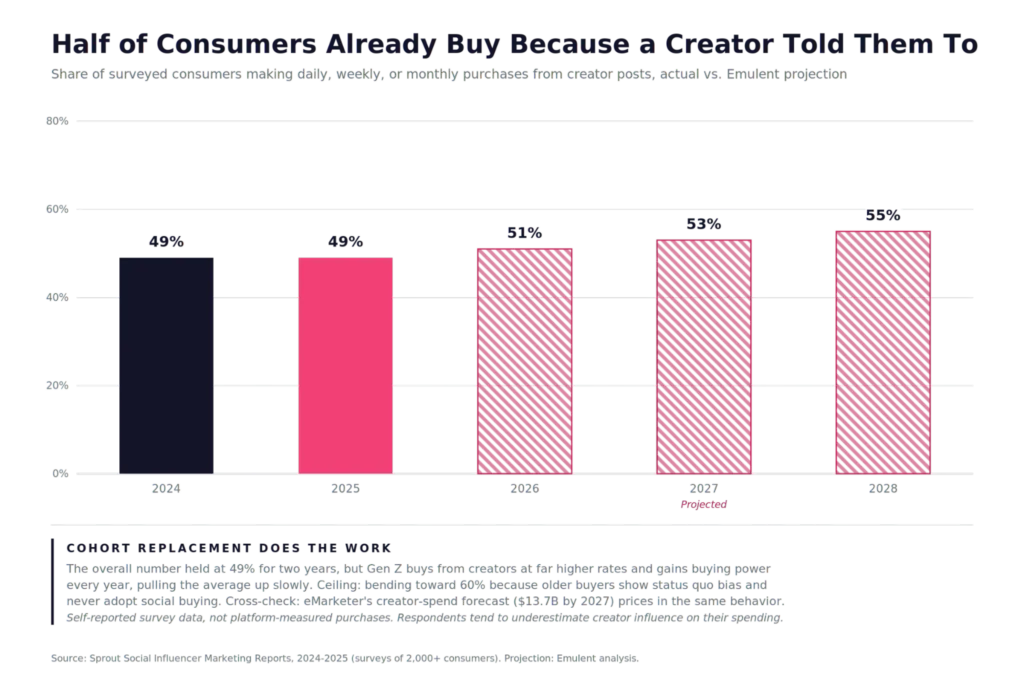
Recent research underscores this point. The Sprout Social 2025 Influencer Marketing Report revealed that nearly half of surveyed consumers make regular purchases directly influenced by creator posts. This statistic highlights the immense purchasing power wielded by creators, but it also implies that not all followers are created equal. Brands must move beyond the superficial appeal of large numbers and delve into the qualitative aspects of an audience.
Effective creator selection, therefore, should never begin with reach. Instead, the initial screening process must prioritize concrete evidence of audience action. Key signals to look for include:
- High engagement rates: This includes likes, comments, shares, and saves, indicating an active and receptive audience.
- Authentic interactions: Comments that are thoughtful and specific, rather than generic or bot-generated, suggest a genuine community.
- Consistent content performance: A history of posts that consistently resonate with their audience, irrespective of follower growth spurts.
- Clear calls to action (CTAs) and conversion metrics: Evidence that the creator successfully prompts their audience to take specific actions, such as visiting a link, signing up, or making a purchase.
- Audience demographics alignment: Ensuring the creator’s audience matches the brand’s target demographic, preventing wasted impressions on irrelevant users.
These actionable signals require no specialized tools beyond careful observation and analysis, yet they offer a far more accurate gauge of a creator’s potential impact than any simple follower tier chart could provide. Ignoring these indicators is akin to investing in a billboard in the desert—visible, but ultimately ineffective.
The Enduring Value of a Creator’s Search Footprint
In an increasingly AI-driven digital landscape, the content creators produce transcends social media platforms to become a critical search asset. The platforms where creators publish their content are now primary sources for search engines and AI tools in generating answers. A groundbreaking Semrush June 2025 study, analyzing over 150,000 AI citations across 5,000 keywords, found that community and creator platforms, notably Reddit and YouTube, were cited more frequently than Google’s own traditional search results.
This seismic shift has profound implications for brand strategy. A creator who publishes content that search engines can index, such as long-form YouTube videos, blog posts, or detailed reviews on community forums, generates an evergreen asset that continues to sell for the brand long after the initial invoice is settled. Conversely, a creator whose work is confined to ephemeral formats like disappearing Stories provides immediate but ultimately fleeting value, leaving no lasting trace in the digital knowledge base.
The "answer page" or AI Overview, which aggregates information from various sources, is rapidly expanding its influence. Semrush’s AI Overviews study of over 10 million keywords tracked the surge in Google searches triggering an AI Overview, charting its growth and projected trajectory through 2028. This data reveals a consistent "sawtooth" growth pattern, indicating that AI-generated summaries are becoming an increasingly prevalent entry point for users seeking information. If this AI Overview becomes the primary interface where buyers cease their search, the creators a brand partners with will directly determine whether their products or services appear in those critical answers.
Brands must proactively screen influencers for their potential search footprint. This involves:
- Analyzing their content formats: Prioritizing creators who produce indexable content (videos, blogs, long-form posts) over those focused solely on short-lived stories or disappearing content.
- Reviewing their presence on community platforms: Assessing their activity and influence on platforms like Reddit, Quora, or niche forums where valuable discussions and recommendations occur.
- Evaluating their keyword relevance: Checking if their content naturally aligns with keywords relevant to the brand’s products or industry, enhancing discoverability.
- Assessing content quality and depth: High-quality, informative content is more likely to be cited by AI and rank well in traditional search.
- Checking for existing organic visibility: Does the creator already rank for relevant terms or have content that appears in search results? This indicates a strong foundation.
Market Dynamics and Lagging Standards
The growth trajectory of influencer and affiliate marketing is nothing short of explosive. US influencer marketing spending nearly tripled between 2021 and 2025, with eMarketer’s March 2026 forecast projecting sustained growth through 2027. This burgeoning market reflects a significant shift in consumer trust and attention away from traditional advertising channels.
Even more striking is the rapid expansion of the affiliate marketing sector. eMarketer’s September 2025 forecast anticipated that this channel would drive billions of dollars in US e-commerce sales in 2026, having already surpassed $10 billion in spend for the first time in 2024. This robust growth across both influencer and affiliate channels underscores their undeniable power in driving consumer behavior and sales.
Despite these staggering projections and the channels’ proven effectiveness, a significant number of brands continue to rely on outdated, superficial methods for selecting their partners. This disconnect between market potential and strategic execution represents a missed opportunity. Brands that are truly winning in these spaces understand that creator selection is not a mere transaction but an investment in partnership marketing—a lasting relationship designed to generate compounding search value and authentic brand advocacy, rather than a fleeting media buy with a recognizable face.
Cultivating Authenticity: The Imperative of Culture Fit
Beyond metrics and search visibility, the importance of culture fit cannot be overstated. Creators, particularly in the digital age, wield significant influence as information sources. The Pew Research Center’s News Influencers Fact Sheet highlights the substantial weight consumers now place on creators as trusted conduits of information and opinion. In this environment, a misaligned creator can inflict considerable damage on a brand’s reputation and authenticity.
Historically, magazines imposed strict editorial standards to ensure that advertisements aligned with the content and values of their publication. This level of rigorous vetting is often absent in modern affiliate and creator marketing. Whatever screening occurs typically falls to the individual brand, often without a comprehensive governance plan to guide the process. This absence of a clear framework exposes brands to unnecessary risk and diluted messaging.
A true "culture fit" is not merely about a "vibe" or subjective feeling; it is a rigorous screening process rooted in a brand’s core purpose and vision. If a company cannot articulate what it stands for, it inherently lacks the framework to effectively vet potential partners against those values. Once the brand’s purpose is clear, culture screening transitions from intuition to document review and demonstrable alignment:
- Reviewing past content for tone and consistency: Does the creator’s historical content align with the brand’s voice, values, and target audience? Are there any past controversies or statements that could reflect poorly on the brand?
- Assessing engagement with their audience: Do they foster a positive, respectful community? Or do they engage in divisive or inappropriate discussions?
- Examining their personal brand and values: Do their publicly expressed values resonate with the brand’s ethical stance and social responsibility?
- Verifying authenticity of product experience: Has the creator genuinely used or expressed interest in the product/service? A creator who has personally experienced and can authentically describe a product for a month will always outperform a bigger name merely reading talking points, both in terms of conversion and risk mitigation.
- Checking for brand safety flags: Utilizing tools to identify potential risks such as controversial content, inappropriate language, or associations with harmful ideologies.
The most effective culture filter is one that possesses the courage to reject a high-performing creator whose public persona or past actions would be deemed unacceptable from an internal employee. This stringent approach safeguards brand integrity and ensures that partnerships amplify, rather than compromise, core values.
The Vetting Audit Any Brand Can Run This Week
To ensure robust creator selection and mitigate risks, brands should implement a comprehensive vetting audit for every potential candidate. This structured process moves beyond surface-level metrics to assess deeper compatibility and long-term potential:
- Analyze audience demographics: Go beyond follower count. Do their followers align precisely with your target demographic in terms of age, gender, location, interests, and purchasing power? Use audience insight tools where available.
- Evaluate engagement rates: Calculate the average engagement rate (likes + comments + shares / followers) across their recent posts. Compare this to industry benchmarks. Look for consistent engagement, not just spikes.
- Assess comment quality and authenticity: Read through comments on multiple posts. Are they genuine, thoughtful, and relevant? Or are they generic, repetitive, or indicative of bot activity?
- Review past sponsored content: Examine how they integrated previous brand partnerships. Was it authentic and seamless, or did it feel forced and overtly promotional? Did they disclose sponsorships appropriately?
- Scrutinize brand safety and reputation: Conduct thorough background checks. Search for any past controversies, offensive content, or negative associations that could tarnish your brand’s image. Use social listening tools.
- Verify content quality and production value: Does their content meet professional standards? Is it well-produced, visually appealing, and reflective of a high-quality aesthetic?
- Check for content diversity and evergreen potential: Do they produce a variety of content types? Is there evidence of long-form, indexable content (e.g., YouTube videos, blog posts) that could contribute to your brand’s search footprint?
- Evaluate consistency of posting schedule: A consistent schedule indicates dedication and reliability, ensuring regular exposure for your brand.
- Look for genuine product affinity/experience: Ideally, the creator should already be a user or fan of your product/service, or at least express a genuine interest in it. This ensures authenticity.
- Assess communication style and professionalism: Gauge their responsiveness, clarity, and overall professionalism in initial interactions. This is indicative of a reliable partner.
- Demand transparency and disclosure adherence: Ensure they understand and commit to all regulatory disclosure requirements for sponsored content (e.g., FTC guidelines).
- Request case studies or performance data (if available): For larger creators, ask for previous campaign performance data to validate their claimed impact and conversion capabilities.
Integrating brand partners who successfully pass these rigorous criteria into an overarching "brand everywhere optimization" plan is crucial. This ensures that their content, along with your website, customer reviews, and social presence, narrates one cohesive, powerful story. Brands that adopt this strategic, holistic approach are the ones that continue to reap the rewards—collecting rankings, valuable backlinks, and crucial AI citations from campaigns that may have concluded months or even a year ago, proving the enduring power of genuine partnership.

