
The global technology sector is currently navigating a significant divergence between corporate strategy and consumer behavior regarding the integration of Artificial Intelligence (AI). While Silicon Valley and major enterprise software providers have pivoted toward an "AI-first" philosophy, recent market data and user experience (UX) research suggest a growing "adoption gap." Many companies operate under the silent assumption that the public craves a constant influx of new AI features, yet evidence indicates that the current implementation of these tools often creates more friction than efficiency. As organizations invest billions into generative AI infrastructure, they are discovering that "powered by AI" is no longer a self-sustaining value proposition, leading to a critical re-evaluation of how technology should serve the human workforce.
The Evolution of the Generative AI Integration Strategy
The current trajectory of AI integration began in earnest in late 2022 with the public release of large language models (LLMs) that demonstrated unprecedented capabilities in natural language processing. This sparked a "gold rush" among software developers to integrate generative features into existing platforms. Throughout 2023 and into 2024, the industry moved through several distinct phases:
- The Novelty Phase (Late 2022 – Early 2023): Initial excitement led to a surge in experimentation. Users explored AI for creative tasks, such as generating art or drafting unconventional text.
- The "Bolt-On" Phase (Mid 2023 – Early 2024): Legacy software companies rushed to add AI sidebars and "Copilot" features to their suites. These were often developed as separate layers on top of existing interfaces rather than being deeply integrated into the core architecture.
- The Realization Phase (Mid 2024 – Present): Organizations began reporting low retention rates for AI features. Users found that while the tools could perform tasks quickly, the time required to verify the output and the disruption to established workflows often negated the productivity gains.
Analyzing the AI Productivity Paradox
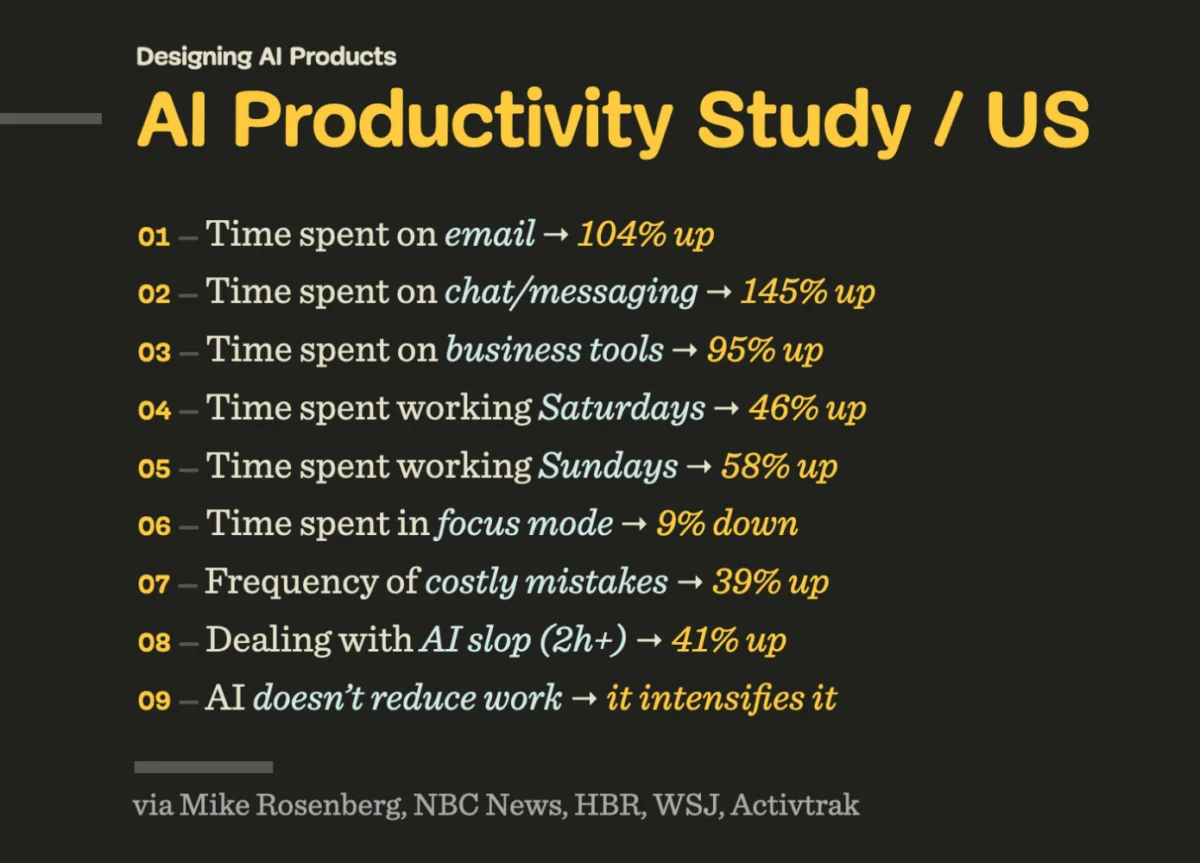
Despite the promise of increased efficiency, recent data from sources including NBC News, Harvard Business Review, and the Wall Street Journal suggests that the current state of AI implementation has resulted in an "intensification" of work rather than a reduction. A comprehensive study on AI productivity in the United States highlighted several alarming trends that explain the current user resistance.
According to the study, the introduction of AI tools has correlated with a 104% increase in time spent on email and a 145% increase in time spent on chat and messaging platforms. Rather than automating communication, AI has facilitated a higher volume of messages that require human oversight. Furthermore, the use of business tools increased by 95%, while "focus mode"—the time employees spend on deep, uninterrupted work—dropped by 9%.
The data also points to a rise in labor during non-traditional hours. Work performed on Saturdays rose by 46%, and Sunday labor increased by 58%. Perhaps most critically, the study found that costly mistakes increased by 39% when users relied on AI-generated content without sufficient vetting, and the time spent dealing with "AI slop"—low-quality or irrelevant automated output—rose by 41%. These statistics indicate that while AI can generate content in seconds, it often imposes a "verification tax" on the user that is both mentally exhausting and time-consuming.

The Failure of AI as a Value Proposition
In the field of business model design, a "value proposition" is the specific benefit a product provides to its customer. Experts in user experience, including the NN Group, have argued that AI itself is not a value proposition; it is a technology that supports a value proposition. When senior leadership teams demand "AI features" without identifying a specific problem to solve, the resulting tools often fail to resonate with the target audience.
One of the primary reasons for low adoption is that AI features frequently take people out of their regular way of working. In a typical modern office environment, employees already navigate a fragmented landscape of disconnected systems. Adding a separate AI interface creates yet another "silo" that requires users to hop between screens. This fragmentation is compounded by the fact that AI is often unpredictable. Unlike traditional software, where a specific input consistently leads to a specific output, AI responses can vary, forcing users to approach the software with a constant state of skepticism rather than trust.
Furthermore, AI has a tendency to amplify existing organizational shortcomings. If a company suffers from poor data quality, broken internal culture, or conflicting priorities, an AI tool will often reflect these inconsistencies back to the user. Instead of fixing technical debt or "quick patches" accumulated over years, AI makes these issues more visible, often handing the "mess" directly to the end-user to resolve.

The Workforce Perspective: Anxiety and Resistance
The push for AI adoption has also encountered significant psychological barriers. For many employees, AI was not a tool they chose to explore but an "uninvited guest" imposed by management. This top-down implementation, combined with widespread media narratives about AI-driven job displacement, has fostered a culture of anxiety rather than excitement.
A study featured in The Washington Post, utilizing data from GovAI and the Brookings Institution, mapped jobs most vulnerable to AI automation. Roles in software development, public relations, and administrative support were found to be highly exposed, while manual labor and emergency services remained relatively insulated. For those in "exposed" industries, the arrival of AI features is often perceived as a threat to their professional identity and job security.
Users have expressed a desire to protect the rewarding, creative parts of their jobs—the tasks that require human taste, intuition, and a specific point of view. When AI attempts to automate these "human" elements—such as writing a personal letter or making a creative decision—it is often met with visceral resistance. As Bo Young Lee, a prominent voice in the industry, noted, people generally do not want AI to replace human-centric experiences like reading books by human authors or engaging with human-made art. Instead, they want AI to handle the "physical and mental labor" that is taxing and mundane.

Shifting Toward an "AI-Second" Integration Model
The path forward for technology companies involves a shift from "AI-first" to "AI-second" design. This philosophy prioritizes the user’s existing mental models and workflows, placing AI in a supportive, background role rather than at the forefront of the experience.
Key characteristics of successful AI integration include:
- Deep Integration: Moving away from sidebars and chat boxes toward features that work within the tools users are already using.
- Predictability and Reliability: Ensuring that the AI performs specific, repetitive tasks consistently so that users can build trust in the system.
- Mundane Automation: Focusing on "boring" tasks that offer no creative reward, such as filing expense reports, sorting data, or scheduling meetings.
- Augmentation, Not Replacement: Designing tools that help humans do their jobs better and faster without attempting to replicate the creative or emotional core of the work.
When AI is used to automate tedious and mentally exhausting tasks, its value becomes immediately apparent to the user. In this context, it does not matter if the feature is branded as "AI" or simply "smart automation." The goal is to provide a tool that works flawlessly and predictably, allowing the user more time to focus on the aspects of their life and work that they truly enjoy.

Broader Implications for the Tech Industry
The current resistance to AI features serves as a vital signal for the technology industry. The high cost of delivering AI—both in terms of server infrastructure and the potential for reputational damage when systems fail—means that companies cannot afford to build features that no one uses.
As the industry matures, the focus is likely to shift from the quantity of AI features to the quality of their integration. This will require a renewed emphasis on UX design and human-centric engineering. Organizations that succeed will be those that recognize that people do not necessarily want "more AI" in their lives; they want more time, more headspace, and more opportunities to connect with other humans.
In conclusion, the "AI adoption gap" is not necessarily a rejection of the technology itself, but a critique of how it has been delivered. By refocusing on the actual needs of users—predictability, reliability, and the automation of mundane tasks—the tech industry can move past the current era of "AI fatigue" toward a future where technology truly augments human potential without demanding that humans change themselves to accommodate the machine.

