

The e-commerce landscape is currently experiencing a significant cultural shift, characterized by a burgeoning adoption of artificial intelligence (AI) and automation technologies. This embrace is not merely about integrating new tools; it is fostering an environment that actively encourages experimentation and proactive problem-solving among employees. The consequence of this cultural evolution is a renaissance of do-it-yourself (DIY) projects, echoing the spirit of innovation that defined the early days of e-commerce. This "test-and-see" attitude is proving to be a powerful catalyst for unlocking new efficiencies and competitive advantages.
The AI-Driven Workplace: A Growing Trend
The pervasive influence of AI on the modern workplace is no longer a hypothetical future; it is a present reality backed by robust data and widespread industry sentiment. Myriad surveys and reports consistently underscore this emerging DIY shift, highlighting a growing consensus among business leaders and employees alike.
A pivotal study released in 2025 by LinkedIn, titled the "Work Change Report," provided compelling evidence of this trend. The report surveyed C-suite executives and revealed that a significant 80% believe the adoption of AI is not only important but also a crucial driver for cultivating a more innovative workplace culture. This sentiment is mirrored by the frontline workforce. In December 2025, Gartner, a leading research and advisory firm, published findings from a comprehensive HR survey indicating that an impressive 65% of employees expressed excitement about the prospect of utilizing AI in their daily work. These figures collectively paint a clear picture: a substantial majority of business leaders and employees recognize the transformative potential of AI and are eager to integrate it into their professional lives.
This widespread enthusiasm and strategic imperative suggest a convergence of three critical priorities for businesses: the pursuit of enhanced operational efficiency, the imperative to foster continuous innovation, and the need to empower employees with cutting-edge tools. This convergence is creating fertile ground for the resurgence of DIY problem-solving, amplified by the capabilities of modern AI and automation platforms. The integration of these technologies is democratizing innovation, allowing individuals with diverse skill sets to contribute to solutions that were once the exclusive domain of specialized IT departments.

Old Tools, New Tricks: The Resurgence of DIY Problem-Solving
The contemporary wave of DIY innovation in e-commerce is strikingly reminiscent of earlier technological advancements, albeit with significantly more powerful tools at its disposal. Consider the case of a mid-sized e-commerce business located in the northwestern United States. In a deliberate effort to foster an AI-driven culture, this company took the proactive step of providing nearly every employee with premium access to leading AI platforms, including OpenAI and Gemini, alongside the robust workflow automation platform, n8n.
The company’s management actively encouraged its staff to leverage these tools to identify and tackle operational challenges. Upon reviewing the initiatives undertaken by the employees, a particularly insightful example emerged: a team developed a straightforward, n8n-powered tool designed to meticulously monitor competitor pricing. This project, while seemingly basic, exemplifies the core principles of the emerging DIY culture. The tool was configured to systematically gather pricing data from competitors, then utilize an AI agent to analyze this information against the company’s own product database. The aggregated results were then compiled into a Google Sheet on a weekly basis. This automated weekly update fed into a pivot table, which a marketing team member then used to identify significant price changes and market shifts.
This practical application bears a striking resemblance to a foundational article published in 2015, titled "Monitor Competitor Prices with Python and Scrapy." That earlier piece detailed a simplified price-checking mechanism developed for a regional retailer. While less sophisticated and functional than the current AI-enhanced solution, it nonetheless represented a functional problem-solver, demonstrating the enduring appeal of self-directed technological solutions. The current iteration, however, benefits from the advanced capabilities of AI and accessible automation platforms, dramatically lowering the barrier to entry and increasing the potential for impactful outcomes.
The Power of Automation: Simplified Solutions for Complex Problems
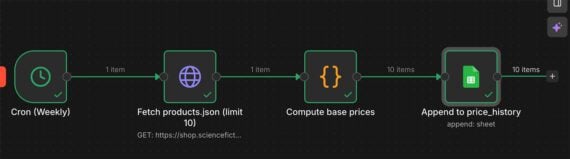
The modern iteration of the competitor price monitoring workflow, exemplified by the n8n solution, can be distilled into a remarkably streamlined process, often requiring no more than four key steps. This simplification is a testament to the power of contemporary automation tools and the intuitive nature of AI-assisted development.
The workflow typically begins with a scheduled trigger, such as a weekly cron job, ensuring the automated execution of the task at predetermined intervals. The subsequent step involves fetching essential data, which in this case might be a product catalog or pricing information, often accessed via an API or a downloaded file. Once the data is acquired, the workflow proceeds to process and compute relevant metrics, such as calculating base prices or identifying discrepancies. The final, crucial step is to append these processed results to a designated data repository, such as a Google Sheet, creating a historical record for analysis.

The true revolutionary aspect of this trend, however, lies in the fact that merchants may not even need to manually assemble these workflows. Generative AI tools are now capable of producing n8n-importable JSON files from simple, natural language prompts. This means an employee can describe the desired automation in plain English, and the AI can generate the underlying code or configuration necessary to build the workflow. This capability dramatically democratizes automation, empowering individuals without deep technical expertise to create sophisticated solutions.
Fostering a Culture of Empowerment and Innovation
The significance of the competitor price monitoring example extends far beyond the technical intricacies of the workflow itself. Its true value lies in the proactive and empowering attitude it cultivates within an organization. The fact that a member of the marketing team, possessing minimal programming background, was able to conceive, build, and implement a problem-solving automation solution is a powerful indicator of this cultural shift.
While it is plausible that a dedicated developer might later refine the workflow or optimize the underlying code for greater efficiency or scalability, the fundamental achievement remains the same: the reduction of the friction that often exists between operational challenges and their practical solutions. This DIY attitude, which was the bedrock of early e-commerce entrepreneurship, is being revitalized and amplified by the accessibility and power of AI and automation tools.
By embracing an "automate-first" culture, underpinned by a strategic integration of AI, teams can rapidly develop custom workflows tailored to their specific needs. This approach can lead to a multitude of innovative solutions, including:
- Automated Customer Service Enhancements: Developing AI-powered chatbots that can handle a wider range of customer inquiries with greater accuracy and speed, freeing up human agents for more complex issues.
- Personalized Marketing Campaigns: Creating automated systems that segment customer bases based on behavior and preferences, delivering highly targeted and personalized marketing messages.
- Inventory Management Optimization: Building automated workflows that predict demand, optimize stock levels, and minimize the risk of stockouts or overstocking.
- Streamlined Order Fulfillment: Implementing automated processes for order verification, shipping label generation, and carrier selection, thereby accelerating the fulfillment cycle.
- Enhanced Data Analysis and Reporting: Developing custom dashboards and automated reports that provide real-time insights into sales performance, customer trends, and operational efficiency.
This cultural shift empowers employees to become active participants in optimizing business processes, fostering a sense of ownership and driving continuous improvement. It transforms the perception of technology from a rigid, departmental function to an accessible tool for everyday problem-solving.
A Convergence of Opportunity: AI, Automation, and Business Needs
The current DIY trend represents a significant opportunity, arising from the convergence of growing demands for AI and automation capabilities with evolving business priorities and economic realities. Executives are increasingly recognizing the critical need to protect their competitive standing in a rapidly changing market, and AI-powered automation offers a potent solution. By streamlining operations, enhancing customer experiences, and enabling faster decision-making, businesses can gain a crucial edge.
Simultaneously, employees are actively pursuing greater efficiency and opportunities for skill development. The ability to leverage AI and automation tools not only makes their daily tasks more manageable but also equips them with valuable, in-demand skills for the future of work. This pursuit of efficiency and professional growth creates a positive feedback loop, encouraging further adoption and innovation.
Furthermore, persistent budget constraints in many sectors limit the scope for extensive, bespoke software development projects or the acquisition of expensive, specialized enterprise solutions. The DIY approach, enabled by accessible AI and automation platforms, offers a cost-effective alternative. It allows businesses to achieve significant gains through the strategic application of readily available tools, often at a fraction of the cost of traditional development. This democratization of innovation ensures that even smaller businesses can leverage the power of AI and automation to compete effectively.
The interplay between these factors—the strategic imperative for competitive advantage, the employee desire for efficiency and skill enhancement, and the economic need for cost-effective solutions—creates a fertile ground for the AI and automation renaissance. As businesses continue to explore and embrace this new paradigm, the e-commerce industry is poised for a period of unprecedented innovation and operational agility, driven by the collective ingenuity of its workforce.

