
The technological gap between the necessity of third-party libraries and the native capabilities of modern web browsers is closing at an unprecedented rate, signaling a paradigm shift in how web applications are architected and maintained. For over a decade, JavaScript developers have relied on an expansive ecosystem of npm packages to fill holes in the web platform, ranging from date formatting to complex UI positioning. However, recent data suggests that a typical mid-sized JavaScript application may be carrying between 60KB and 90KB of redundant, minified, and gzipped dependencies that contemporary browsers can now handle natively. This surplus code not only increases bundle sizes but also impacts performance metrics, particularly on low-powered mobile devices where JavaScript execution is a primary bottleneck.
The Rise of the Baseline Standard
To address the historical fragmentation of browser support, the WebDX Community Group—comprising representatives from Google, Microsoft, Apple, and Mozilla—introduced the "Baseline" initiative. This standard provides a clear, unified definition of when a web feature is considered safe for production use. Under this framework, a feature is categorized into one of three stages: "Limited Availability" when it is only supported in some engines, "Newly Available" when it has reached support across all major engines (Chrome, Edge, Firefox, and Safari), and "Widely Available" once 30 months have passed since the initial cross-browser support milestone.
This 30-month window serves as a critical buffer, ensuring that the vast majority of users have updated their browsers to versions that support the feature. For engineering teams, the "Widely Available" badge serves as a green light to decommission legacy libraries in favor of native APIs. The emergence of Baseline marks a turning point in dependency management, moving the industry away from "install and forget" patterns toward a more disciplined, platform-first approach.
The Performance Cost of Dependency Inertia
The primary reason legacy libraries persist in modern codebases is rarely a result of technical necessity, but rather a lack of systematic re-auditing. While security-focused tools like npm audit are standard in most CI/CD pipelines, few teams regularly ask if a library’s core functionality has been superseded by the browser.

The implications of this inertia are measurable. According to industry performance benchmarks, 100KB of JavaScript has a significantly higher "cost" than 100KB of images or CSS. JavaScript must be downloaded, uncompressed, parsed, compiled, and finally executed on the main thread. On a median mobile device, processing 1MB of uncompressed JavaScript can delay interactivity by several seconds. By auditing dependencies against the Baseline standard, developers can achieve substantial performance gains without sacrificing application functionality.
Chronology of Web Platform Convergence
The journey toward a library-free web has accelerated over the last five years. In 2015, the introduction of the Fetch API began the slow decline of older XMLHttpRequest wrappers. By 2022, the <dialog> element reached broad cross-browser support, addressing a decade of complex, often inaccessible modal implementations. In 2023 and 2024, the platform saw a surge in utility methods, such as Object.groupBy and structuredClone, which directly challenged the dominance of utility libraries like Lodash.
This timeline demonstrates that the web platform is no longer a static environment. The current "Baseline" status of various features allows for a categorized audit of the typical JavaScript "package.json" file.
Cluster 1: The Modernization of Internationalization
Internationalization (i18n) has historically been one of the most library-intensive aspects of web development. Libraries such as moment.js, timeago.js, and numeral were once essential for handling the complexities of localizing dates, numbers, and lists. Today, the Intl namespace provides a robust, native alternative that is Widely Available.
The Intl.RelativeTimeFormat API, for example, handles the conversion of timestamps into human-readable strings like "3 hours ago" or "yesterday." Similarly, Intl.NumberFormat supports currency, percentages, and compact notation (e.g., "1.2M") across hundreds of locales without requiring additional data payloads. Replacing a suite of i18n libraries can reduce bundle sizes by approximately 14KB gzipped, as the localization logic and data are already baked into the browser’s engine.

Cluster 2: HTTP Clients and the Fetch API
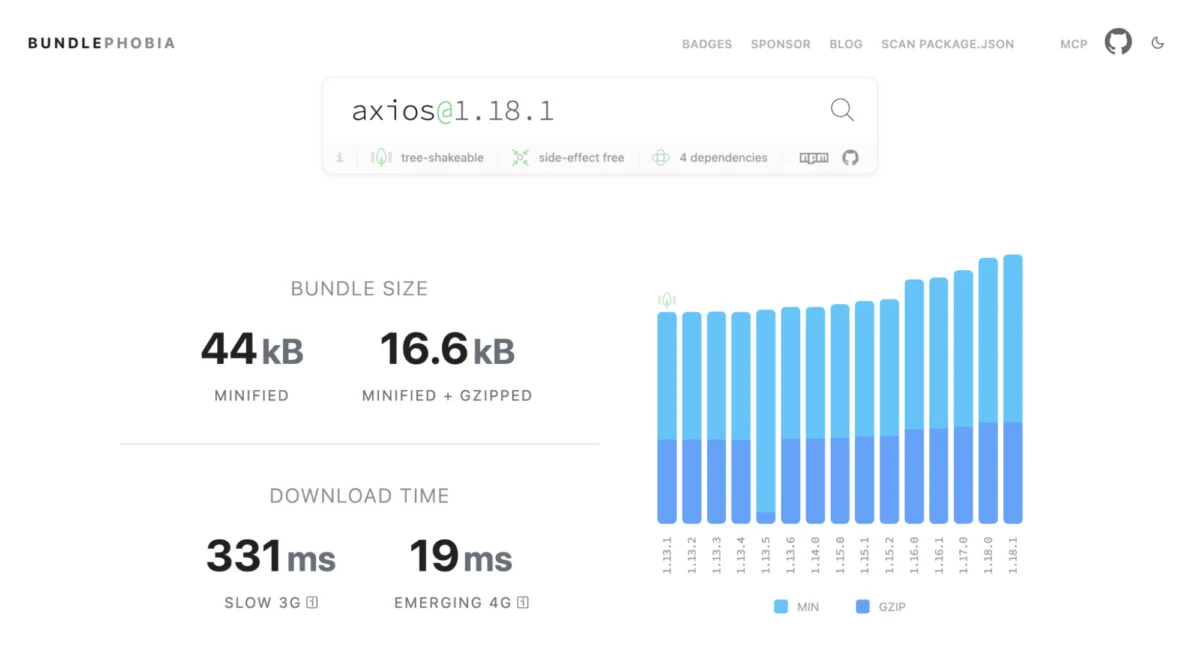
The transition from axios or superagent to the native fetch API is a frequent point of discussion in modern development. While axios provides a convenient abstraction, including automatic JSON parsing and interceptors, the native fetch API, combined with AbortController for request cancellation and AbortSignal.timeout(), covers the vast majority of use cases.
Data indicates that axios adds roughly 17KB to a gzipped bundle. For many applications, this is an unnecessary overhead. However, technical analysis suggests that the decision to switch must be nuanced. Developers relying heavily on request/response interceptors or advanced progress tracking for uploads may find that the platform still requires a thin wrapper. The modern approach is to build a project-specific, lightweight wrapper around fetch rather than importing a heavy, general-purpose library.
Cluster 3: UI Primitives and Accessibility
One of the most significant wins for the web platform has been the standardization of UI primitives. Historically, creating a modal that was accessible—trapping focus, handling the "Escape" key, and managing the "Top Layer"—required sophisticated libraries like a11y-dialog or focus-trap.
The native <dialog> element now handles these requirements automatically. When invoked via the showModal() method, the browser ensures that the rest of the page is inert, focus is managed correctly, and the element sits atop the browser’s internal stacking order, independent of CSS z-index conflicts. Furthermore, the newly available Popover API and CSS Anchor Positioning are beginning to replace tooltip and dropdown libraries like tippy.js and Popper. Collectively, moving these UI primitives to the platform can save upwards of 24KB gzipped while improving the experience for users of assistive technology.
Cluster 4: The Decline of Utility Libraries
Utility libraries like Lodash and Underscore were once the backbone of JavaScript development, providing essential methods for data manipulation. However, the ECMAScript specification has rapidly absorbed these utilities.

- Deep Cloning: The
structuredCloneAPI is now Widely Available, providing a native way to clone complex objects, including those with circular references, without the need forlodash.clonedeep. - Grouping:
Object.groupByandMap.groupBy, which reached cross-browser support in 2024, offer a native replacement forlodash.groupby. - Set Operations: Modern JavaScript now includes native methods for
union,intersection, anddifference, rendering many specialized set utilities obsolete.
A Case Study in Caution: The Temporal API
While the trend is toward native adoption, the "Temporal" API serves as a vital case study in why the Baseline framework is necessary. Temporal is the proposed replacement for the notoriously flawed Date object in JavaScript. While it offers a vastly superior API for time zone handling and arithmetic, it has not yet reached "Widely Available" status.
As of early 2026, while support is growing in Chrome and Firefox, Safari’s stable support is still maturing. Because the official polyfill for Temporal is approximately 44KB gzipped—significantly larger than lightweight libraries like dayjs (3KB)—a premature switch would actually penalize users with a larger bundle. This highlights the importance of the first question in any dependency audit: "Is the replacement safe for my specific audience?"
Strategic Framework for Dependency Auditing
To maintain a lean, performant codebase, industry experts recommend a quarterly dependency audit. This process involves four distinct steps:
- Inventory: Use tools like
npm ls --omit=devto identify production dependencies andsource-map-explorerto visualize their actual footprint in the final bundle. - Platform Mapping: Identify which libraries have native equivalents. Resources like MDN and webstatus.dev provide real-time tracking of Baseline status.
- Feasibility Analysis: Evaluate the "cost" of the swap. If a native feature requires a heavy polyfill for a significant portion of the user base, the library should remain.
- Progressive Enhancement: For features in the "Newly Available" stage, implement them with a feature check. This allows modern browsers to run the lean, native code while providing a fallback for older devices.
Broader Implications and Future Outlook
The shift toward the web platform is more than a technical optimization; it is a movement toward a more sustainable and accessible internet. By reducing the amount of JavaScript sent over the wire, developers lower the barrier to entry for users in emerging markets and those on restricted data plans.
Looking ahead, the roadmap for the web platform remains ambitious. Upcoming features such as "Invoker Buttons" (allowing buttons to control elements like dialogs without JavaScript) and "CSS Masonry" will continue to erode the necessity of specialized libraries. The successful engineering teams of the future will not be those who can integrate the most libraries, but those who can most effectively leverage the powerful, native capabilities of the browser. The mandate is clear: audit often, respect the Baseline, and ship less JavaScript.

