
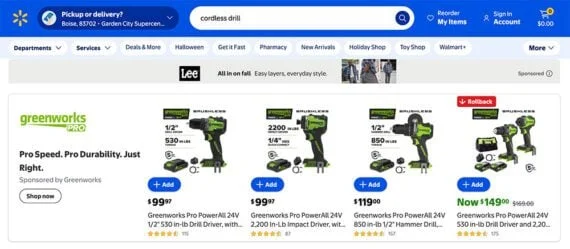
A recent investigation into search results for "cordless drill" on Walmart’s e-commerce platform unveiled a complex and increasingly common challenge faced by enterprise retail sites: the delicate balance between organic merchandising and paid media placements. The search query, a common entry point for consumers actively seeking a specific product, revealed a striking dominance of sponsored content, illustrating a broader trend in how retailers are monetizing their digital shelf space.
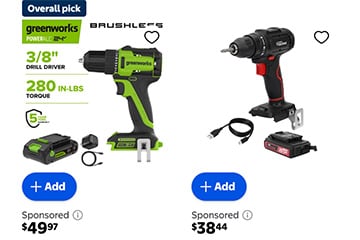
On the day of the observation, a prominent brand module featuring Greenworks products occupied the top position on Walmart’s search results page, showcasing four distinct items. The dominance of sponsored listings continued directly below, with three additional Greenworks products appearing as paid advertisements. It wasn’t until the seventh product listed that a result driven purely by organic search algorithms surfaced. This observation, while specific to a single search query and retailer, represents a microcosm of the broader strategic shifts occurring within the rapidly expanding retail media networks.
Crucially, the sponsored listings in this instance were all relevant to the "cordless drill" search, mitigating potential user frustration. However, the sheer volume of paid placements immediately raised pertinent questions for industry observers: what criteria determine the ranking of these sponsored products, and how do these decisions intersect with traditional merchandising strategies? For retailers actively developing and expanding their retail media businesses, these questions are no longer peripheral but central to their operational and strategic planning. As advertising increasingly influences product visibility at the crucial initial stages of a shopper’s journey, the lines between effective merchandising and strategic media placement are becoming increasingly blurred.
The Dual Objectives: Merchandising Meets Media
The core of this evolving dynamic lies in the inherent, and often competing, objectives that drive product placement on e-commerce platforms. Merchants aim to showcase products that are not only relevant but also likely to convert, thereby maximizing sales and revenue. This involves leveraging sales data, customer behavior, and product popularity to highlight best-sellers, new arrivals, or seasonal items. The goal is to facilitate a seamless and efficient shopping experience, guiding customers to products that meet their needs and preferences.
Simultaneously, retailers are increasingly capitalizing on their digital real estate to generate advertising revenue. This burgeoning retail media sector allows brands to pay for prominent placement on e-commerce sites, reaching engaged consumers at the point of purchase. This dual objective now converges in some of the most valuable real estate on any e-commerce site. The search results page, as demonstrated by the "cordless drill" example, is a prime area where algorithmic relevance and sales signals, traditionally dictating organic ranking, now share space with sponsored products whose positions are influenced by an advertising auction.
The impact extends beyond search results. Category pages, another critical touchpoint for shoppers, are also subject to this dual influence. Merchandisers traditionally use these pages to curate selections based on factors like sales performance, seasonality, or new product introductions. However, the advent of retail media means these same prime positions are now available to advertisers, creating a potential conflict for visibility.
Sherry Smith, president of retail media at Criteo, emphasized the need for strategic implementation, stating, "Retailers also need to be thoughtful about where and how they introduce advertising. More inventory doesn’t necessarily mean more value. The focus should be on placements that perform for advertisers, remain useful to shoppers, and create incremental value for the retailer once the costs of running the program are taken into account." This underscores the imperative for a balanced approach that prioritizes both commercial viability for the retailer and a positive user experience for the shopper.
The Governance Challenge: Competing Metrics and Structural Advantages
The tension between merchandising and media objectives is more than a mere layout issue; it represents a fundamental governance challenge within large retail organizations. These two crucial functions often operate under separate teams, each measured by distinct metrics and driven by different incentives.
The merchandising team is typically evaluated on key performance indicators such as conversion rates, sell-through percentages, and profit margins. Their success is tied to the efficient movement of inventory and the profitability of the products they manage. In contrast, the media team is primarily measured on advertising revenue generated and advertiser retention. Their focus is on maximizing the commercial return from the retail media network.
When these two teams’ objectives collide on the same digital real estate, such as a search results page, a natural conflict arises. The merchandiser has a rational incentive to ensure that the most valuable organic placements are occupied by products most likely to convert, thereby contributing to sales and margin goals. Conversely, the retail media sales team is motivated to secure these same high-visibility placements for their highest-paying or most strategically important advertising partners, aiming to boost ad revenue.
In the absence of clear governance and defined rules of engagement, the media side often holds a structural advantage. Ad revenue is typically immediate, directly attributable to specific campaigns, and relatively easy to report upwards to senior management. The impact of a displaced organic placement, however, is often more diffuse, delayed, and challenging to quantify. A sponsored slot that generates significant revenue in the current quarter, while subtly depressing overall conversion rates for less visible organic products, might appear as a win on the media team’s dashboard, while its detrimental effect on merchandising performance is difficult to definitively prove and attribute.
This asymmetry necessitates a clear governance framework. The critical question becomes: who ultimately owns these prime digital spaces, and by what established rules will the merchandising and media functions share them? Establishing this framework is paramount to ensuring that both objectives are pursued in a way that benefits the retailer holistically, rather than creating internal competition that may undermine overall business health.
Relevance as the Natural Boundary: Aligning Objectives
While the potential for conflict is significant, the two objectives—merchandising and media—do not have to be mutually exclusive. A sponsored product can, and ideally should, align with what the retailer would naturally want a shopper to discover. The key lies in ensuring that paid placements enhance, rather than detract from, the overall shopping experience.
In the observed Walmart "cordless drill" search, the paid placements were indeed relevant to the user’s query. This relevance is the critical factor that transforms a potentially intrusive advertising experience into a value-adding one. Sherry Smith of Criteo elaborates, stating, "The key is making sure media adds to the experience rather than getting in the way of it or simply replacing organic discovery. At the end of the day, relevance matters. If the advertising is useful to the shopper, it’s much more likely to create value for everyone involved."
Relevance, therefore, serves as the natural boundary. When a sponsored product and the merchandising algorithm independently identify the same item as a top contender, there is no inherent conflict. In such scenarios, retail media revenue is generated without displacing any potentially more valuable organic placement. This represents the ideal state, where advertising complements the existing commerce business.
Tension, however, inevitably arises when a paid placement elevates a less relevant or less desirable product above one that merchandising signals would otherwise favor. This is where the governance structure and the clarity of rules for sharing digital real estate become crucial. Without such guidelines, the pursuit of immediate advertising revenue can inadvertently compromise the long-term health of the merchandising strategy, potentially alienating shoppers and eroding trust.
Establishing Rules for Shared Success
Retailers that are proactively addressing the governance question and recognizing the intrinsic value of relevant advertising are beginning to converge on a few practical rules for sharing digital real estate. These guidelines aim to create a symbiotic relationship between merchandising and media functions, ensuring that both contribute to the retailer’s overall success.
One foundational principle involves prioritizing relevance and user intent. Sponsored placements should be strongly aligned with the search query or the category context. If a sponsored product is a poor fit for the user’s expressed need, its placement becomes detrimental, regardless of its advertising value. Retailers can implement stricter relevance thresholds for sponsored products, ensuring they meet a baseline level of congruence with organic search results.
Another key consideration is the careful selection of placement zones. Not all areas of an e-commerce site are created equal in terms of their impact on merchandising versus media revenue. Certain highly visible areas, like the absolute top of search results, might be reserved for a blend of sponsored and top-performing organic products, with clear rules governing their proportion. Less critical areas might be more heavily weighted towards advertising.
Furthermore, transparency in labeling is essential. Clearly distinguishing between sponsored and organic results, as Walmart does, is a baseline requirement. However, retailers can go further by providing more nuanced explanations or visual cues about why a product is being featured, whether through paid promotion or organic ranking. This transparency can help manage shopper expectations and build trust.
Implementing a shared success model, where both merchandising and media teams benefit from the presence of relevant sponsored products, can also be effective. This could involve revenue-sharing models or performance-based bonuses that incentivize collaboration rather than competition. For example, if a sponsored product also drives significant organic sales or positive customer reviews, both teams could be recognized for their contribution.
Finally, continuous monitoring and iterative refinement are critical. The retail media landscape is dynamic, and shopper behavior evolves. Retailers must regularly analyze the performance of both sponsored and organic placements, gathering data on conversion rates, average order value, customer satisfaction, and return on ad spend. This data should inform ongoing adjustments to placement strategies and governance rules.
The Broader Impact: Value Creation in the Digital Economy
Retail media represents a significant opportunity for retailers to unlock new revenue streams and enhance their existing business models. As Sherry Smith articulated, "Retail media gives retailers another way to create value from assets they already have, including their digital traffic, shopper data, and the moments when consumers are actively looking for products." This includes leveraging the immense volume of traffic that flows through their e-commerce sites, the rich insights derived from shopper data, and the critical junctures when consumers are actively seeking to make a purchase.
This opportunity is maximized when advertising actively contributes to the commerce business, rather than simply occupying space that the business itself created. The goal should be to create a synergistic ecosystem where brands can effectively reach consumers, shoppers can discover relevant products, and retailers can generate incremental revenue and profit.
The successful integration of retail media requires a strategic and nuanced approach. It necessitates a clear understanding of the delicate interplay between merchandising principles and media monetization strategies. Retailers that can effectively navigate this intersection, establishing robust governance frameworks and prioritizing relevance and user experience, are best positioned to harness the full potential of retail media, driving both brand visibility and commercial success in the evolving digital marketplace. The "cordless drill" search on Walmart, while a snapshot, serves as a potent reminder of the ongoing evolution and the critical decisions that lie ahead for retailers worldwide.

