
The digital landscape of late 2026 has been significantly reshaped by the emergence of the Boo Trend, a viral phenomenon characterized by users crossing their eyes and uttering the word "boo" while leaning toward a camera lens. What began as a singular comedic post in mid-September has rapidly evolved into a complex social maneuver, blending elements of cringe comedy, performance art, and interpersonal pranking. This trend represents a shift in social media engagement, moving away from high-production aestheticism toward a raw, intentionally "ugly" form of humor that prioritizes relatability and the subversion of traditional beauty standards. As of mid-October 2026, the trend has amassed tens of millions of interactions across TikTok and Instagram, drawing in diverse demographics ranging from Gen Z influencers to K-pop enthusiasts and family-oriented content creators.
The Mechanics and Cultural Context of the Boo Trend
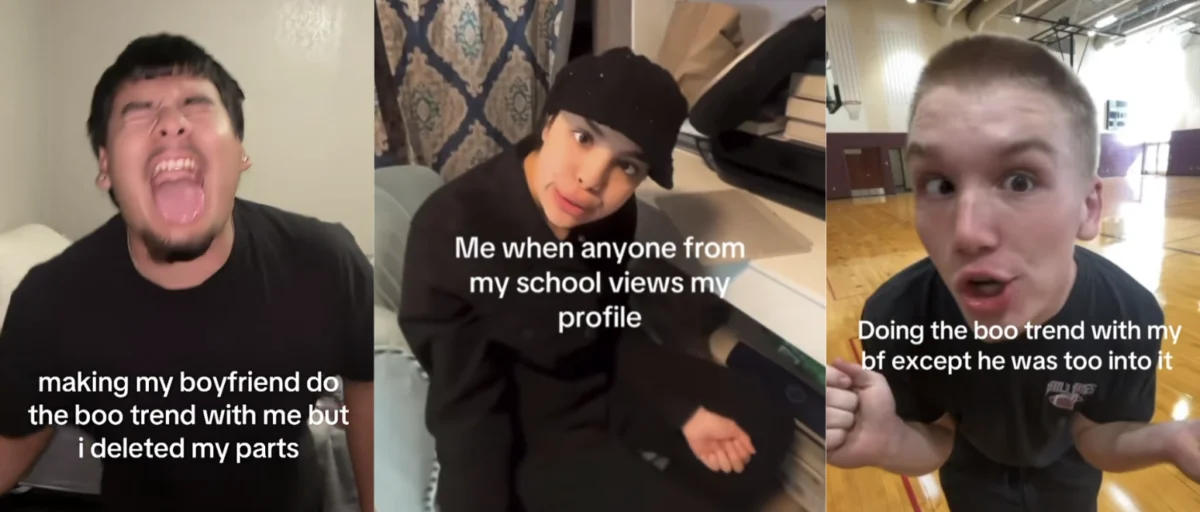
At its core, the Boo Trend is a visual and auditory "jump scare" subverted by humor. The participant typically positions themselves in a medium close-up shot. As they lean into the camera—often with a sudden, jerky movement—they cross their eyes and make a distorted facial expression, punctuated by a soft or comedic vocalization of the word "boo." The humor is derived from the deliberate abandonment of vanity; in an era where filters and AI-driven enhancements often dictate social media appearances, the Boo Trend invites users to look as ridiculous as possible.
The trend is most frequently utilized as a "bait-and-switch" prank. In this variation, a user convinces a partner, friend, or family member to perform the action alongside them under the guise of a "cute" or "shared" couple’s trend. However, upon recording the footage, the initiator deletes their own participation or crops themselves out, leaving the unsuspecting victim as the sole subject of the embarrassing video. This specific iteration has turned the Boo Trend into a vehicle for domestic comedy, highlighting the playful power dynamics between couples and family members.
Chronological Development and Viral Explosion
The timeline of the Boo Trend’s ascent provides a textbook example of how a niche comedic bit can achieve global saturation within a three-week window. The origin is traced back to September 20, 2026, when TikTok user @v99191 uploaded a video with the caption “Booooo #boooo #relatable #funny #blowthisup.” The video, which featured the creator performing the now-iconic cross-eyed expression, struck a chord with the platform’s algorithm, garnering over 8.4 million views and 1.1 million likes in its first twenty days. This initial spark provided the "blueprint" for the facial expression and the specific comedic timing that would define subsequent recreations.
By the final week of September, the trend began to fragment into different sub-genres. On September 28, the K-pop community—one of the most active and influential sectors of social media—adopted the trend. User @cakeyruna posted an edit featuring Sunoo, a member of the group ENHYPEN, which received 260,900 views. This crossover was pivotal, as it introduced the trend to a global audience and linked the "boo" expression to established celebrity culture, proving that even high-profile idols could be associated with the movement’s self-deprecating humor.
The transition to Instagram Reels occurred shortly thereafter. On September 30, user @siixuc posted a variation that emphasized the "staring" aspect of the trend, receiving over 22,400 likes. This migration signaled that the trend had successfully moved beyond its platform of origin, a key indicator of a truly "viral" phenomenon.
By early October, the "prank" element became the dominant form of the trend. On October 2, creator @jayciebelcher3 uploaded a video titled “Anyone hear that ghost??” which featured a prank on another individual. This post achieved massive reach, exceeding 1 million views and 241,200 likes in less than a fortnight. This was followed by @93930.r on October 3, who pranked their boyfriend, accumulating 1.7 million views. The trend reached a fever pitch on October 6, when @kkk4t33’s simple execution of the "boo" face garnered 2.6 million views and over 641,000 likes, cementing the trend’s status as a cultural mainstay of the season.
Quantitative Analysis and Engagement Metrics
The data surrounding the Boo Trend suggests a high level of "stickiness"—a term used by digital analysts to describe content that encourages users to stay on a platform and interact. Unlike trends that rely on complex editing or expensive props, the Boo Trend has a low barrier to entry. This accessibility is reflected in the following engagement patterns observed during the peak of the trend:
- View-to-Like Ratio: Many of the top-performing videos maintain a like-to-view ratio of approximately 10-15%, which is significantly higher than the platform average for general entertainment content. This suggests a high level of viewer satisfaction and "shareability."
- Platform Synergy: The hashtag #boo and its variations saw a 400% increase in search volume on TikTok between September 25 and October 10. Simultaneously, Instagram saw a spike in "cross-eyed" filter usage, as users sought to emulate the look without the physical strain of crossing their eyes manually.
- Demographic Reach: While initially popular among Gen Z, the "Dad prank" iterations—exemplified by @nimrashamid’s October 9 post, which reached 735,300 views—demonstrate the trend’s successful expansion into older demographic brackets.
The Role of K-Pop and Celebrity Influence
The intersection of the Boo Trend with K-pop fandom cannot be overstated. In the digital age, fandoms act as "amplifiers" for viral content. When creators began associating the trend with members of groups like ENHYPEN or BTS, they tapped into a pre-existing infrastructure of fan accounts that cross-post content across Twitter (X), TikTok, and Instagram.
This association often involves "fancams" or edited clips where idols are shown making similar faces during live streams or behind-the-scenes footage. By framing the "boo" face as something a beloved celebrity might do, the trend transitioned from being merely "weird" to being "endearing." This "kawaii-cringe" hybrid is a powerful driver of engagement in East Asian markets and among global K-pop fans, providing the trend with a level of longevity that many Western-only trends lack.
Psychological and Sociological Implications
Sociologists studying digital behavior suggest that the Boo Trend is a reaction to the "perfection fatigue" prevalent on social media. For years, the dominant mode of self-presentation was the "Instagram Face"—a look characterized by flawless skin, specific contouring, and a serene, detached expression. The Boo Trend is the antithesis of this. By crossing their eyes and making a "scary" or "ugly" face, users are engaging in a form of digital rebellion.
Furthermore, the prank aspect of the trend speaks to a desire for "authentic" reactions. In a world of scripted content, seeing a boyfriend or a father look genuinely confused or embarrassed after being tricked into making a "boo" face provides a moment of genuine human connection. It is a shared joke that relies on the trust between the participants, even if that trust is playfully exploited for "clout."
The trend also utilizes the "uncanny valley" effect. The sudden movement toward the camera and the distorted eyes create a brief moment of visual dissonance that grabs the viewer’s attention in a crowded feed. This "pattern interrupt" is highly effective in the attention economy, where creators have less than two seconds to prevent a user from scrolling past their video.
Conclusion and Future Outlook
As the Boo Trend approaches the mid-way point of October 2026, its trajectory suggests it may find a second life as a Halloween-themed staple. The linguistic connection to "boo"—the quintessential ghostly greeting—makes it a natural fit for the October holiday season. We can expect to see more sophisticated iterations, perhaps involving costumes, professional makeup, or augmented reality filters that enhance the "boo" effect.
From a journalistic perspective, the Boo Trend serves as a case study in the lifecycle of modern virality. It demonstrates how a simple, low-effort concept can be transformed through community participation, celebrity integration, and the repurposing of the content into a prank format. While the trend will eventually fade as new sounds and visual gags take its place, its impact on the cultural lexicon of 2026 remains significant. It has reinforced the value of the "unfiltered" moment and proven once again that in the world of social media, the most effective way to capture a million eyes is often to make them look at each other.

