
In the nascent stages of the World Wide Web, website architects and developers employed a foundational method for guiding users and nascent search engine crawlers through the digital landscape. This involved the creation of "sitemaps," essentially curated lists of links pointing to a website’s core sections. These could manifest as concise summaries embedded within the footer of web pages or as standalone documents, providing an organized overview of a site’s structure, encompassing elements like product categories, company information, legal policies, and contact details. This early iteration, designed primarily for human navigation and rudimentary bot interaction, laid the groundwork for more sophisticated indexing strategies.
The evolution of internet search technology necessitated a more robust and machine-readable approach to site mapping. In 2005, a pivotal moment arrived with Google’s introduction of a standardized sitemap protocol based on the Extensible Markup Language (XML). XML, a data-formatting language originating in the 1990s, offered a structured, text-based method for organizing information. This new breed of sitemap allowed website owners to submit detailed lists of their web pages directly to search engines, primarily through interfaces that would eventually coalesce into Google’s Search Console. The explicit objective was to empower search engines to efficiently discover, crawl, and index the vast and ever-expanding content of websites, thereby improving their visibility in search results.
This divergence in form and function led to the industry commonly distinguishing between these two primary types of sitemaps: the original "HTML sitemaps" and the more technically oriented "XML sitemaps." While both serve the overarching goal of site discoverability, their mechanisms and primary audiences differ significantly, often leading to confusion among website owners, particularly those in the e-commerce sector.
The Fundamental Differences: Function and Audience
The primary distinction between HTML and XML sitemaps lies in their intended purpose and how they interact with search engine algorithms and human users.
XML Sitemaps: The Search Engine’s Blueprint
XML sitemaps are meticulously crafted to facilitate search engine discoverability. They act as a direct communication channel to search engines like Google, Bing, and others, providing an exhaustive list of URLs that the website owner wishes to have indexed. By submitting an XML sitemap, site owners enable search engine bots to efficiently locate and process all intended pages without necessarily having to navigate the website through conventional user pathways. This streamlined approach significantly accelerates the indexing process, a critical factor for new websites or those undergoing substantial content updates.
However, the mere inclusion of a URL in an XML sitemap does not guarantee its indexing or ranking. A multitude of factors influence whether a search engine bot will access and index a newly discovered page. These include the site’s "crawl budget" (the resources a search engine allocates to crawling a specific site), the website’s overall authority and reputation, the relevance and originality of its content, the depth and structure of its internal linking strategy, and the presence of authoritative external backlinks. These signals collectively inform search engines about the value and trustworthiness of a website and its individual pages.
HTML Sitemaps: The User-Centric Navigator
In contrast, HTML sitemaps are designed primarily for human users, though they can also offer indirect benefits for search engine crawling. Unlike XML sitemaps, which are submitted directly to search engines, HTML sitemaps are web pages themselves, accessible through a website’s normal navigation. Search engine crawlers must land on the website and follow internal links to discover an HTML sitemap.
The impact of HTML sitemaps on search engine optimization (SEO) is a subject of ongoing discussion among SEO professionals. However, many agree that they can be beneficial, particularly in revealing the internal linking structure of a website. When strategically placed, often in the website’s footer, HTML sitemaps can effectively distribute "link equity" – the authority and ranking power passed from one page to another through links – to the pages they list. This distribution can be particularly helpful in mitigating the issue of pages being "crawled, currently not indexed," a status often observed in tools like Google Search Console, indicating that while a page has been discovered, it has not yet been deemed worthy of indexing.
The Synergy of Both: A Comprehensive Strategy
For optimal search engine visibility, particularly for e-commerce businesses with extensive product catalogs and intricate site structures, employing both HTML and XML sitemaps is a highly recommended strategy.
Enhancing Discoverability and Indexing
Both types of sitemaps contribute to the fundamental goals of helping search engines discover, crawl, and index a greater number of pages. For large websites with thousands or even millions of product pages, as is common in e-commerce, this dual approach ensures that no valuable content is overlooked by search engine algorithms.
The Primacy of Website Architecture
It is crucial to understand that neither sitemap can substitute for a well-designed website hierarchy. A fast, logically structured, and comprehensively interlinked website remains the cornerstone of strong organic search visibility. Sitemaps are tools to enhance discoverability within an already robust site architecture, not a workaround for fundamental structural deficiencies.
In specific scenarios, such as during a website restructuring project, temporary HTML sitemaps can serve as a valuable interim measure. They can help maintain discoverability and link equity while the new interlinking structure is being finalized. However, they should never be considered a permanent replacement for a well-executed internal linking strategy.

Industry Perspectives on HTML Sitemaps
The role and efficacy of HTML sitemaps have been a topic of debate within the SEO community. Notably, in a recent episode of the "Search off the Record" podcast, John Mueller, a prominent figure at Google, acknowledged their potential benefits. While historically expressing skepticism, Mueller noted that "they would help crawling because from this place we can find all the links." This statement suggests a nuanced understanding within search engine development that HTML sitemaps can indeed contribute to the crawling process by providing a central point from which to discover numerous internal links.
Construction and Implementation: Tailoring to Purpose
The construction and content of HTML and XML sitemaps are tailored to their respective functions.
XML Sitemaps: Dynamic and Comprehensive
XML sitemaps are inherently dynamic, designed to be continuously updated as new pages are added, products are listed, or content is modified. They should encompass every URL that a website owner intends for search engines to index. This dynamism ensures that search engines are always presented with the most current representation of the website’s content.
HTML Sitemaps: Static and Prioritized
Conversely, HTML sitemaps are typically more static, focusing on the most important pages and categories of a website. They are not intended to list every single product or individual page, especially on large e-commerce sites. Instead, they guide users and crawlers toward key sections and hierarchical structures.
Guidance from Industry Leaders
John Mueller provided further clarity on the strategic use of HTML sitemaps in the context of e-commerce during the aforementioned podcast. He illustrated this point by suggesting that on an e-commerce site, an HTML sitemap would not typically list every individual product. Instead, it would prioritize listing the main product categories, thereby directing users and crawlers to the appropriate sections where they could then browse for specific products. This approach emphasizes the role of HTML sitemaps in providing navigational guidance rather than exhaustive listing.
Technical Implementation and Submission
Modern Content Management Systems (CMS) and e-commerce platforms often include built-in functionality for generating XML sitemaps automatically. Website owners typically need to locate the URL of their XML sitemap(s) within their platform’s documentation and then submit these URLs to search engine webmaster tools, such as Google Search Console and Bing Webmaster Tools. This submission process is crucial for ensuring that search engines are aware of and can access the sitemap.
Tools like Screaming Frog, a popular web crawler, can be invaluable for auditing XML sitemaps. These tools can identify potential issues such as broken links, URLs that are incorrectly marked as "noindexed," and other technical glitches that might hinder search engine crawling and indexing.
Human-Centric Design of HTML Sitemaps
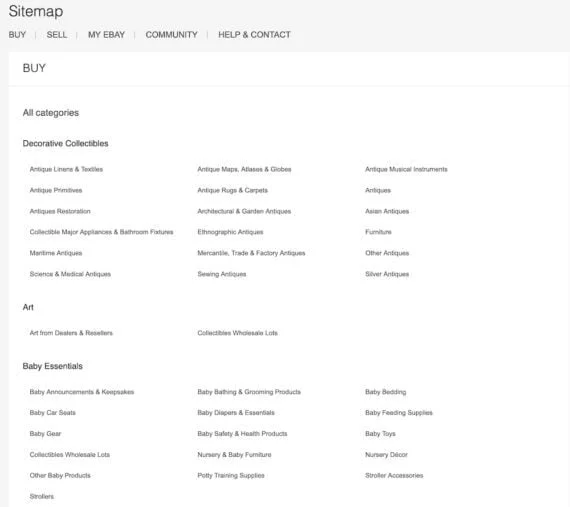
HTML sitemaps, on the other hand, are built with a focus on human users and the site owner’s strategic priorities. Their design aims to facilitate easy navigation to important pages. A prime example of an effective HTML sitemap can be observed on eBay’s website. eBay’s HTML sitemap links to its main categories and subcategories, providing a clear hierarchical structure for users to explore. This type of sitemap is particularly beneficial for users who are browsing for specific types of products, seeking help pages, or engaging with community discussions. The visual structure of eBay’s HTML sitemap, as depicted in accompanying visuals, clearly illustrates this user-focused approach, with top-level links for core site functions followed by a detailed breakdown of product categories.
Conclusion: A Dual Approach for Optimal Online Presence
In conclusion, while both HTML and XML sitemaps play distinct yet complementary roles in enhancing a website’s online presence, their effective utilization hinges on understanding their fundamental differences and strategic applications. XML sitemaps are indispensable for direct communication with search engines, ensuring comprehensive discoverability and efficient indexing of all intended content. They are dynamic, machine-readable, and crucial for SEO performance.
HTML sitemaps, while less directly influential on algorithmic ranking, serve a vital purpose in user navigation and can indirectly aid search engine crawling by revealing a site’s internal linking architecture. They are best employed as navigational aids, guiding users to key sections and providing a human-readable overview of the site’s structure.
For e-commerce businesses and websites with substantial content, a dual approach that leverages the strengths of both HTML and XML sitemaps is the most effective strategy. This comprehensive method ensures that both search engines and human users can efficiently navigate and understand the website, ultimately contributing to improved visibility, better user experience, and enhanced organic search performance. The ongoing evolution of search engine technology and the insights from industry experts underscore the continued relevance of these foundational web development tools in the pursuit of a strong and discoverable online presence.

