
Front-end architect Gabriel Shoyombo and other industry observers have noted a recurring pattern: a developer replaces a complex ResizeObserver implementation with a few lines of CSS, only to find that seemingly unrelated parts of the application—such as dashboard cards, headings, or spacing—behave erratically. This phenomenon highlights a fundamental tension between local simplicity (shorter, cleaner code in a single file) and system complexity (how that code interacts with the broader environment of the browser, the cascade, and existing JavaScript).
The Evolution of "Smart" CSS: A Chronology of Change
The transition to modern CSS did not happen overnight. It is the result of a multi-year effort by browser vendors and the W3C to bring high-level logic directly into the stylesheet.
- 2021–2022: The Foundation. The introduction of Cascade Layers (
@layer) and the initial implementation of Container Queries began to shift the responsibility of responsiveness from the viewport to the individual component. - 2023: The Breakthrough. Major browsers achieved "Interop 2023" goals, ensuring stable support for the
:has()selector, which was dubbed the "parent selector" that developers had requested for decades. - 2024–2025: Native Nesting and Beyond. CSS Nesting reached baseline support, allowing developers to write styles that mirror the structure of HTML without relying on pre-processors like Sass.
- 2026: The Migration Crisis. As large-scale enterprises began migrating legacy JavaScript logic to these native features, reports of "accidental complexity" began to surface in developer forums and bug trackers.
This chronology illustrates a shift from CSS as a purely presentational language to one that handles conditional logic, a domain previously reserved for JavaScript.
Scenario 1: The Fragmentation of Logic
One of the most significant risks in modern front-end development is the "behavior with two owners." In many professional environments, migrations from JavaScript to CSS happen incrementally. A developer may implement a Container Query to handle a card’s layout but fail to remove the legacy ResizeObserver or the JavaScript-toggled classes that control other aspects of the same component, such as typography or internal spacing.
When a designer later requests a change to a breakpoint—for instance, moving it from 480px to 600px—the developer might update the CSS Container Query but miss the hidden JavaScript observer. This results in a "hybrid state" where the card’s layout follows the new rules while its font size follows the old ones. Because the logic is split across two different languages and files, debugging these edge cases becomes significantly more difficult than when the logic was contained entirely within a single JavaScript function.
Scenario 2: Unintended Layout Side Effects
The introduction of container-type: inline-size is often viewed as a simple toggle for responsiveness. However, the browser interprets this declaration as a request to create a new Block Formatting Context (BFC) and apply size containment. According to documentation from the Mozilla Developer Network (MDN), this single line of CSS can fundamentally alter how an element interacts with its neighbors.

Technical analysis reveals three common side effects:
- Margin Collapse Termination: In standard flow, vertical margins of adjacent elements often "collapse" into one. A container query prevents this, potentially doubling the expected space between components.
- Float Interference: Elements within a new BFC no longer wrap around floated elements in the same way, which can cause layouts to shift by hundreds of pixels.
- Content-Sized Collapse: Elements that rely on their children to determine their width (such as flex items or
fit-contentboxes) can collapse to 0px width when size containment is applied, causing components to literally vanish from the screen.
Scenario 3: The Cascade and Specificity Inflation
Modern features like :has() and Nesting allow for shorter, more readable selectors, but they often carry hidden "weight" in the CSS Cascade. The :has() selector, for example, can inadvertently match elements deep within the DOM tree if not properly constrained.
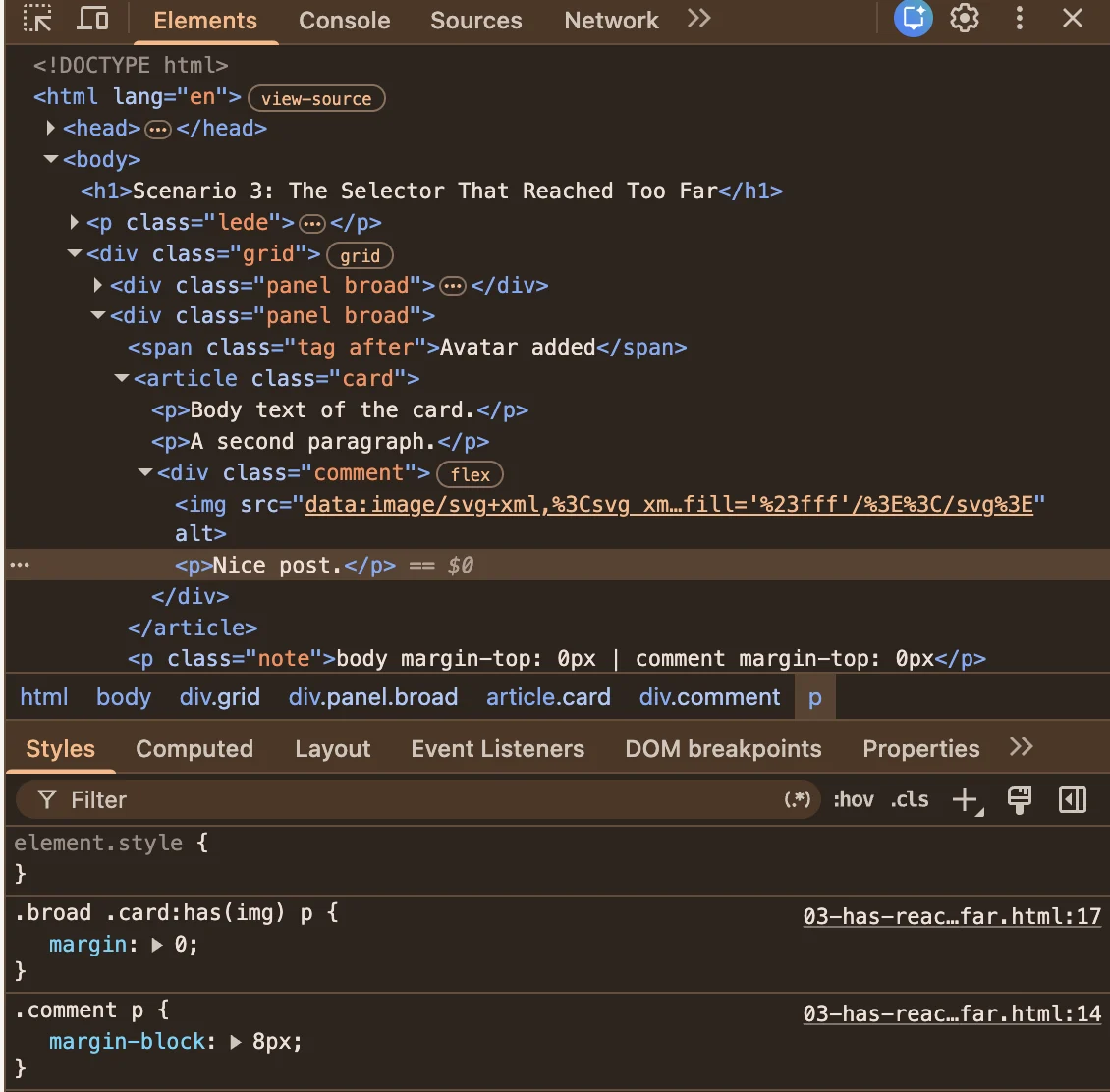
In a recent case study, a selector designed to remove margins from a card containing an image—.card:has(img) p—ended up stripping margins from paragraphs inside user comments because those comments also contained avatar images. Furthermore, native nesting borrows specificity from the most specific element in its selector list. If a developer nests styles under a selector that includes an ID (e.g., .card, #featured), every nested rule inherits the high specificity of the ID, even when applied to a standard class. This leads to "specificity wars" where developers are forced to use !important or increasingly complex selectors to override simple styles.
Scenario 4: Performance and the Rendering Engine
A common justification for moving logic to CSS is that "it is faster." However, data suggests this is not a universal truth. While CSS often handles layout more efficiently than JavaScript, certain selectors can trigger massive "style recalculation" events.
In a performance test involving a list of 5,000 rows, researchers compared different methods of styling a toolbar based on row selection:
- JavaScript Class Toggle: Took under 0.1ms and restyled only one element.
- CSS
:has()on Body: Took approximately 1.4ms. - Combined CSS Rules: When two seemingly harmless
:has()rules were present in the same stylesheet, the time per toggle jumped to 7ms, and the browser was forced to restyle all 5,001 elements on every single interaction.
While 7ms is still within the 16.7ms window required for a 60Hz frame rate, the cost scales linearly. At 20,000 rows, the same operation takes 31ms, causing noticeable "jank" and dropped frames. This demonstrates that CSS complexity is not just an organizational issue, but a computational one.
Industry Reactions and Developer Sentiment
The debate over "Modern Frontend Complexity" has polarized the developer community. On platforms like Reddit’s r/programming, some developers argue that the industry is simply "doing less" under the guise of "doing it with less."

User "Kwantuum" noted that many articles advocating for CSS-only solutions ignore the robust error handling and state management that JavaScript provides. Conversely, proponents like user "Keyser Söze" argue that the industry’s over-reliance on JavaScript frameworks has led to "accidental complexity" that modern CSS is finally equipped to solve.
Front-end experts suggest that the truth lies in the "greenfield vs. migration" perspective. While a new project (greenfield) can be built from the ground up to leverage these features safely, most professional work involves migrations. In a migration, the primary challenge is not the new technology itself, but how it "gets along" with the legacy code already in the "shared apartment" of the codebase.
Implications for Future Development
The rise of "Smart CSS" necessitates a change in how front-end teams approach quality assurance and code reviews. Deleting fifty lines of JavaScript in favor of three lines of CSS is a "win" only if the developer can verify that the system’s stability remains intact.
To mitigate these risks, industry leaders are beginning to adopt a "Migration Checklist" for CSS updates:
- Ownership: Does this behavior have only one owner (CSS or JS)?
- Scope: Are all legacy selectors and observers deleted?
- Side Effects: Does the container change the layout of its neighbors or children?
- Specificity: Does the new selector use
:where()to keep its weight low? - Layers: Is the new rule correctly placed in a cascade layer?
- Performance: Has the restyle cost been measured in a browser profiler?
Conclusion
Modern CSS is an undeniably powerful toolset that brings the language closer to the declarative ideal developers have long sought. Features like Container Queries and :has() are essential for building truly modular, component-based systems. However, the "local simplicity" they provide can be deceptive.
As the industry moves forward, the role of the CSS developer is evolving from a "styler" to a "system architect." Success in this new era requires a deep understanding of browser rendering, the intricacies of the cascade, and the performance implications of relational selectors. The goal is no longer just to write less code, but to ensure that the code we do write doesn’t disrupt the delicate balance of the wider application. If a pull request deletes more than it adds, it is cause for celebration—but only after the developer has answered where that complexity went.

