
The European Union has officially entered a new era of digital regulation as the transparency obligations under the landmark EU AI Act move toward full implementation, setting a global precedent for how artificial intelligence-generated content must be disclosed to the public. While initial discourse surrounding the legislation was characterized by concerns over "sweeping bans" and "stifling innovation," the finalized guidelines for Article 50 reveal a more nuanced framework designed to balance technological advancement with consumer protection. Beginning August 2, 2026, any entity providing or deploying AI systems that interact with EU citizens—regardless of where the company is headquartered—must adhere to strict labeling requirements for synthetic content. This mandate signals the end of the "wild west" era of generative AI, replacing ambiguous icons like the ubiquitous "sparkle" with standardized, legally enforceable disclosure patterns.
The Core Mandate: Transparency as a Legal Requirement
The primary objective of the EU’s AI labeling initiative is to ensure that individuals can distinguish between human-generated content and that which has been artificially created or manipulated. Under Article 50(4) of the AI Act, the obligation to label applies specifically to several high-stakes categories. These include deepfakes (manipulated images, audio, or video that resemble existing persons, places, or events), AI-generated text intended to inform the public on matters of public interest, and realistic synthetic media that could be mistaken for authentic documentation.
The law distinguishes between two primary actors: providers and deployers. Providers are the developers and suppliers of the AI systems, while deployers are the organizations or individuals who utilize those systems to produce content. Both parties share legal responsibility. A corporation based in the United States or Asia that operates a platform accessible to EU users cannot circumvent these rules simply by licensing a third-party AI tool. If the output reaches a citizen within the Union’s borders, the transparency obligations are triggered.
Failure to comply with these regulations carries significant financial risk. The EU AI Act provides for a tiered fine structure, with the most severe violations—such as non-compliance with transparency and data governance standards—potentially resulting in penalties of up to €15 million or 3% of a company’s total global annual turnover, whichever is higher. For larger tech conglomerates, these figures represent a multi-billion dollar liability.
Chronology of the EU AI Act and Labeling Deadlines
The path toward the 2026 deadline has been a multi-year legislative journey, reflecting the rapid evolution of generative AI technologies.

- April 2021: The European Commission proposes the initial framework for the AI Act, focusing on a risk-based approach.
- December 2023: EU lawmakers reach a provisional agreement on the Act, incorporating specific provisions for General Purpose AI (GPAI) and generative models following the explosion of tools like ChatGPT and Midjourney.
- March 2024: The European Parliament overwhelmingly approves the AI Act.
- August 1, 2024: The AI Act officially enters into force, initiating a staggered implementation timeline.
- February 2025: Prohibitions on "unacceptable risk" AI systems (such as social scoring) take effect.
- August 2, 2026: Transparency obligations under Article 50, including the labeling of AI-generated content, become legally enforceable for all covered entities.
- August 2027: Full compliance for high-risk AI systems integrated into regulated products (e.g., medical devices) is required.
This timeline provides a two-year grace period for organizations to overhaul their user interfaces (UI) and technical infrastructures to support robust watermarking and labeling protocols.
Supporting Data: The Rise of Synthetic Media and Misinformation
The urgency behind the EU’s labeling mandate is supported by a growing body of data regarding the prevalence of synthetic content. According to estimates by Europol, as much as 90% of online content could be synthetically generated or enhanced by 2026. This surge presents a unique challenge for digital literacy.
Research conducted by the Nielsen Norman Group (NNGroup) has highlighted a significant "transparency gap" in current AI interfaces. Their studies indicate that the "sparkle" icon (✨), which has become the de facto industry standard for AI features in apps like Google Workspace, Notion, and Adobe Photoshop, is frequently misinterpreted by users. Many consumers view the sparkle as a symbol for "new features" or "enhancement" rather than a clear indicator of synthetic generation.

Furthermore, the 2024 Edelman Trust Barometer revealed that 59% of global respondents worry about the use of AI in spreading misinformation. By mandating "clear and distinguishable" labels, the EU aims to restore a baseline of trust in digital media, providing users with the necessary context to evaluate the information they consume.
Defining the "Human-in-the-Loop" Threshold
One of the most complex aspects of the new guidelines is determining exactly when AI-assisted content ceases to require a label. The European Commission has provided "fuzzy" but foundational guidance on the distinction between "edited" and "generated" content.
Disclosure is not required for minor assistive edits. This includes:

- Standard spell-checking and grammar correction.
- Basic formatting and cropping of images.
- Color correction and stylistic filters.
- AI-powered translations, provided they are reviewed for accuracy.
Conversely, a disclosure is mandatory for:
- AI-generated summaries of long-form documents.
- Substantive rewrites of human-drafted text.
- The addition or removal of significant elements within a photograph.
- Composite imagery created from multiple synthetic sources.
The Commission is explicit that "skim-reading" by a human before publication does not constitute an editorial review. For content to be exempt from labeling, there must be a named person or entity taking full editorial responsibility, implying a substantive manual intervention that fundamentally alters or validates the AI’s output.
Technical and Design Standards: Beyond the Sparkle
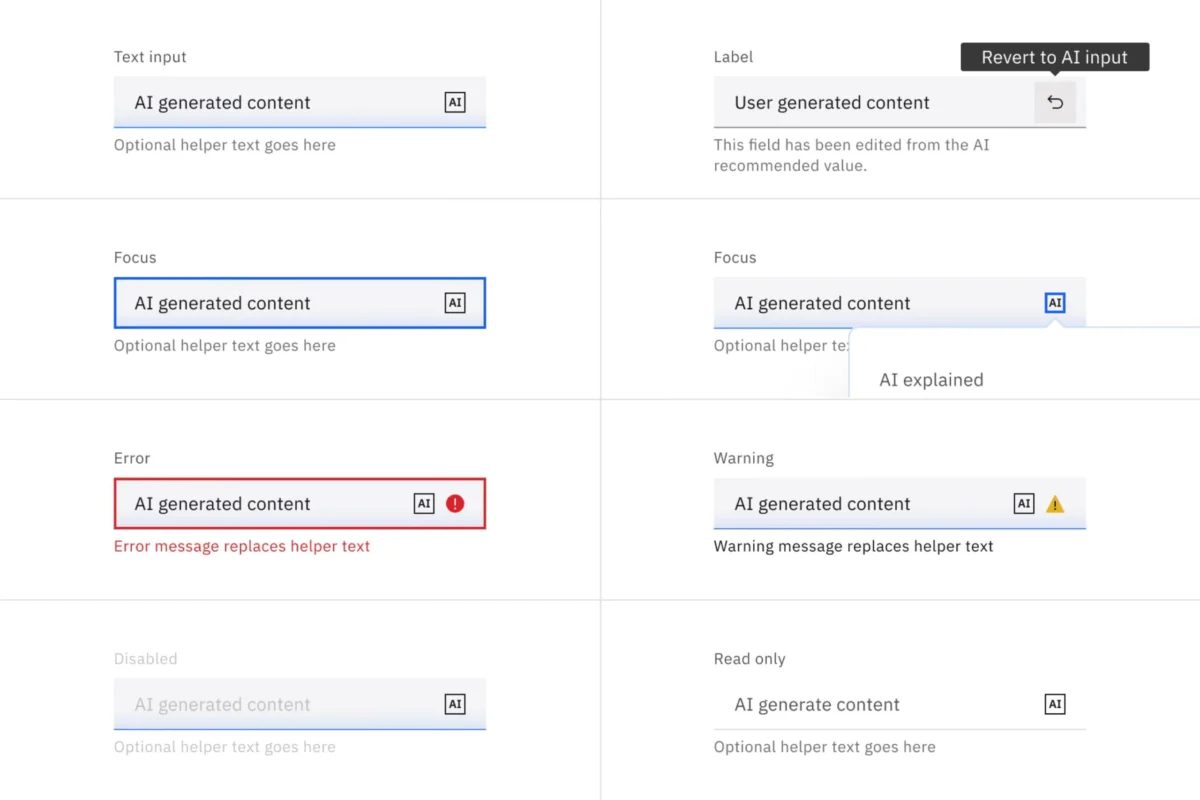
The EU guidelines move away from vague iconography toward standardized visual markers. The Commission has published a specific set of AI icons, featuring distinct variants for content that is "fully AI-generated" versus content that is "partially AI-modified."

Legal experts and design systems, such as IBM’s Carbon Design System, are already advocating for "explainability panels." These UI components go beyond a simple tag, offering users a hover-state or a dedicated "AI Info" section that explains which parts of a dataset or image were generated by a model.
The guidelines emphasize that labels must be:
- Persistent: The disclosure must remain attached to the content even when it is downloaded, shared, or screenshotted. This necessitates the use of robust metadata standards and invisible watermarking (such as C2PA) alongside visible UI labels.
- Accessible: Labels must be readable by assistive technologies, ensuring that visually impaired users are equally informed of a content’s synthetic nature.
- Plain Language: Technical jargon is discouraged. Labels should use clear terms like "AI-generated" or "Synthetically altered" in the local language of the user.
Global Reactions and the "Brussels Effect"
The tech industry’s response to the EU’s mandates has been a mixture of cautious cooperation and logistical concern. Major players like Meta, Google, and OpenAI have already begun implementing their own labeling systems, such as Meta’s "Made with AI" tags. However, the EU’s specific requirements for "public interest" disclosures and persistent metadata may force these companies to adopt more rigorous standards than they currently use in the United States.

Legal analysts suggest that the EU AI Act will trigger the "Brussels Effect," a phenomenon where EU regulations become the global default because it is more efficient for multinational corporations to maintain a single compliance standard than to fragment their services by region. This was previously observed with the General Data Protection Regulation (GDPR), which reshaped privacy settings worldwide.
In the United States, regulation remains fragmented. While California has passed laws requiring transparency for "synthetic performers" and Utah has enacted the AI Policy Act, there is no federal equivalent to the EU’s comprehensive labeling mandate. The EU’s proactive stance positions it as the primary architect of international AI ethics and transparency.
Broader Impact and Implications for Digital Trust
The long-term implications of Article 50 extend beyond mere compliance. By institutionalizing the disclosure of AI content, the EU is attempting to safeguard the "information environment" from an influx of what critics call "AI slop"—low-quality, mass-produced synthetic content that can drown out human discourse.

For businesses, these rules necessitate a shift in product strategy. Marketing teams must now consider whether a realistic AI-generated spokesperson or product image will require a disclaimer that might affect consumer perception. For news organizations, the rules provide a framework for using AI tools for efficiency while maintaining journalistic integrity through clear attribution.
Ultimately, the EU AI Act’s labeling requirements are based on the principle of informed consent. In an era where the line between the real and the synthetic is increasingly blurred, the mandate ensures that the burden of identification rests on the creator and the platform, not the consumer. As August 2026 approaches, the global digital landscape will likely transition toward a more transparent—if more heavily labeled—reality, where the presence of AI is no longer a hidden variable but a disclosed fact of life.

