
The pursuit of cleaner codebases frequently leads front-end developers to replace legacy JavaScript logic with modern CSS features, such as Container Queries, the :has() pseudo-class, and native nesting. While these migrations often result in a "red diff"—where more lines of code are deleted than added—the perceived simplification can mask a significant increase in systemic complexity. As explored by industry experts and documented in recent technical analyses, the shift from imperative JavaScript to declarative CSS does not always eliminate logic; rather, it redistributes it across different layers of the browser’s rendering engine, often making the wider application harder to reason about and debug.
The Evolution of the CSS-First Paradigm
The landscape of front-end development has undergone a radical transformation between 2023 and 2026. The introduction of CSS Container Queries (Level 3) and the :has() relational pseudo-class provided developers with tools that were previously the exclusive domain of JavaScript. Historically, creating responsive components required ResizeObserver or Window.matchMedia to toggle classes based on element dimensions. With the arrival of modern CSS, these behaviors can now be defined directly within stylesheets.
However, the industry has begun to observe a phenomenon known as "local simplicity versus system complexity." In April 2026, technologist Igor Roztropiński published a seminal essay titled "Modern Frontend Complexity: Essential or Accidental?" which sparked a global debate on whether the current trajectory of browser evolution truly reduces technical debt. While proponents argue that native browser features are inherently more efficient, critics suggest that "doing it with less" often results in "doing less" while leaving behind fragments of logic that conflict with existing systems.
Scenario I: Behavioral Fragmentation and Dual Ownership
One of the most pervasive issues in modernizing a codebase is the "partial migration" trap. This occurs when a component’s behavior is split between JavaScript and CSS, leading to a state where neither language has full control over the element’s appearance.
For example, a developer may replace a ResizeObserver with a Container Query to handle a card component’s layout. If the migration is not exhaustive, legacy JavaScript may still be active in a separate utility file, or CSS selectors referencing old classes may remain in the stylesheet. When a designer requests a breakpoint change, a developer might update the @container rule but overlook the hidden JavaScript logic or the orphaned CSS classes.
This creates a "ghost state"—a visual configuration that no developer explicitly wrote but which exists because two different logic systems are competing for control. Technical documentation from MDN and various web standards groups emphasizes that while CSS and JavaScript can share a component, they should never share the same behavior. The failure to fully decommission legacy observers during a migration often results in UI bugs that are difficult to reproduce in isolation.
Scenario II: Structural Side Effects and Layout Containment
The introduction of container-type: inline-size is often viewed as a simple toggle for responsive styling. However, the browser interprets this declaration as a directive to change the fundamental layout behavior of the element. According to the CSS Containment Module Level 3, declaring an element as a container creates a new Block Formatting Context (BFC) and applies size containment.

The implications of this shift are three-fold:
- Margin Collapse Termination: In standard flow, vertical margins of adjacent elements often collapse into one. When a container query is applied, the BFC prevents this collapse, often resulting in unexpected spacing increases (e.g., a 24px margin and a 16px margin adding up to 40px rather than collapsing to 24px).
- Float Interaction: Elements within a new BFC no longer wrap around external floats in the same way. A containerized card may shift entirely to the side of a floated image rather than allowing its text to flow naturally around the asset.
- Content-Sized Collapse: Size containment prevents an element from deriving its dimensions from its children. In flexbox or grid layouts where width is set to
fit-content, adding a container query can cause the element’s width to collapse to 0px, effectively making the component vanish from the viewport.
These side effects demonstrate that a single line of modern CSS can alter layout behaviors that have nothing to do with the intended query, necessitating a comprehensive audit of the surrounding DOM tree before implementation.
Scenario III: The Specificity and Cascade Conflict
The CSS Cascade remains the most powerful and misunderstood aspect of web styling. Modern features like native nesting and the :has() selector introduce new risks regarding selector weight and reach.
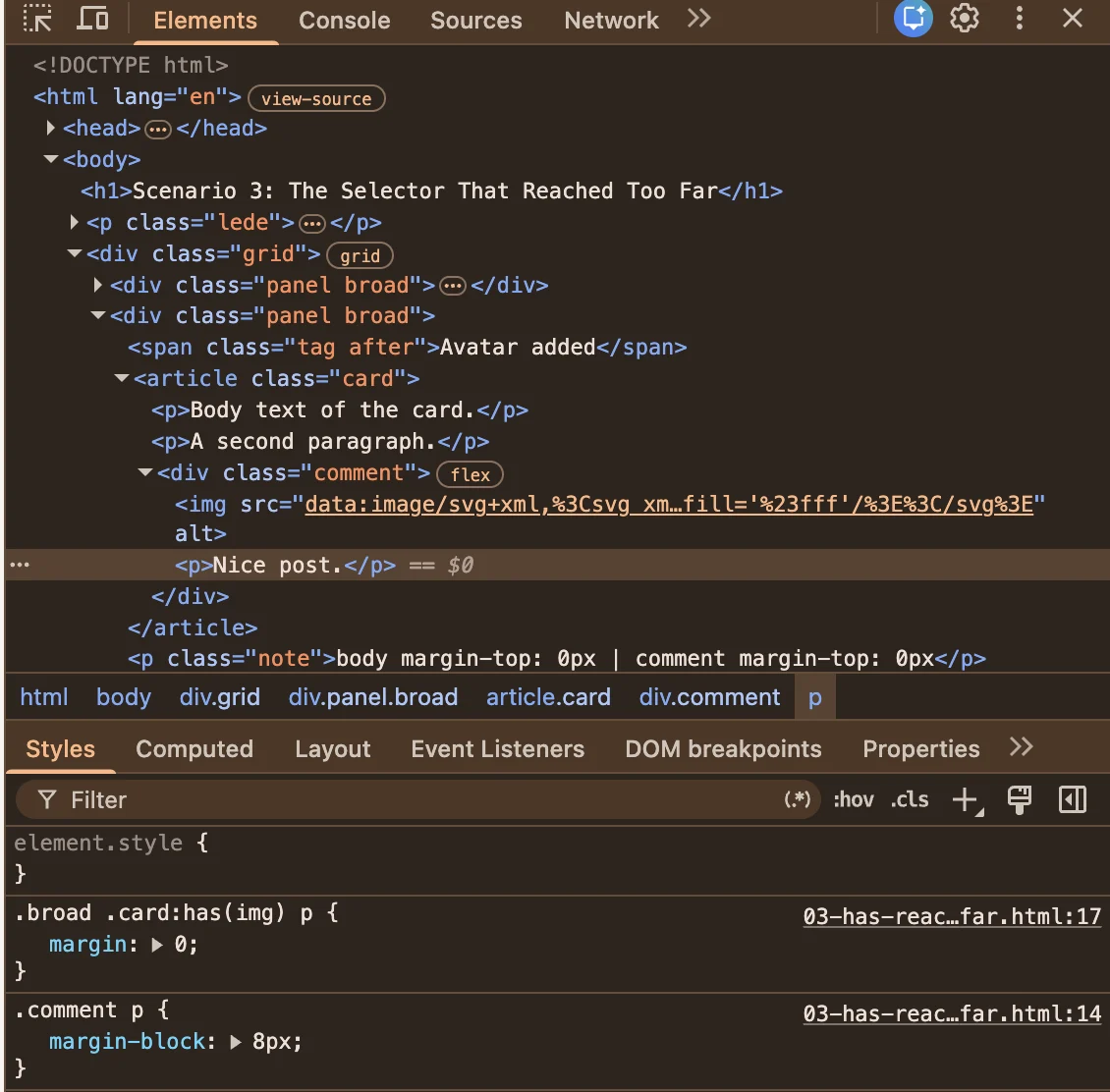
The :has() selector, while powerful, can easily "over-reach." A selector such as .card:has(img) p is intended to target paragraphs within a card containing an image. However, without strict child combinators (e.g., .card:has(> img) > p), the selector may inadvertently target paragraphs inside nested components, such as a comment section or a sidebar, stripping them of their intended margins.
Furthermore, native nesting borrows specificity from its parent selectors. Using the & nesting selector in a list of selectors (similar to the :is() pseudo-class) causes the nested rule to take on the specificity of the most "weighty" item in that list. This can lead to situations where a simple utility class is overridden by a nested rule because the nested rule is tethered to an ID elsewhere in the stylesheet.
The introduction of Cascade Layers (@layer) was intended to solve these specificity wars. However, recent findings suggest that a "half-layered" codebase—where new styles are layered but legacy styles remain unlayered—actually prioritizes the legacy styles. This is because unlayered styles always override layered styles of the same importance, regardless of specificity.
Scenario IV: Performance Realities of the Rendering Engine
A common justification for moving logic to CSS is performance. While it is true that CSS animations are often more efficient than JavaScript-driven ones, the cost of complex selectors can be significant.
In late 2026, performance audits conducted on large-scale applications using Chrome 153 revealed startling data regarding the :has() selector. In a test environment featuring a list of 5,000 rows, the use of a "body-anchored" :has() selector (e.g., body:has(.selected) .toolbar) added approximately 1.4ms of processing time per toggle. While this is negligible in isolation, combining it with other relational selectors caused the browser to restyle all 5,001 elements on every interaction.

| Rule Configuration | Median Time per Toggle | Elements Restyled |
|---|---|---|
| JavaScript Toggle (Single Element) | < 0.1ms | 1 |
CSS :has() (Body Anchored) |
1.4ms | 1 |
Two Harmless :has() Rules Combined |
7.0ms | 5,001 |
| JavaScript Restyling 5,000 Rows | 6.0ms | 5,001 |
The data indicates that while a single modern CSS rule is performant, the cumulative effect of multiple relational selectors can force the rendering engine to perform work equivalent to a heavy JavaScript loop. This "systemic drag" is often invisible in code reviews because each individual CSS rule appears harmless.
Chronology of CSS Logic Evolution (2022–2026)
- Late 2022: Browser vendors reach consensus on Container Queries; Chrome and Safari ship initial support.
- Early 2023: The
:has()selector gains "Interop 2023" status, ensuring cross-browser stability. - 2024: Native CSS Nesting and Cascade Layers become the industry standard for new "greenfield" projects.
- 2025: The "Great Migration" begins as legacy React and Vue applications attempt to strip out CSS-in-JS libraries in favor of native features.
- 2026: Widespread reports of "untraceable" UI bugs lead to a re-evaluation of declarative logic. The Chromium team begins investigating specific performance regressions related to nested relational queries.
Official Responses and Industry Standards
Organizations like the World Wide Web Consortium (W3C) and developers at MDN have responded to these complexities by updating their documentation to include performance warnings. The MDN guide for the :has() selector now specifically advises against anchoring queries to the body or html elements in large documents.
Browser engineers from the Chromium project have acknowledged that while they strive to optimize selector matching, the "combinatorial explosion" of certain modern CSS patterns remains a challenge. Their official stance encourages developers to use "the right tool for the job," noting that JavaScript is sometimes more predictable for complex, global state changes than deeply nested CSS logic.
Broader Impact and Implications for Engineering Teams
The transition to modern CSS represents a shift from "How do I build this?" to "How does this interact with the rest of the system?" For engineering teams, this necessitates a change in how pull requests are evaluated. A "red diff" should no longer be the sole metric of success; instead, teams must consider the "housemate" analogy: every new CSS feature is a new tenant in a shared apartment. It must get along with JavaScript, the Cascade, the Layout engine, and the Browser’s performance budget.
To mitigate the risks of modern CSS migrations, experts suggest a six-point checklist for developers:
- Identify if the behavior now has two owners (JS and CSS).
- Verify if the old logic (observers/classes) was completely deleted.
- Check if
container-typehas disrupted margin collapse or floats. - Ensure selectors are constrained with child combinators to prevent over-reaching.
- Audit Cascade Layers to ensure new styles aren’t being silenced by unlayered legacy code.
- Measure the restyle cost in the browser profiler for long lists or complex pages.
As the web platform continues to mature, the boundary between styling and logic will continue to blur. The primary challenge for the next generation of front-end developers will not be learning new features, but managing the invisible complexity that arises when those features are integrated into existing, multi-layered systems.

