
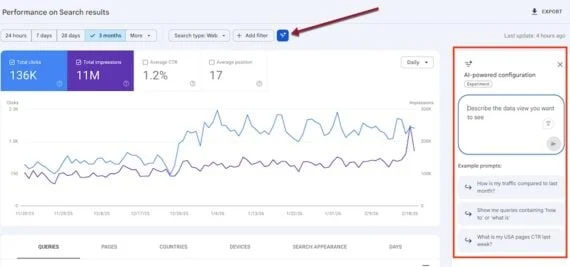
Google Search Console has rolled out a significant enhancement to its platform, making its AI-powered performance analysis feature publicly available after a period of limited testing. This new functionality, located within the Performance > Search results tab, promises to revolutionize how website owners and SEO professionals dissect their organic search performance. By enabling users to input generative AI-like prompts, the tool offers a more intuitive and dynamic way to extract actionable insights, moving beyond traditional pre-built filters. The move signals Google’s ongoing commitment to integrating advanced AI capabilities into its core webmaster tools, aiming to empower users with more sophisticated data analysis at their fingertips.
A New Era of Query Analysis
Previously, users relied on a predefined set of filters within Search Console to understand the nuances of their search queries. These filters, while functional, often required a degree of familiarity with SEO terminology and a manual process of applying and refining criteria. The new AI analysis fundamentally alters this paradigm. Instead of navigating through dropdown menus or inputting complex regular expressions manually, users can now articulate their analytical needs in natural language.
For instance, to identify queries demonstrating informational intent, a user can simply prompt: "Show queries with informational intent." The AI, in turn, generates a regular expression that encapsulates this intent. The example provided in the initial rollout demonstrates this clearly: the prompt "Show queries with informational intent" resulted in the AI generating the regex (what|how|why|guide|tutorial|explain|definition|example|best way to|steps to|tips for|reasons why|benefits of|difference between). This regex effectively captures a wide array of question-based and instructional search terms that users typically employ when seeking information. Once generated, the user has the option to "Apply" this regex to filter their performance data, immediately revealing the queries that fall under this category.
Similarly, the tool can identify queries related to product research. A prompt such as "Show product research queries" yields a regex designed to capture terms associated with purchasing decisions, comparisons, and evaluations. The example regex provided for this is (best|review|compare|vs|price|buy|alternatives|guide|recommendations |features|specs|cost|discount|deal|sale|where to buy|how to choose|top rated|pros and cons). This demonstrates the AI’s ability to recognize patterns in search behavior that indicate a user is in the consideration or decision-making phase of a purchase journey. The ability to apply these filters directly streamlines the process of understanding consumer intent and optimizing content accordingly.

Unpacking Brand Search Performance
The integration of AI also extends to analyzing brand visibility. Understanding how users search for a brand directly is crucial for reputation management and for measuring brand recall. The AI analysis has shown surprising efficacy in this area. A prompt like "Show branded queries" is designed to identify searches that directly include the brand’s name. The AI’s response, such as (brandname|brand name), indicates its capability to recognize variations of a brand’s name, including single-word and multi-word formulations. This is a critical distinction, as users might search for a brand as a single entity or as a two-word phrase (e.g., "Google" vs. "Google Search"). The ability to automatically segment these queries provides a clearer picture of direct brand traffic and the effectiveness of brand marketing efforts.
Diagnosing Traffic Fluctuations with AI
One of the most pressing concerns for website owners is understanding and addressing drops in organic traffic. Search Console’s AI analysis offers a more agile approach to diagnosing these fluctuations. Users can now formulate prompts to pinpoint changes in traffic performance over specific periods or across different segments of their search data.
For example, a prompt designed to investigate a recent traffic dip might be: "Show queries where clicks decreased by more than 10% in the last month." The AI’s ability to process such a request and generate a targeted report is a significant step forward. While the specific regex generated for such a query is not detailed in the initial reports, the implication is that the AI can correlate changes in query performance with specific metrics like click volume and date ranges. This capability allows for quicker identification of underperforming keywords and content, enabling prompt corrective actions.
Country-Specific Performance Evaluation
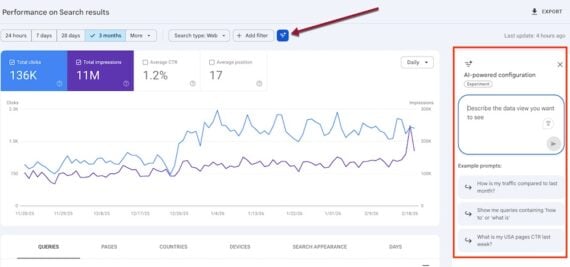
In an increasingly globalized digital landscape, understanding search performance on a country-specific basis is paramount for international SEO strategies. The AI feature enhances this capability by allowing users to query data based on geographical location. A prompt like "Show queries with a significant number of impressions in Canada" would enable users to focus their analysis on a particular market.
Furthermore, the AI can assist in analyzing traffic changes within specific regions. For instance, a prompt such as "Show queries with a notable increase in clicks in Germany over the past quarter" would allow marketers to assess the impact of localized campaigns or identify emerging trends in that market. This granular control over geographical data analysis, driven by natural language prompts, empowers businesses to tailor their content and marketing efforts to diverse international audiences more effectively.
Limitations and Future Potential
Despite its promising capabilities, the new AI analysis feature in Google Search Console is not without its limitations. The article notes that for inexperienced users, the challenge lies in knowing what to ask. Without a clear understanding of SEO principles or the data available within Search Console, users might struggle to formulate effective prompts. Conversely, seasoned SEO professionals, who are already adept at using the platform’s robust pre-built filters and advanced regex capabilities, may find the AI’s current offerings to be less of a paradigm shift and more of an alternative method for tasks they can already perform efficiently.
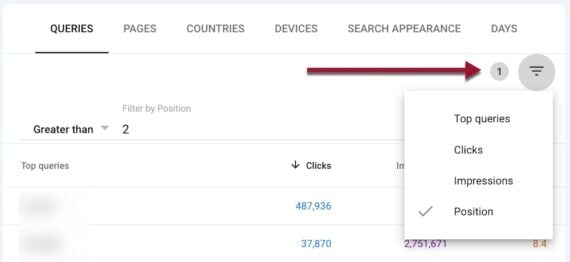
A key constraint highlighted is the AI’s current integration with only the top-level filters available in the Performance reports. This means the AI cannot process requests for filtering based on metrics or dimensions that are not directly accessible or pre-filtered in the standard interface. For example, the AI cannot currently respond to prompts like "Show queries with an average position greater than 2." This limitation restricts the depth of analysis achievable through natural language prompts, as sophisticated queries often require combining multiple filter criteria, including those related to average position, impression thresholds, or specific device types that might not be directly addressed by the AI’s current generative capabilities.
The accompanying screenshot illustrating the limitation of filtering only on "position 1" in default Performance reports further emphasizes this point. While users can manually apply such a filter, the AI’s inability to interpret and execute this specific instruction through a prompt indicates that its understanding of the full spectrum of Search Console’s filtering logic is still evolving. This suggests that the AI’s primary function is to translate common SEO analytical questions into existing filter parameters rather than to enable entirely new forms of data exploration that go beyond the platform’s current reporting structure.
Broader Implications for SEO and Content Strategy
The introduction of AI-powered analysis in Google Search Console signifies a broader trend towards democratizing advanced data analytics. By lowering the barrier to entry for complex query analysis, Google is empowering a wider range of website owners, including small business owners and content creators who may not have dedicated SEO teams, to gain valuable insights into their search performance.
This shift has several implications:
- Enhanced Content Optimization: The ability to quickly identify informational, transactional, or navigational queries allows content creators to tailor their output more precisely to user intent. This can lead to higher engagement, better conversion rates, and improved search rankings.
- More Agile SEO Strategies: The speed at which users can now analyze traffic drops or brand performance enables quicker responses to market changes or performance issues. This agility is crucial in the dynamic landscape of search engine optimization.
- Focus on Strategic Thinking: As the AI handles the more mechanical aspects of data filtering, SEO professionals can potentially shift their focus towards higher-level strategic thinking, such as content gap analysis, competitive landscape assessment, and long-term SEO planning.
- Evolution of Search Console: This move suggests that Google intends to continue evolving Search Console into a more intelligent and user-friendly tool, leveraging AI to provide proactive insights and recommendations.
While the current iteration of the AI analysis in Search Console has its limitations, its public release marks a significant step. It opens up new avenues for understanding website performance through natural language, making sophisticated SEO analysis more accessible. As Google continues to refine these AI capabilities, we can anticipate even more powerful and intuitive ways for users to engage with their search data, further solidifying the importance of Search Console as an indispensable tool for any online presence. The ongoing development of this feature will likely see it expanding to encompass more complex filtering capabilities and potentially offering more direct analytical interpretations, moving beyond just generating regex. This evolution is a clear indicator of Google’s commitment to harnessing AI for the benefit of webmasters and search marketers worldwide.

