
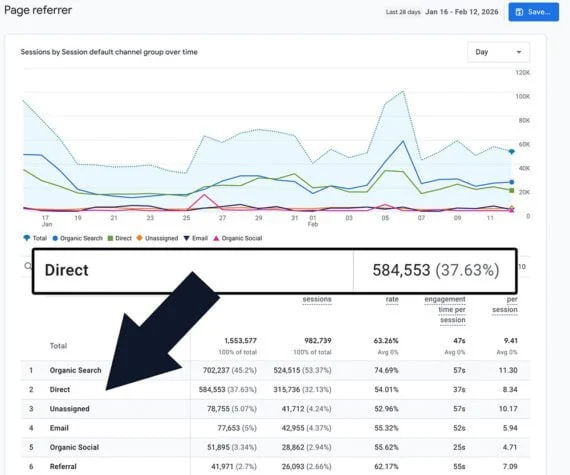
The seemingly straightforward "direct" traffic channel within website analytics platforms, including industry giants like Google Analytics, is increasingly coming under scrutiny for its potential to mislabel, mislead, and ultimately harm marketing strategies. What was once a clear indicator of brand recognition and user intent has evolved into a complex, often inaccurate, catch-all category that can obscure the true performance of various marketing initiatives.
The fundamental issue lies in how analytics software defines and categorizes traffic sources. In essence, when a user visits a website, analytics platforms attempt to identify the origin of that visit. This is typically achieved through two primary mechanisms: referrers and UTM parameters. Referrers are the URLs of the previous page a user visited before landing on the current site. UTM parameters, on the other hand, are tags added to URLs that allow marketers to track the performance of specific campaigns, such as email newsletters, social media posts, or paid advertisements.
When a visit lacks a discernible referrer or UTM parameters, analytics platforms default to categorizing it as "direct" traffic. This creates an analogy to a busy e-commerce sortation center that, upon receiving a package without an identifiable origin address, places it in a hypothetical "direct" bin for later, perhaps less precise, handling. Similarly, direct traffic in analytics can encompass a wide array of user journeys that lack the explicit attribution signals the software is designed to detect.
The Escalating Concern Over Direct Traffic Misattribution
Industry reports consistently indicate that direct traffic often constitutes a significant portion of a website’s overall visits, frequently ranging from 20% to a substantial 60%. While this figure might initially suggest strong brand recall and organic interest, a growing chorus of prominent digital marketing practitioners has voiced concerns that this substantial "direct" segment is not as straightforward as it appears. Figures such as Neil Patel, Jon Henshaw, and Katie Rigby have publicly highlighted the potential for mislabeled direct traffic, suggesting that it may be masking the true effectiveness of various marketing channels.
Historically, a "direct" visit was unequivocally understood as a user who had consciously typed a website’s URL into their browser or used a bookmark. This behavior was a strong indicator of brand loyalty, established recognition, and a clear intention to engage with a specific brand or service. However, the contemporary landscape of online interactions has rendered this definition increasingly inadequate. The proliferation of new digital channels and evolving user behaviors have blurred the lines, leading to a situation where marketing-driven visits, genuine direct inbounds, and even traffic from emerging platforms like Google Discover can all be consolidated under the "direct" umbrella.
The Problematic Nature of a Catch-All Category
The core problem with the "direct" traffic category’s catch-all nature is its potential to obscure the success of marketing efforts. For instance, a well-executed outreach campaign on a platform like Discord, where referral data is often absent, might see its traffic inaccurately attributed to direct visits. Similarly, effective SMS marketing campaigns, which may not consistently pass referrer information, could have their impact diluted within the direct traffic pool. This lack of accurate attribution makes it exceedingly difficult for marketers to assess the return on investment (ROI) of their campaigns, identify high-performing channels, and optimize future strategies.

Investigating Suspicious "Direct" Traffic
While it is important to acknowledge that a portion of "direct" traffic will always represent genuine direct visits, marketers can take several steps to investigate potential misattributions within their analytics platforms. By examining specific segments and cross-referencing data, a clearer picture of traffic origins can begin to emerge.
One initial step involves a thorough review of the "direct" traffic segment within Google Analytics or similar platforms. This often involves segmenting the data further to identify patterns or anomalies. For example, looking at the landing pages for direct traffic can sometimes reveal insights. If a significant portion of "direct" traffic is landing on specific campaign landing pages that should ideally be tracked with UTM parameters, it suggests a tracking issue.
Another critical area of investigation involves looking at the behavior of "direct" traffic visitors compared to other channels. Are these visitors exhibiting similar engagement metrics, such as time on site, bounce rate, and conversion rates, as users from known, attributable channels? Significant deviations could indicate that the "direct" segment is not homogenous.
Furthermore, examining the devices and browsers used by "direct" traffic visitors can sometimes offer clues. While not a definitive indicator, certain patterns might correlate with specific traffic sources that are less likely to pass referrer data.
The "Dead," "Dark," and "Blind" of Direct Traffic
Beyond the general misattribution, the "direct" traffic category can be further complicated by several distinct phenomena: "dead" traffic, "dark" traffic, and "analytics blindness." Understanding these categories can help to more accurately diagnose the composition of a site’s direct traffic.
Dead Traffic: The Rise of Non-Human Visitors
While likely representing the smallest percentage of "direct" traffic, "dead" or "zombie" visits refer to traffic generated by non-human entities, such as AI agents, search engine crawlers, website monitoring systems, or competitor price scrapers. These automated programs often operate undetected by standard analytics providers, making their traffic appear as if it originated from a direct source.
The issue of bot traffic has been a growing concern in the digital advertising ecosystem for years. Fast Company, in a notable report, explored how such traffic can significantly distort behavioral signals and undermine marketing efforts. The article highlighted the emergence of platforms like Moltbook, described as a vibe-coded social network exclusively for AI agents, as a harbinger of a "zombie internet." This new digital frontier, populated by AI entities, could have profound and potentially devastating consequences for the advertising industry by skewing engagement metrics and ad performance data. The ability of these bots to mimic human behavior, albeit imperfectly, makes their detection and exclusion a significant challenge.
Dark Traffic: Legitimate Visits Without Clear Origins
"Dark" traffic encompasses legitimate user visits that, for various technical or privacy-related reasons, do not pass clear referral or parameter data to analytics platforms. This category is broad and can include a range of scenarios:
- Email Opens and Clicks: While many email marketing platforms attempt to append tracking parameters, some email clients or user settings can strip this information, leading to email-driven traffic being classified as direct.
- Messaging App Referrals: Clicks originating from popular messaging applications like WhatsApp, Telegram, or Signal often do not pass referrer data. As these platforms become increasingly used for marketing and customer communication, this represents a growing source of dark traffic.
- Social Media Private Messages: Similar to messaging apps, traffic originating from private messages on social media platforms typically lacks referrer information.
- Certain Mobile App Interactions: Some in-app browsing experiences or deep links can also fail to pass referrer data, contributing to the dark traffic pool.
- Google Discover and Similar Platforms: Content discovery platforms like Google Discover, which present personalized content feeds to users, often serve content in a way that does not pass referrer information to the destination website.
The opaque nature of dark traffic means that valuable insights into user engagement and campaign performance are lost. Marketers actively investing in content distribution through these channels may be unaware of their actual reach and impact.
Analytics Blindness: Privacy-Driven Data Gaps
A distinct, yet related, issue is "analytics blindness," which occurs when visits are not recorded by analytics software at all, rather than simply being miscategorized. This is often a consequence of robust privacy protection applications. Unlike the scenarios that lead to dark traffic, where the visit occurs but lacks attribution data, analytics blindness means the session is entirely invisible to the analytics platform.
This can happen when users employ browser extensions or settings that block JavaScript from loading altogether. Google Analytics and many other web analytics platforms rely heavily on JavaScript to collect data about user sessions. When this script is blocked, the analytics software cannot record the visit, effectively rendering the user "blind" to the analytics system. While this is a legitimate privacy choice by the user, it creates a blind spot for the website owner, preventing them from understanding a segment of their audience.
Addressing Attribution Gaps for Strategic Advantage
The pervasive issue of mislabeled "direct" traffic poses a significant challenge for businesses, particularly those engaged in community marketing, social media outreach, or those who cater to privacy-conscious consumers. Without an accurate understanding of their traffic sources, these merchants risk inadvertently cutting off or underfunding high-performing channels that are being incorrectly attributed.
To mitigate these attribution gaps, a proactive audit of "direct" traffic is essential. This involves a multi-faceted approach:
- Deep Dive into Direct Traffic Segments: Analyzing landing pages, user behavior metrics, and device/browser data associated with direct traffic can reveal patterns indicative of misattribution.
- Leveraging Alternative Tracking Methods: Beyond standard web analytics, businesses can explore other measurement tools. This includes:
- CRM Data Integration: Connecting website analytics with customer relationship management (CRM) data can help attribute leads and conversions to their original marketing touchpoints, even if web analytics alone struggles.
- Call Tracking: For businesses that receive a significant volume of phone inquiries, implementing call tracking solutions can attribute inbound calls to specific marketing campaigns.
- Unique Landing Pages and Promo Codes: Using unique landing pages or specific promotional codes for different marketing channels can provide a direct link between a campaign and subsequent website visits or sales.
- Surveys and Feedback Forms: Directly asking customers how they heard about the business through post-purchase surveys or feedback forms can offer invaluable qualitative data on traffic origins.
By employing these supplementary methods, businesses can begin to reconstruct a more accurate picture of their marketing ecosystem, moving beyond the limitations of a potentially misleading "direct" traffic metric. The ongoing evolution of digital tracking, coupled with increasing user privacy concerns, necessitates a dynamic and comprehensive approach to understanding website traffic and attributing success effectively.

