
Google Search Console has rolled out a significant update, introducing new filters designed to isolate and analyze branded search queries. This enhancement, powered by artificial intelligence, aims to streamline the process for website owners and digital marketers to understand how their brand is being searched for on Google. While the feature simplifies existing capabilities, it represents a notable step forward in providing more granular insights into user search behavior related to brands.
The core functionality of the new filters lies in their ability to either display search queries that Google classifies as "branded" or to exclude them entirely. This distinction is crucial for businesses aiming to understand their brand visibility, competitive landscape, and the effectiveness of their marketing efforts. Google employs AI to categorize these queries, a process that, as the company acknowledges, is not infallible and can occasionally lead to misclassifications.
Historically, isolating branded queries within Search Console required more advanced techniques. Marketers relied on regular expressions (regex) to identify specific brand names within the vast dataset of search queries. More recently, the integration of AI prompts allowed for a more intuitive, though still somewhat experimental, approach to query filtering. The new dedicated "branded query" filter aims to democratize this capability, making it accessible to a broader range of users without requiring specialized technical knowledge.
During initial testing and user feedback, the new filter has demonstrated its ability to capture a wide array of brand-related terms. These often include direct brand names, variations of brand names, and terms commonly associated with a particular brand. For instance, if a brand is "Acme Corp," the filter is expected to identify queries such as "Acme Corp," "Acme Corporation," "Acme," and potentially even "Acme products." Similarly, product names directly linked to a brand are generally recognized.
However, the AI’s classification system is not without its limitations. In practice, the filter has shown instances where it correctly identified a founder’s name as a branded query, but failed to recognize the title of a book authored by that same founder, classifying it instead as a non-branded term. This highlights the AI’s current reliance on direct name recognition and its potential challenges with indirect brand associations or derivative works. Furthermore, the filter has, in some cases, included queries for unrelated executives, competing brands, and even client case studies, suggesting that Google’s definition of a "brand" search might be broader than initially anticipated by some users. These broader inclusions, while potentially surprising, could offer valuable insights depending on a business’s strategic objectives.

Strategic Applications of Brand-Name Filters
Despite these occasional misclassifications, the introduction of dedicated brand-name filters offers significant advantages for strategic analysis. By enabling users to easily separate branded from non-branded search traffic, these filters unlock powerful use cases for understanding market position and campaign effectiveness.
Identifying Competitive Threats and Lost Customer Opportunities
One of the most immediate applications of the branded query filter is the identification of competitive threats. Competitors frequently target branded keywords, either through paid advertising campaigns on platforms like Google Ads or by creating content that directly contrasts their offerings with established brands. Common strategies include bidding on a brand’s own name in ads or publishing "Alternative to [Your Brand]" pages.
When a website’s average position for a branded search term is not the coveted number one spot, or if the click-through rate (CTR) falls below a benchmark of 50%, it signals a potential problem. This could indicate that a competitor is either outranking the brand for its own name through superior SEO or is aggressively advertising against it, siphoning off potential customers. By utilizing the branded query filter, businesses can pinpoint these specific instances, analyze the performance metrics for their branded terms, and develop targeted strategies to improve their branded search rankings and overall visibility. This proactive approach is essential for protecting brand equity and retaining customer loyalty.
Measuring the Impact of Marketing Campaigns
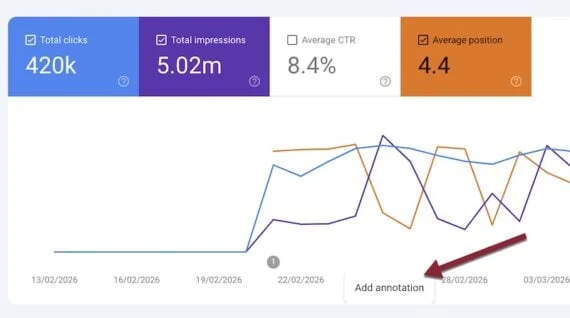
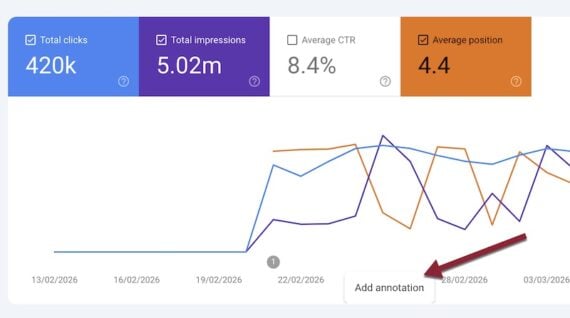
The branded query filter also provides a powerful tool for tracking the efficacy of marketing initiatives. Any promotional activity, whether it’s paid advertising, email marketing, public relations outreach, or content marketing, is likely to influence the volume of branded search traffic. While direct attribution for every branded search may be elusive, the new filter allows marketers to annotate their performance reports with specific campaign timelines.
This annotation feature, accessible by right-clicking on any performance chart within Search Console, enables users to mark the start and end dates of their campaigns. By correlating these annotations with fluctuations in branded search volume and rankings, businesses can gain a clearer understanding of which marketing efforts are effectively driving brand awareness and interest. The data for these branded filters is available from February 21st onwards, providing a recent historical baseline for analysis. Visualizing this data allows for a more intuitive understanding of cause and effect between marketing activities and brand search performance.
Global Brand Recognition and Regional Market Analysis
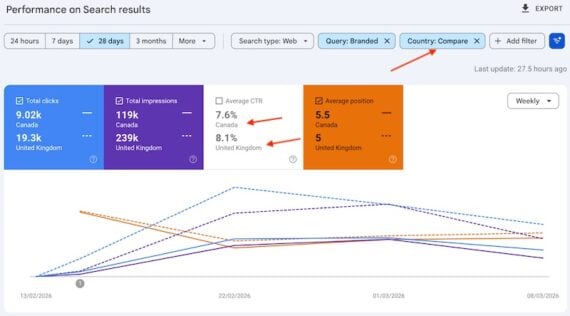
For businesses operating on a global scale, understanding regional brand perception is paramount. The branded query filter, when combined with location-based filtering, offers valuable insights into how brand awareness varies across different countries.
Sellers can now easily filter for branded searches and then segment these results by specific countries. This allows for a comparative analysis of brand recognition and search volume in diverse markets. For example, a company can compare branded traffic in Canada versus the United Kingdom to gauge the relative strength of its brand in these two English-speaking markets. Such granular regional analysis can inform localized marketing strategies, resource allocation, and product development efforts, ensuring that campaigns are tailored to the specific nuances of each market. This capability is particularly useful for identifying regions where brand building efforts may need to be intensified or where existing strategies are proving particularly successful.
Background and Broader Context
The introduction of AI-powered classification and filtering in Google Search Console marks an evolution in how search engines provide data to website owners. In previous years, Search Console’s performance reports offered a wealth of information, but extracting specific insights often required significant manual effort or specialized tools. The move towards AI-driven features reflects Google’s broader commitment to leveraging machine learning to improve the usability and analytical power of its developer and webmaster tools.
This update can be seen in the context of Google’s ongoing efforts to enhance Search Console’s capabilities, which began with more fundamental query and page filtering and has progressively incorporated more sophisticated analytical functions. The ability to filter by regular expressions, for instance, was a significant step that allowed for complex pattern matching. The subsequent exploration of AI prompts hinted at a future where more natural language processing would be integrated into the platform. The current branded query filter is a tangible manifestation of this evolution, offering a more user-friendly and sophisticated way to interpret search data.
The timeline of these developments suggests a gradual but deliberate enhancement of Search Console. While specific release dates for the regex and AI prompt features are not detailed in the provided text, the current branded filter is noted to be showing results from February 21st onwards, indicating a recent rollout. This ongoing development cycle underscores Google’s responsiveness to the needs of SEO professionals and digital marketers who rely on accurate and actionable data to optimize their online presence.
Implications for the Digital Marketing Landscape
The implications of these enhanced filters are far-reaching for the digital marketing landscape. For small and medium-sized businesses (SMBs) with limited SEO resources, the new branded query filters democratize access to sophisticated brand analysis. Previously, such in-depth analysis might have been cost-prohibitive, requiring specialized agencies or expensive third-party tools. Now, SMBs can gain valuable insights into their brand’s performance directly within Search Console, empowering them to make data-driven decisions without significant additional investment.
For larger enterprises and digital marketing agencies, the new filters offer a more efficient workflow. The time saved by not having to manually construct complex regex queries or wade through non-branded terms can be reinvested in strategic analysis and campaign optimization. This increased efficiency can lead to more agile marketing strategies and a quicker response to market changes or competitive actions.
Furthermore, the development highlights the growing importance of AI in search engine optimization. As AI continues to evolve, its role in classifying content, understanding user intent, and influencing search rankings will likely become even more pronounced. Tools like Search Console are adapting to this reality by integrating AI-powered features that help users understand and leverage these AI-driven dynamics. This means that SEO professionals will need to continually adapt their skill sets to incorporate an understanding of how AI operates within the search ecosystem.
The potential for misclassification, while acknowledged by Google, also serves as a reminder that human oversight remains critical. While AI can automate and simplify complex tasks, a nuanced understanding of brand strategy, competitive positioning, and market context is still essential for interpreting the data accurately and formulating effective strategies. The branded query filter is a powerful tool, but its true value is realized when combined with expert human analysis.
In conclusion, the introduction of branded query filters in Google Search Console is a significant enhancement that empowers businesses to gain deeper insights into their brand’s performance in organic search. By simplifying the process of identifying and analyzing branded search terms, Google is providing valuable tools that can inform competitive analysis, measure marketing impact, and facilitate global brand strategy. As AI continues to shape the search landscape, such advancements in analytics will be crucial for businesses seeking to thrive in the digital age.

