
Google Ads is set to implement significant changes to its bidding system on August 17, a move the company asserts will enhance performance predictability for advertisers. However, industry observers and early analyses suggest these alterations could introduce unforeseen fluctuations in campaign outcomes, potentially impacting return on ad spend (ROAS) and cost per acquisition (CPA) in ways that require careful management. The adjustments primarily affect target-based bidding strategies, such as Target ROAS (tROAS) and Target CPA (tCPA), aiming to align actual campaign performance more closely with the set objectives.
Understanding the Shift: From Flexibility to Focused Achievement
Historically, target-based bidding strategies in Google Ads have operated with a degree of flexibility, aiming to achieve a target while allowing for performance that might exceed or fall short of the specified goal, within certain parameters. The upcoming changes signal a fundamental shift in this philosophy. Google’s stated intention is to prioritize hitting the advertiser’s defined target as the primary objective. For instance, if an advertiser sets a tROAS of 300%, the system will now actively work to achieve precisely that 300% return, even if the campaign has been performing at a higher rate, such as 500%. Previously, exceeding a target significantly might have been seen as a positive indicator, allowing the algorithm to operate within a broader, more opportunistic range. This new directive means that campaigns consistently outperforming their targets may see their performance intentionally steered downwards to meet the established goal.
While Google has indicated that the primary impact will be felt by budget-limited campaigns, the prudent approach for advertisers is to review all campaigns utilizing target-based bidding strategies. The nuance lies in how the algorithm interprets "hitting the goal." This implies a more stringent adherence to the set metrics, potentially sacrificing higher-than-expected returns in favor of consistent achievement of the programmed target.
Navigating the Transition: Advertiser Preparedness is Key
The onus is now on advertisers to proactively establish their performance preferences and understand how these changes will affect their campaigns. This necessitates a critical evaluation of current bidding strategies and a forward-looking assessment of desired outcomes. Google has provided a tool designed to facilitate this transition, allowing advertisers to view their current bid targets alongside recent campaign performance data.
The Bid Target Adjustment Tool: A Snapshot of Performance and Future Direction
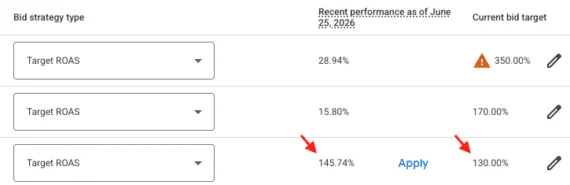
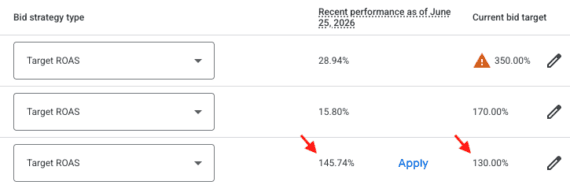
This newly introduced tool offers a crucial visual representation of campaign performance relative to its set targets. For example, a campaign might show a current target ROAS of 130%, while its actual recent performance has been 145.74%. In the pre-change environment, this scenario would typically mean the campaign is succeeding and optimizing towards that 130% goal. However, under the new system, if the target remains at 130%, the system will actively work to reduce the performance from 145.74% down to the 130% mark. This is a critical distinction, as it means advertisers who are content with their current higher performance levels must actively intervene to preserve them.
Strategic Options for Advertisers in the Face of Change
Google Ads has outlined four primary options for advertisers to consider when adapting to these new bidding dynamics:
-
Keep the Target As Is: For advertisers who are satisfied with their current performance and are willing to accept the system’s drive to align with the existing target, no immediate action is required. This approach essentially allows the algorithm to optimize downwards if performance exceeds the set goal. While this ensures adherence to the target, it may mean leaving potential higher returns on the table.
-
Maintain Recent Performance (Adjusting Targets Upward): This strategy is crucial for advertisers who have consistently surpassed their bidding targets and wish to maintain those higher performance levels. The recommendation is to gradually increase the target if actual performance has exceeded it by a significant margin, for example, by more than 20%. If a campaign is achieving a 200% ROAS against a 130% target, an advertiser might consider increasing the target to no more than 156% (a 20% increase on the current performance). This adjustment should ideally be made incrementally over a period, perhaps in two-week intervals, allowing the algorithm to adapt and learn. This approach requires careful monitoring to ensure that the overall account-level ROAS does not suffer due to individual campaigns being artificially suppressed to meet lower targets. A single campaign achieving a 500% return against a 300% goal, for instance, would negatively impact the overall account ROAS if not managed properly under the new system.
-
Adjust the Custom Target: In situations where a defined target ROAS or CPA is deemed unrealistic based on actual performance, advertisers have the option to adjust their custom target. If 400% ROAS is a demonstrably achievable and desirable performance level, and the current target is set at a lower figure like 300%, a direct adjustment to the new, higher target is advisable. This option bypasses the gradual adjustment and sets a new, more ambitious benchmark that aligns with proven performance.
-
Switch to a Maximize Strategy: For advertisers whose primary objective is to maximize the volume of conversions or revenue within a defined budget, regardless of specific ROAS or CPA targets, switching to a "Maximize Conversions" or "Maximize Conversion Value" strategy might be the most appropriate course of action. These strategies are designed to achieve the highest possible volume of desired outcomes within the allocated budget. While this approach is likely to increase conversion volume and revenue, it may come at the cost of efficiency, meaning the cost per conversion or the ROAS might decrease.
The Broader Context: A History of Algorithm Evolution in Google Ads
This latest alteration to Google Ads’ bidding system is part of a continuous evolution of its advertising platform, driven by advancements in machine learning and artificial intelligence. For years, Google has progressively shifted towards automated bidding strategies, aiming to simplify campaign management and improve performance through sophisticated algorithms. Features like Smart Bidding, which encompasses tCPA and tROAS, were introduced to leverage machine learning to optimize bids in real-time for conversions or conversion value.
The underlying principle has always been to use vast amounts of data to predict user behavior and allocate ad spend more effectively. However, the inherent challenge with automated systems is balancing predictability with the potential for unintended consequences. Advertisers often rely on a degree of predictability to forecast budgets and expected returns. When algorithms change, especially in ways that might suppress higher-than-expected performance, it can create uncertainty.
This change can be viewed as Google’s attempt to solidify the "target" aspect of target-based bidding. By making the target the paramount objective, Google aims to provide a more stable and predictable baseline performance for advertisers. However, the "unpredictable swings" mentioned in early analyses stem from the fact that if an advertiser is not prepared, their campaigns could be actively steered away from their current, higher performance levels, leading to a perceived decline in efficiency.
Implications for Advertisers and the Digital Marketing Landscape
The ramifications of this Google Ads bidding system overhaul are multifaceted:
-
Increased Need for Proactive Management: Advertisers can no longer afford a passive approach to target-based bidding. Regular monitoring and strategic adjustments will be essential to align campaign performance with evolving business goals.
-
Potential for Reduced Efficiency in Some Campaigns: Campaigns that have been outperforming their targets may see a decrease in their ROAS or an increase in their CPA if advertisers do not intervene to adjust their targets upward. This could impact profitability for businesses that have optimized their operations around these higher performance metrics.
-
Opportunity for Strategic Re-evaluation: The changes provide a catalyst for advertisers to re-evaluate their core objectives. Is the goal consistent target achievement, maximum volume, or a specific balance between the two? The new system compels a clearer articulation of these priorities.
-
Data-Driven Decision-Making Becomes Paramount: The bid target adjustment tool highlights the critical importance of understanding campaign data. Advertisers will need to be more adept at analyzing performance trends and making informed decisions based on this data.
-
Impact on Budget Allocation: For businesses that rely heavily on Google Ads for lead generation or sales, understanding how these changes will affect their overall budget efficiency is crucial. A sudden shift in campaign performance could necessitate a reallocation of marketing spend.
Expert and Industry Reactions (Inferred)
While direct quotes from Google representatives on the specific nuances of potential volatility are not readily available, the company’s official communication emphasizes improved predictability. However, within the digital marketing community, there is a palpable sense of caution. Industry consultants and agency leaders are advising clients to prepare for a period of adjustment. The consensus is that while the goal of predictability is laudable, the execution could lead to a learning curve for both advertisers and Google’s algorithms. The key takeaway is that proactive engagement with the new system, rather than a wait-and-see approach, will be the most effective strategy for navigating this significant platform update.
Looking Ahead: Adapting to the Evolving Bidding Landscape
The August 17th change to Google Ads’ bidding system represents a significant evolution in how campaigns will be managed and optimized. While Google aims for greater predictability, the onus is on advertisers to understand these changes deeply and take proactive steps to align their strategies with their business objectives. The transition demands a sharper focus on data analysis, strategic planning, and a willingness to adapt to an increasingly sophisticated automated bidding environment. The success of this overhaul will ultimately be measured not just by Google’s stated intentions, but by the tangible outcomes and the ability of advertisers to harness these changes to their advantage.

