
The landscape of e-commerce is undergoing a profound transformation, driven by the rapid advancement and integration of Artificial Intelligence (AI). For years, marketers have grappled with the concept of "intent" – understanding why a shopper is searching and what they ultimately aim to acquire. Traditionally, this manifested as "purchase intent" or "informational intent," guiding targeted campaigns based on discernible needs. However, the advent of generative AI, particularly in search and conversational interfaces, is introducing an unprecedented level of granularity and opportunity, allowing marketers to effectively engage with shoppers who are not yet sure of their exact desires. This new paradigm necessitates a strategic shift towards "Product Intent Clusters," a sophisticated approach to content creation and optimization designed to influence AI-driven product discovery and ultimately drive conversions.
The evolution of online search has always been intertwined with the concept of user intent. Early search engines primarily processed keyword-based queries, averaging a mere four words per search. This limited the depth of understanding regarding a user’s specific needs. For instance, a shopper seeking a coffee grinder might have typed "small simple coffee grinder." While this query provided a basic direction, it lacked the nuanced context that truly defines a shopper’s requirements. The subsequent rise of content marketing and SEO strategies focused on long-tail keywords and topic clusters aimed to address this by creating more specific content that matched these granular searches. This allowed businesses to rank for more precise queries, thereby capturing highly motivated buyers.
The introduction of conversational AI, exemplified by platforms like ChatGPT, Claude, and Gemini, has dramatically altered the search dynamic. These AI models are capable of processing significantly longer and more complex queries. A Semrush analysis from 2026 highlighted that ChatGPT queries, on average, extend to approximately 23 words. This increased verbosity allows users to articulate their needs with far greater detail and context. Consider the same coffee grinder scenario. Instead of a simple keyword string, a user interacting with an AI assistant might articulate their needs as: "I need a quiet coffee grinder for my small apartment that works well for pour-over coffee and is easy to clean without making a mess." This detailed prompt, while potentially longer, reveals a much richer set of requirements: quiet operation, suitability for a compact living space, compatibility with a specific brewing method (pour-over), and ease of maintenance.
The implications of this shift are immense for e-commerce marketers. While a traditional search engine might surface a broad range of coffee grinders based on "small simple," a conversational AI, armed with the more detailed query, can identify a more specific product category that meets all the stated criteria. In this case, a conical burr grinder might be the ideal solution. The AI’s ability to process such detailed natural language queries opens up new avenues for product discovery. Marketers are no longer solely competing on broad keywords but on their ability to provide comprehensive, contextually relevant information that AI systems can readily process and recommend.
The Emergence of Product Intent Clusters
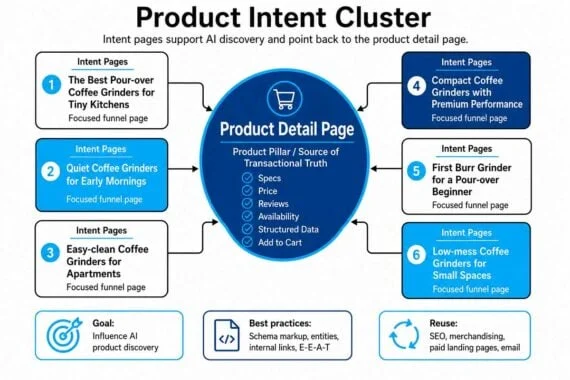
To effectively capitalize on these evolving AI-driven search behaviors, e-commerce businesses are increasingly adopting a strategy centered around "Product Intent Clusters." These clusters represent a structured approach to content creation and organization, designed to comprehensively address specific shopper scenarios and use cases. At their core, Product Intent Clusters are analogous to traditional topic clusters or content silos but are specifically tailored to the nuances of product discovery within AI-powered environments.
The central element of any Product Intent Cluster is the Product Detail Page (PDP). This page remains the ultimate source of truth for a purchase decision, housing critical information such as product specifications, pricing, customer reviews, availability, and structured data essential for machine readability. The PDP is designed to drive conversions and must be structured in a way that is both comprehensible to human shoppers and easily extractable and understandable by AI entities.
Surrounding this central PDP is a network of supporting content pages. These pages are not merely additional blog posts; they are meticulously crafted to address specific facets of a shopper’s intent, as revealed by detailed AI queries. Each supporting page within a cluster targets a particular shopping scenario or user need, providing in-depth information that guides the AI towards recommending the central product.
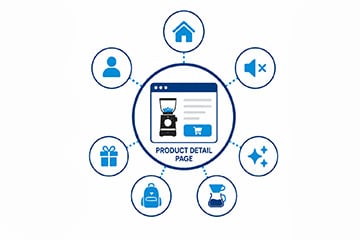
The structure of a Product Intent Cluster can be visualized as a hub-and-spoke model. The Product Detail Page is the hub, and the supporting content pages are the spokes, each radiating outwards to address a specific user journey. For example, if the central product is a high-end blender, the supporting pages might include:
- "Best Blenders for Making Smoothies with Frozen Fruit": Addresses a specific use case and ingredient challenge.
- "Quiet Blenders for Small Kitchens": Focuses on noise levels and spatial constraints, echoing the coffee grinder example.
- "Easy-to-Clean Blenders for Busy Professionals": Highlights convenience and time-saving aspects.
- "Blender Attachments for Nut Butters and Dips": Explores extended functionality and versatility.
- "Comparing High-Performance Blenders: Vitamix vs. Blendtec": Offers comparative analysis for shoppers making informed decisions.
These supporting pages are designed to be more than just informational; they are intended to influence AI product discovery. By providing comprehensive answers to specific, often implicit, questions within an AI query, these pages increase the likelihood that the AI will identify and recommend the relevant product.
Crafting Intent-Focused Content
The creation of effective intent pages requires a departure from traditional content strategies. While SEO best practices, such as Schema.org structured data markup and the strategic use of entities, remain crucial for human readability and machine understanding, the focus shifts towards deeply understanding and addressing specific shopper scenarios.
A key differentiator for these intent pages is their specificity. Instead of a broad topic like "best coffee grinders for pour-over," a more effective intent page would be "best pour-over coffee grinders for tiny kitchens." This refined title immediately signals to both AI and human users that the content is tailored to a very particular set of circumstances. The shopper seeking this information likely values pour-over quality, faces space limitations, desires quiet operation, and prioritizes easy cleanup – all critical factors that an AI can interpret and use to match with product features.
Each intent page should serve as a mini-guide, meticulously crafted to lead the shopper towards a purchase decision. This involves:
- Detailed Product Feature Explanations: Going beyond basic specifications to explain how features directly address the shopper’s specific scenario. For the "tiny kitchen" example, this would involve detailing the grinder’s compact footprint, its quiet motor, and its simple disassembly for cleaning.
- Use Case Demonstrations: Illustrating how the product excels in the specific scenario described. This could include visuals or descriptions of the grinder in a small kitchen setting or demonstrating its effectiveness for pour-over brewing.
- Addressing Potential Concerns: Proactively answering questions or mitigating concerns that a shopper in this specific situation might have. For instance, discussing any potential for static cling or grind inconsistency in a small-scale setup.
- Clear Calls to Action: While not overtly salesy, the content should naturally guide the user towards exploring the product details and considering a purchase. This could involve links to the PDP, comparisons with other relevant products within the cluster, or highlighting key benefits that align with the user’s stated needs.
The ultimate goal is to create a robust ecosystem of content where each page, while focused on a niche scenario, collectively points towards the central product. Marketers are encouraged to aim for dozens, if not hundreds, of these specialized intent pages per product, creating a comprehensive web of information that AI can navigate and leverage.
The AI Unlock: A New Era of Content Scalability
The feasibility and economic justification for creating such an extensive network of highly specific content pages were historically prohibitive for most e-commerce businesses. The labor-intensive process of researching, outlining, writing, optimizing, and maintaining hundreds of individual pages for niche use cases was simply not cost-effective, given the uncertain return on investment. The narrow scope of each page often made it difficult to justify the significant resources required.
However, the advent of generative AI has fundamentally altered this calculus. Automation and advanced AI models are now capable of producing and maintaining an almost endless supply of high-quality intent pages. These pages can be meticulously crafted through precise prompt engineering, allowing for the rapid generation of content that is both relevant and informative. This dramatically reduces the time and cost associated with content creation, making the Product Intent Cluster strategy a viable and even essential component of modern e-commerce marketing.
Furthermore, AI can play a crucial role in identifying the very topics that should form these intent pages. By feeding structured customer feedback – such as support tickets, product reviews, forum discussions, and social media comments – into a generative AI platform, businesses can gain insights into the specific questions, pain points, and use cases that their customers are articulating. This data-driven approach ensures that the content created is directly aligned with real-world customer needs and inquiries, maximizing its effectiveness.
In essence, the rise of generative AI in consumer search and shopping has created a powerful new opportunity. Shoppers, when faced with a complex decision or an unclear need, are increasingly turning to AI assistants for guidance. Product Intent Clusters provide these AI systems with the necessary information to connect a shopper’s nuanced needs with the most suitable products. By strategically building these clusters, e-commerce businesses can ensure that their products are not only discoverable but are also presented in a way that resonates deeply with the evolving methods of consumer inquiry, driving both engagement and conversion in the AI-driven marketplace. The ability to anticipate and cater to these undefined needs marks a significant evolution in how businesses approach customer engagement and product promotion in the digital age.

