
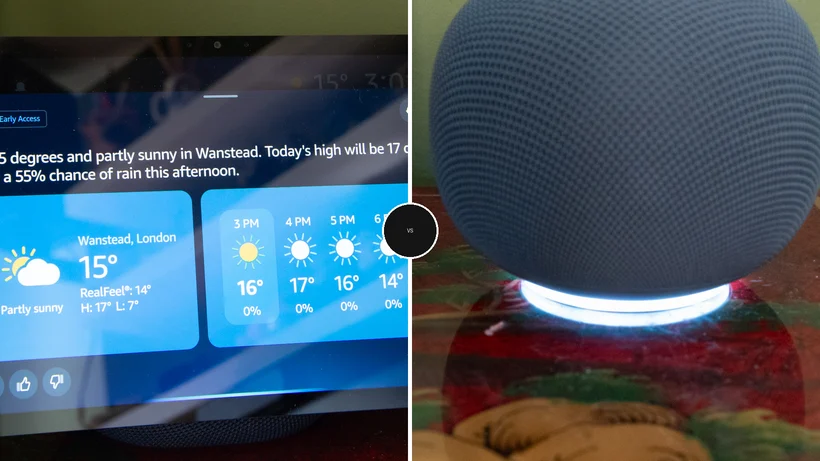
The landscape of voice assistant technology is undergoing a seismic shift, moving beyond the limitations of rigid command structures to embrace the power of Generative AI. For years, users have grappled with the frustration of voice assistants that faltered when deviating from pre-programmed phrases or struggled with anything beyond the most basic queries. This era of limited functionality appears to be drawing to a close, ushering in a new generation of intelligent agents capable of understanding natural language and drawing information from an expansive array of sources. At the forefront of this technological evolution stand two titans: Amazon’s Alexa+ and Google’s Gemini for Home.
The choice between these advanced voice assistants is intrinsically linked to existing hardware ecosystems, particularly the prevalence of smart speakers and displays. However, beyond the initial hardware considerations, a deeper examination is required to determine which system currently reigns supreme and which holds the most promise for the future. This comprehensive analysis delves into the capabilities, availability, and performance of both Alexa+ and Gemini for Home, providing a detailed comparison to guide consumers through this transformative technological transition.
Evolution of Voice Assistant Capabilities
The journey of voice assistants from rudimentary command-line interfaces to sophisticated conversational AI is a testament to rapid technological advancement. Early iterations, prevalent in the early 2010s, were characterized by their reliance on specific phrasing. Users quickly learned that uttering a command in a slightly different order or using an alternative verb could render the assistant unresponsive. This inflexibility led to widespread user dissatisfaction and a perception that these devices were largely confined to basic tasks like setting timers or checking the weather.
The introduction of machine learning and natural language processing (NLP) marked a significant step forward, enabling assistants to understand a broader range of linguistic variations. However, the underlying architecture often relied on retrieving pre-defined answers or executing narrowly defined functions. The advent of Generative AI, exemplified by large language models (LLMs), represents a paradigm shift. These models can not only understand complex, nuanced language but also generate novel responses, synthesize information from disparate sources, and engage in more fluid, context-aware conversations. This generative capability is what differentiates current offerings like Alexa+ and Gemini for Home from their predecessors.
Availability and Rollout Strategies
The accessibility of these advanced voice assistants plays a crucial role in their immediate adoption. Google has adopted a proactive approach with Gemini for Home, initiating an automatic rollout process. Users are being notified via email with invitations to sign up, signaling a broad deployment strategy. This new intelligence is being integrated into a wide spectrum of Google’s smart home hardware, encompassing devices released over the past seven years. This includes popular models such as the Nest Mini, Nest Audio, both generations of the Nest Hub, and the recently introduced Google Home Speaker. This extensive compatibility ensures that a significant portion of existing Google smart home users can seamlessly transition to Gemini for Home.
Amazon’s strategy for Alexa+, in contrast, is currently more constrained, operating under an invite-only Early Access program. Prospective users are encouraged to register their interest, with the understanding that an invitation will be extended at a later stage. The company has indicated that purchasing newer smart speaker models, such as the Echo Show 11, Echo Studio, or Echo Dot Max, may expedite the invitation process. This tiered rollout suggests a phased approach, potentially aimed at managing server load, gathering feedback from a controlled user base, and refining the service before a wider public release.
From a commercial perspective, the pricing models also differ significantly. Once Alexa+ achieves a broader launch, it is slated to be a free service for Amazon Prime subscribers. For non-Prime customers, a monthly subscription fee of $19.99 (£19.99) will be implemented. Google’s Gemini for Home, in its basic form, is offered at no additional cost. However, Google also provides premium subscription tiers that bundle additional features, such as expanded cloud storage and enhanced camera functionalities for its Nest Cams and other security devices. The Google Home Premium Standard plan, priced at $10 (£8) per month or $100 (£80) annually, includes 30 days of video history, intelligent alerts, Gemini Live integration, and in-app assistance for automation creation. An even more comprehensive option, Google Home Premium Advanced, is available for $20 (£16) per month or $200 (£160) per year, extending video history to 60 days and incorporating 24/7 recording for wired devices, AI-powered video search, and descriptive notifications. These tiered offerings from Google indicate a strategy to monetize enhanced features beyond the core AI capabilities.
Conversational Prowess and General Knowledge
The core differentiator of these next-generation voice assistants lies in their ability to engage in natural, fluid conversations and to access and synthesize general information. Alexa+, from its early iterations, has demonstrated a strong focus on conversational continuity. It adeptly handles follow-up questions without losing context and exhibits a capacity to remember user-provided personal details. For instance, if a user informs Alexa+ that a particular individual is a vegetarian, the assistant will subsequently filter recipe recommendations to exclude meat-based dishes when that person is involved in the query.
Furthermore, Alexa+ offers a degree of personality customization. Users can instruct the assistant to provide shorter answers or to avoid specific terminology. The example cited from the UK, where the assistant’s use of "mate" was deemed undesirable, illustrates this adaptive capability. Over time, Alexa+ refines its responses based on user preferences, becoming more attuned to individual communication styles.
In terms of general knowledge, Alexa+ performs admirably. It can accurately answer queries about film casts, public transport status, or optimal times for weekend activities. A significant advantage highlighted is Alexa+’s regional tuning. In the UK, for example, it demonstrates an understanding of diverse regional dialects, employs a more familiar tone, and utilizes appropriate units for measurements and temperature, reflecting a localized adaptation strategy.
Google Gemini for Home largely matches Alexa+ in its ability to handle basic conversational exchanges and answer general knowledge questions, also leveraging natural language understanding. However, the article points out some critical shortcomings in regional adaptation and reliability. A notable instance involved Gemini suggesting a thermostat setting of 72 degrees in the UK, which, without explicit Celsius specification, is interpreted as extremely hot, highlighting a potential misinterpretation of regional conventions.
Reliability issues have also been observed. In one frustrating scenario, Gemini appeared to forget a previously established fact about a user’s dietary preferences. More alarmingly, when presented with a seemingly simple linguistic query – "how many ‘Ms’ there are in the word mammal" – Gemini responded with an erroneous and nonsensical answer about "megaseconds," a unit of time. When pressed for an explanation, the assistant doubled down on its incoherent response, attempting to frame it as a "trick question" and elaborating on the definition of a megasecond. This demonstrated a lack of robust reasoning and an inability to recognize its own errors, leading to a less than satisfactory user experience.
Winner: Amazon Alexa+
The current iteration of Alexa+ demonstrates superior conversational depth, personalization, and regional adaptation, coupled with a more consistent grasp of factual recall, despite some early access limitations.
Local Business Search Capabilities
The utility of a voice assistant in daily life is significantly enhanced by its ability to provide accurate and up-to-date information about local businesses. In this domain, the performance of the two assistants diverges considerably.
Alexa+ appears to be hampered by an outdated database of local establishments. When prompted to recommend the nearest French restaurant, it suggested a venue that was not only not the closest but had reportedly closed in 2023. While Alexa+ attempts to mitigate this by integrating with OpenTable, allowing users to book tables via voice command and even check their diary for availability, its limitations become apparent with establishments requiring a card deposit for reservations.
Google Gemini for Home, on the other hand, exhibits a considerably more robust and current database of local businesses. It provides accurate information on operating establishments, offering a more reliable resource for users seeking local dining or services. However, a notable drawback is its current inability to facilitate restaurant bookings directly.
Winner: Google Gemini for Home
Despite its inability to book reservations, Gemini for Home’s superior accuracy in local business information makes it the more dependable choice for this specific use case.
Document, Calendar, and Advanced Data Handling
The capacity of a voice assistant to interact with personal data, such as documents and calendars, represents a significant leap in its practical application. Alexa+ exhibits a marked advantage in this area, offering advanced functionalities that extend far beyond basic data retrieval. Users can upload PDFs or photos, or even email them to Alexa+, which can then interpret the information. This capability allows for the creation of calendar entries, such as school closure dates, or the compilation of lists for specific tasks, like packing for a trip. Furthermore, users can query uploaded documents, such as appliance manuals, to retrieve specific instructions or information. For example, asking Alexa+ "how to do something" from a dishwasher manual is a testament to its sophisticated data processing.
Alexa+ also demonstrates broad calendar support, integrating with both Google and Microsoft calendars. However, this support is presently limited to free accounts, excluding enterprise or work-related calendars.
Google Gemini for Home, while capable of basic calendar operations like creating entries or checking daily schedules, falls short in its document handling capabilities. When asked to read a PDF, it suggested the user read the document aloud to the assistant, an impractical and unhelpful response for a smart speaker. Its integration with calendars is also restricted to free Google accounts.
Winner: Amazon Alexa+
Alexa+’s ability to actively process and act upon documents and a wider range of calendar services positions it as the clear leader in this critical aspect of advanced personal assistance.
Smart Home Integration and Control
The seamless control of a smart home environment is a primary expectation for modern voice assistants. Alexa+ again demonstrates a significant lead in this arena, excelling in its interpretation of nuanced commands and its ability to orchestrate multiple smart home devices. It responds effectively to contextual cues, such as "It’s cold in here," triggering the heating system. Alexa+ can also execute multiple commands issued within a single sentence and facilitates the creation of both regular and one-time routines based on voice prompts.
Gemini for Home manages basic smart home functions adequately. It can handle simple, chained commands, but its performance deteriorates rapidly with more complex requests. Command implementation can be sluggish, and the assistant lacks the ability to create routines. Confusion has also been noted; for instance, in response to being told it was hot, Gemini activated air conditioning units in an entirely different room.
Winner: Amazon Alexa+
Alexa+’s superior understanding of context, its ability to execute multi-step commands, and its robust routine creation capabilities make it the more competent and reliable smart home controller.
Comparative Analysis: Key Specifications
| Feature | Amazon Alexa+ | Google Gemini for Home |
|---|---|---|
| Subscription Cost | £19.99/$19.99 per month; Free with Prime | $10/£8 per month (Standard); $20/£16 per month (Advanced) |
| PDF/Photo Data Extraction | Supported | Not Supported |
| Calendar Support (Free) | Supported (Google, Microsoft) | Supported (Google) |
| Calendar Support (Paid) | Not Supported | Not Supported |
| Local Business Accuracy | Poor (Recommended closed restaurant) | Better (Recommended correct open restaurant) |
| Restaurant Booking | Supported (via OpenTable) | Not Supported |
Broader Implications and Future Outlook
The current competitive landscape suggests that while Google Gemini for Home offers immediate accessibility and a strong foundation in conversational AI, it lags behind Amazon Alexa+ in critical areas of functionality and reliability. Alexa+’s advanced capabilities in document processing, sophisticated smart home control, and more nuanced conversational understanding position it as a more potent tool for daily life management. The implications of this technological divergence are significant. Consumers invested in the Amazon ecosystem are likely to find Alexa+ a more natural and powerful extension of their existing devices, capable of handling complex tasks and truly integrating into their routines.
Conversely, Google’s approach, while offering broader initial availability, appears to be still refining its core AI capabilities. The observed instances of factual inaccuracies and nonsensical responses from Gemini for Home, particularly when pushed beyond basic queries, suggest that while the potential is immense, the execution is not yet on par with its competitor in all aspects. The tiered subscription model for Google’s premium features also indicates a strategy to monetize advanced functionalities, potentially creating a wider gap between basic and enhanced user experiences.
For users prioritizing smart home automation, complex data management, and a more intuitive conversational experience, Alexa+ currently presents a more compelling proposition. Its ability to go beyond simple commands and actively engage with user-provided information, such as documents and calendars, marks it as a more integrated and intelligent assistant. The future trajectory of both platforms will undoubtedly involve continuous development, with ongoing updates and feature enhancements expected to further refine their capabilities and address current shortcomings. However, based on the current performance and feature set, Alexa+ has established a notable lead in delivering a truly intelligent and functional voice assistant experience for the home.

