
Global enterprise investment in artificial intelligence is projected to reach unprecedented levels, yet a growing adoption gap suggests a fundamental misalignment between corporate strategy and end-user needs. As technology conglomerates and software-as-a-service providers aggressively integrate generative AI into every facet of their product suites, data from market researchers and user experience analysts indicate that the anticipated surge in user enthusiasm has largely failed to materialize. Instead of a productivity revolution, many organizations are encountering a workforce characterized by skepticism, resistance, and a distinct preference for traditional, reliable workflows over experimental AI-driven features.
The central tension lies in a common executive assumption: that the mere presence of artificial intelligence constitutes a value proposition. However, recent findings from the Nielsen Norman Group and various industry analysts suggest that AI is more accurately categorized as a "key activity" or a "key resource" rather than a standalone benefit for the customer. This distinction is critical for understanding why many expensive AI rollouts are currently yielding low retention rates and high delivery costs.
The Emergence of the AI Adoption Gap
Since the public debut of advanced large language models in late 2022, the technology sector has operated under a "move fast and break things" mentality regarding AI integration. This has led to a chronological shift in product development: from exploratory research to the current phase of "bolt-on" features. In this secondary phase, companies have rushed to add chat interfaces and generative summaries to existing tools, often without considering how these additions disrupt established user mental models.
Market studies, including data from IBM, suggest that by 2026, the gap between AI capability and actual enterprise adoption will widen if current trends persist. The primary cause of this gap is the disconnect between the "AI-first" vision of leadership and the "utility-first" reality of the workforce. For many employees, a new AI feature is not a gift but an uninvited guest—a separate system that requires them to "hop" between fragmented tools, thereby increasing the cognitive load rather than reducing it.
Quantifying the Productivity Deficit
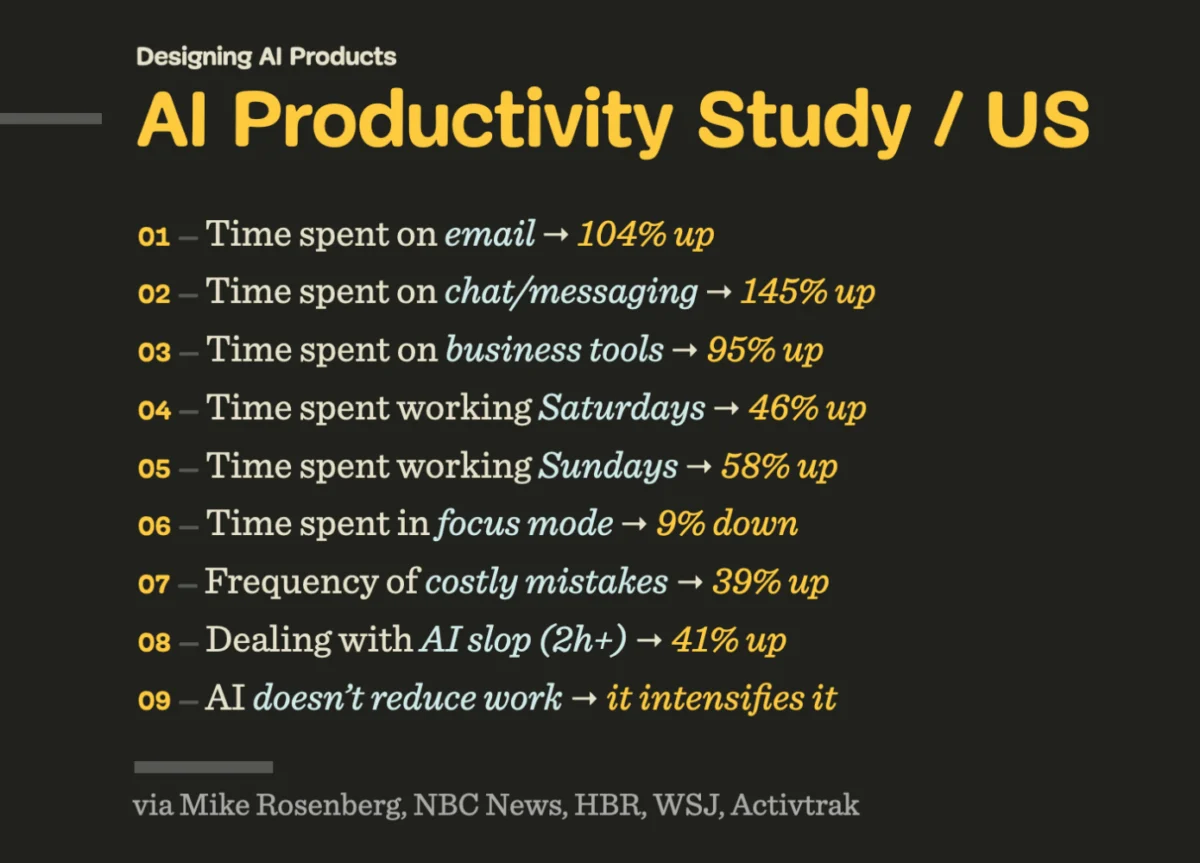
Contrary to the narrative of immediate efficiency gains, recent productivity studies in the United States present a more complex picture. Data aggregated from NBC News, the Harvard Business Review, and the Wall Street Journal indicates that the introduction of AI in the workplace has, in many instances, intensified labor rather than alleviating it.
Key metrics from these studies reveal startling trends in how AI affects the daily workflow:
- Communication Overhead: Time spent on email has increased by 104% in some sectors, while chat and messaging volumes have surged by 145%.
- System Complexity: Usage of disparate business tools has risen by 95%, as users struggle to integrate AI outputs into their primary work environments.
- Extended Work Hours: There has been a recorded 46% increase in work performed on Saturdays and a 58% increase on Sundays among teams heavily utilizing generative AI tools.
- Error Rates and Remediation: Costly mistakes have risen by 39%, largely attributed to the "hallucination" phenomenon, where AI generates plausible but incorrect information. Consequently, time spent "dealing with AI slop"—the process of filtering and correcting low-quality AI output—has increased by 41%.
These figures suggest that while AI can generate content faster, the subsequent "human-in-the-loop" requirement for verification and formatting creates a new category of labor that many find more taxing than the original task.

Structural Barriers to Effective Integration
One of the most significant hurdles to AI success is its tendency to amplify existing organizational shortcomings. Companies with poor data quality, technical debt, or fragmented internal politics find that AI does not fix these issues; it makes them more visible to the end user. When AI is layered over a "broken" culture, the resulting inconsistencies and conflicting priorities are handed directly to the user, who is then tasked with making sense of the chaos.
Furthermore, the "bolt-on" nature of most current AI features forces users out of their regular flow. Instead of augmenting an existing process, the user is often required to enter a separate "sandbox" or chat interface to interact with the AI, then copy and paste the result back into their primary document or system. This fragmentation is a major deterrent to long-term adoption, as it violates the fundamental user desire for software that is predictable and reliable.
The Labor Market and the Psychology of Resistance
The resistance to AI is not merely a matter of technical friction; it is deeply rooted in psychological and economic concerns. A study by the Brookings Institution and data published by The Washington Post highlight a stark divide in how different professions are "exposed" to AI automation.
While roles such as software developers and public relations specialists are highly exposed to AI-driven change, other sectors, such as emergency services and physical trades, remain relatively insulated. For those in high-exposure roles, the arrival of AI is often viewed through the lens of job insecurity. When a tool is marketed as a replacement for human creative labor, the natural response is anxiety rather than excitement.

There is also a growing sentiment regarding the loss of "rewarding work." Many professionals derive satisfaction from the process of creation—the "thinking time" required to solve a problem or craft a narrative. When AI automates the creative core of a job while leaving the user with the "boring" tasks of auditing and administrative cleanup, the sense of professional achievement diminishes.
Shifting the Paradigm: From AI-First to AI-Second
To bridge the adoption gap, design experts are beginning to advocate for an "AI-second" philosophy. This approach prioritizes the user’s existing workflow and mental models, using AI as a subtle, supportive background element rather than the primary interface.
The characteristics of successful AI-second integration include:
- Invisibility: The AI works within the existing interface, performing mundane tasks like data entry, formatting, or scheduling without requiring the user to switch contexts.
- Predictability: Unlike generative models that produce different results every time, useful automation must be reliable and consistent.
- Augmentation over Replacement: The tool focuses on the "mental labor" that taxes the user—such as searching through thousands of documents—rather than attempting to replace the creative or empathetic aspects of the job.
As noted by industry observers and cultural critics, the general public rarely expresses a desire for AI-narrated children’s books or AI-generated art. Instead, the demand is for AI that manages the "slop" of modern life—sorting taxes, managing bank accounts, or handling tedious administrative emails—thereby freeing up human time for activities that require genuine human connection.

Broader Implications and the Human Element
The long-term success of artificial intelligence in the enterprise depends on a fundamental shift in how leadership perceives the technology. If AI continues to be treated as a magical solution that can replace human intuition and culture, it will continue to face low adoption and high rates of skepticism.
The reality is that people do not compare software to other people; they compare features to other features. If an AI-driven tool is less reliable than a traditional tool, the user will eventually abandon it, regardless of the "intelligence" it claims to possess. The market is currently seeing a "vibe-coded" transition where users are beginning to value human-centric products more highly as a reaction to the influx of generic AI content.
The most successful implementations of AI will likely be those that remain humble and calm, taking a supportive role in the background. By automating the truly dull and unnecessary parts of work, AI can fulfill its potential not as a replacement for humanity, but as a tool that grants people more "headspace" to engage with the things they love—be it creative projects, complex problem-solving, or simply spending time with other humans.
Conclusion: The Path Forward
The current state of AI adoption is a cautionary tale for the tech industry. It serves as a reminder that technological capability does not automatically translate into user value. For organizations to realize a return on their AI investments, they must move beyond the hype and focus on the practical, everyday needs of their workforce.

The goal should not be "more AI," but rather "better outcomes." This requires a deep understanding of user experience, a commitment to fixing underlying data and cultural issues, and a respect for the human element of work. As the industry moves toward 2026, the winners will not be the companies that integrated AI the fastest, but those that integrated it the most thoughtfully—ensuring that technology serves the person, rather than forcing the person to change for the technology.

