
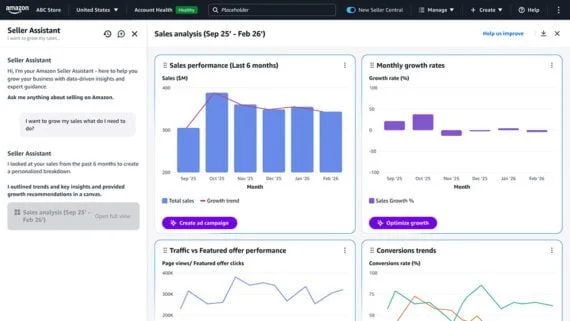
Amazon has unveiled a significant enhancement to its Seller Central platform, introducing an artificial intelligence-powered feature designed to revolutionize how merchants interact with and analyze their performance data. Moving beyond traditional static reports, this new "dynamic canvas experience" allows sellers to explore complex marketplace datasets through intuitive, visual workspaces, signaling a pivotal shift towards conversational business intelligence within the e-commerce landscape. This innovation empowers sellers to ask natural language questions about their sales, advertising, and inventory, receiving dynamic visual representations and insights in real-time.
The core of this new functionality lies in its AI assistant, which acts as a central interface for data exploration. Sellers can now pose queries such as "How did my recent advertising campaigns impact product sales?" or "Compare my sales performance between the last quarter and the same period last year." In response, the AI generates interactive charts, graphs, and other visual elements, presenting the requested metrics in an easily digestible format. This transforms Amazon’s extensive marketplace data into an accessible, text- or chat-driven dialogue. The system’s flexibility extends to allowing sellers to customize their workspaces, arranging these visual components to suit their analytical needs, fostering an environment of active data experimentation rather than passive report consumption.
This "canvas experience" represents a broader trend in business analysis software, driven by the rapid advancements and widespread adoption of artificial intelligence. For e-commerce merchants, who are often inundated with vast amounts of performance metrics from various channels, the ability to intuitively query and visualize data is becoming increasingly crucial. Amazon’s initiative suggests a future where reliance on manual data compilation, intricate spreadsheets, and even conventional business intelligence tools may diminish, giving way to AI systems that can interpret signals, provide informed insights, and potentially even suggest or automate decision-making processes. The paradigm is shifting from a manual data-mining exercise to an interactive conversation with business intelligence.
This evolving approach to e-commerce analytics is not unique to Amazon. Shopify, another major player in the e-commerce ecosystem, has also been actively integrating AI enhancements into its platform. The company’s Winter ’26 platform update, for instance, included over 150 AI-related improvements, notably to its AI assistant, Sidekick. Enhanced features like Sidekick Pulse are designed to assist merchants with data analysis, task generation, and workflow automation. Similar to Amazon’s offering, Shopify merchants can query Sidekick about sales trends, inventory levels, or marketing performance, receiving prompt, data-driven responses. This parallel development across leading e-commerce platforms underscores the growing industry consensus on the transformative potential of conversational BI for online businesses.
The concept of conversational business intelligence, where users can interact with data using natural language, is not entirely novel and has been emerging in dedicated analytics software for some time. Platforms such as Microsoft Power BI, Google Looker, and Qlik have been incorporating natural language query capabilities, allowing users to ask questions like "Why did our conversion rate drop yesterday?" and receive immediate graphical summaries and explanations. However, Amazon’s integration of this technology directly within its Seller Central platform marks a significant step in democratizing advanced analytics for a vast base of individual sellers, many of whom may not have dedicated analytics teams.

For online sellers, the implications of these advancements are profound. The sheer volume of data available through platforms like Amazon Seller Central—covering traffic, conversion rates, advertising expenditure, return on ad spend (ROAS), customer reviews, and inventory turnover—can be overwhelming. Historically, understanding the interplay between these metrics often necessitated exporting data, constructing complex spreadsheets, or investing in third-party analytics solutions. Conversational business intelligence aims to dramatically reduce this complexity. Instead of sifting through numerous reports, a merchant can ask targeted questions and receive immediate, visualized answers and explanations. As these tools mature, they are poised to fundamentally alter how sellers engage with their business data, moving towards a more dynamic and responsive analytical workflow.
The potential benefits for merchants are multifaceted. Firstly, it promises increased efficiency. By reducing the time spent on data compilation and report generation, sellers can allocate more resources to strategic decision-making and operational improvements. Secondly, it enhances accessibility to insights. Sophisticated data analysis, previously the domain of experienced analysts, becomes more attainable for a wider range of sellers, irrespective of their technical expertise. Thirdly, it fosters a more proactive approach to business management. With faster access to critical performance indicators, merchants can identify trends, opportunities, and potential issues more rapidly, enabling quicker adjustments to their strategies.
However, it is crucial to acknowledge that conversational business analysis is unlikely to completely supplant traditional reporting methods. Robust data models, clearly defined key performance indicators (KPIs), and a fundamental understanding of business operations remain indispensable. The AI tools are designed to augment, not replace, the human element of business acumen and strategic thinking. Sellers will still need to interpret the insights provided by AI within the broader context of their business goals and market dynamics. The accuracy and utility of AI-driven insights are intrinsically linked to the quality and structure of the underlying data.
Looking ahead, the evolution of AI technology suggests that these systems may transcend simply answering queries. Future iterations of conversational BI tools could move towards making proactive recommendations or even executing actions automatically, operating within predefined parameters. Imagine an AI assistant that, upon detecting a highly profitable advertising campaign, automatically suggests or implements an increase in its budget. Conversely, it might identify underperforming keyword groups and automatically pause them to optimize ad spend, or alert a seller to critically low inventory levels for a popular product, triggering an automated reorder process. This trajectory points towards a more automated e-commerce environment, where software not only illuminates data but actively participates in the day-to-day management and optimization of a business.
The current iteration of tools like Amazon’s Seller Central canvas primarily focuses on responding to user inquiries. However, the rapid pace of AI development within e-commerce platforms indicates a shrinking gap between data insight and actionable execution. This evolution promises to transform the role of merchants from solely data analysts and strategists to collaborators with intelligent systems, where the line between understanding performance and driving it becomes increasingly blurred. This shift represents a significant leap forward, offering unprecedented potential for efficiency, agility, and growth for e-commerce businesses operating on a global scale. The introduction of these AI-powered features by Amazon and others signals a clear direction for the future of e-commerce management, one where data is not just observed but actively engaged with, leading to more informed and efficient business operations.

