
The digital landscape has undergone a significant transformation in recent years, moving away from static information delivery toward immersive, high-fidelity interactive experiences. As brands seek to capture the dwindling attention spans of users, the demand for "tactile" web interfaces—those that respond with the weight, bounce, and elasticity of physical objects—has reached an all-time high. However, a growing debate within the front-end development community centers on the methodology used to achieve these effects. While the industry standard often defaults to complex physics engines such as Matter.js or Cannon.js, a new architectural rationale suggests that for many creative projects, "intentional motion" designed by human animators is superior to the "plausible motion" generated by algorithms.
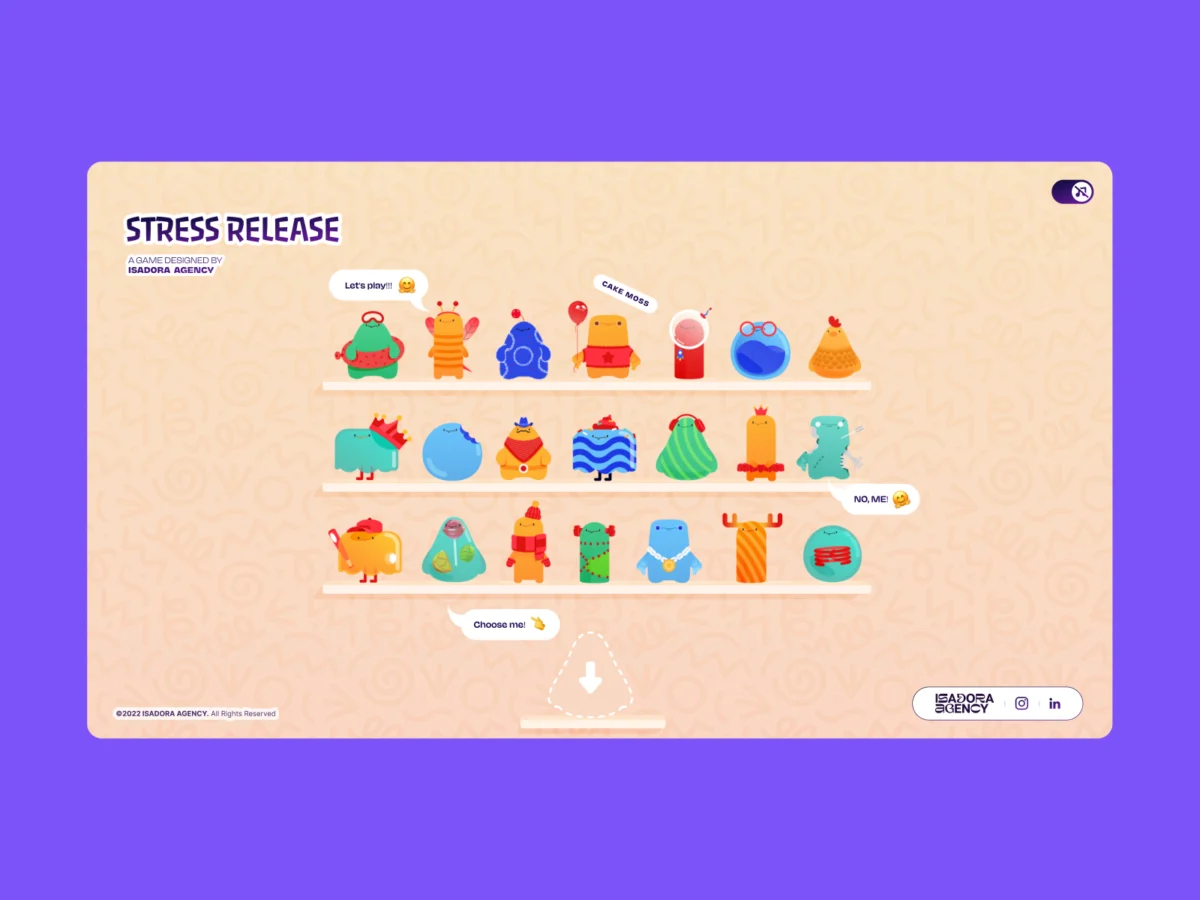
This shift in perspective was recently highlighted by the development team at Isadora Agency during the creation of "Stress Release," a digital stress-relief tool. The project, designed as a playground for burnt-out creative professionals, allows users to interact with a series of animated characters through clicking, dragging, and "smashing" UI elements. The technical journey of this project serves as a definitive case study in why traditional physics simulations may occasionally hinder rather than help the realization of a specific artistic vision.
The Project Genesis: Stress Release and the Need for Tactility
The "Stress Release" project was conceived as more than a simple game; it was intended to be a highly responsive, emotional experience. The design requirements called for characters that didn’t just move, but reacted with personality. When a user clicks a character, the "squish" must feel satisfying, and the "bounce" must align with the character’s unique visual identity.
Initially, the development team explored the use of physics engines. These frameworks are designed to simulate real-world forces—gravity, friction, and restitution—allowing objects to interact "plausibly" within a digital environment. However, early prototyping revealed a fundamental conflict. A physics engine calculates motion based on mathematical approximations of reality. If a character is hit, the engine determines its trajectory based on velocity and mass. While realistic, this approach often lacked the "soul" or specific timing required by the agency’s animators.
Alexey Kopytin, a lead developer on the project, noted that the team realized physics engines produce motion that is merely "plausible," whereas their goal was "intentional motion." The distinction is critical: intentional motion is a sequence of frames specifically crafted to evoke a particular feeling, such as a "mega squeeze" that requires a precise 181-frame build-up. An algorithmic simulation cannot easily replicate the nuance of a hand-crafted animation sequence without immense effort in tuning variables that often result in unpredictable edge cases.

The Technical Pivot: Choosing Lottie and the DOM
To maintain absolute control over the art direction, the team made the unconventional choice to scrap physics engines entirely. Instead, they built the experience using a combination of Lottie animations, standard Document Object Model (DOM) events, and distance-based mathematics.
Lottie, an open-source animation file format by Airbnb, allows designers to export Adobe After Effects animations as JSON files. These files are then rendered natively on the web as scalable vector graphics (SVGs) or on canvas. By utilizing Lottie, the developers could ensure that every frame of the "Stress Release" characters remained exactly as the animators intended. The challenge, however, was making these pre-rendered animations feel interactive and responsive to user input in real-time.
The architecture relied on three core pillars:

- Deterministic Frame Control: Using the Lottie API to jump to specific frame ranges based on user state.
- Radial Input Mapping: Using the Pythagorean theorem to calculate click distance and intensity.
- CSS-Driven Responsiveness: Utilizing CSS custom properties to ensure the experience scaled across devices without breaking the hit-detection logic.
Chronology of Development: From Prototype to Polish
The development of "Stress Release" followed a structured timeline that reflects the iterative nature of modern UX engineering:
- Phase 1: Conceptualization and Asset Creation. Animators created 21 unique characters, each with a suite of states: an idle loop, multiple "reaction" segments (light, medium, and heavy squishes), and a "destruction" or "end" sequence.
- Phase 2: Physics Prototyping. The team attempted to integrate these assets into a Matter.js environment. They found that the collision boxes often felt "stiff" and the transition between animated states and physics-driven motion created a visual "jitter."
- Phase 3: The Architectural Pivot. The decision was made to move to a pure DOM/Lottie stack. This required the development of a custom "state manager" that could translate clicks into animation triggers.
- Phase 4: Implementation of Radial Math. The team developed a coordinate-mapping system. By calculating the center point of a character and comparing it to the (x, y) coordinates of a user’s click, they could determine not just if a character was hit, but how hard.
- Phase 5: Performance Optimization. With 21 heavy JSON files, the team had to implement aggressive loading strategies and quality-toggling to ensure 60 frames-per-second (FPS) performance on mobile devices.
Supporting Data: The Math of Tactile Feedback
The "feel" of the game is driven by a concentric zone system, similar to a dartboard. The developers used the Pythagorean theorem ($a^2 + b^2 = c^2$) to calculate the straight-line distance from the center of the character to the point of interaction.
According to technical documentation provided by the agency, the scoring and feedback were mapped as follows:

- Distance < 10px: "Bullseye" (100 points, maximum animation intensity).
- Distance 10px–70px: High-intensity feedback (40–90 points).
- Distance 70px–145px: Low-intensity feedback (1–40 points).
- Distance > 145px: A "miss" (0 points).
By repositioning the "explosion" Lottie animation to the exact (a, b) vector of the click, the team created a "spatial accuracy" that tricked the user’s brain into perceiving a physical impact. Data from user testing indicated that this math-based approach felt more "connected" than the previous physics-based prototype, as the visual feedback was instantaneous and perfectly aligned with the user’s cursor.
Official Responses and Industry Context
The decision to avoid WebGL and physics engines has sparked conversation among UX engineers. Traditionally, high-performance web games are built within a <canvas> element to avoid the overhead of the DOM. However, Isadora Agency’s approach argues that for "UI-centric" games, the DOM offers superior accessibility and responsiveness.
"By mapping Lottie’s native timeline capabilities to the DOM, you can deliver incredibly rich, tactile user experiences while maintaining absolute control over the art direction," the agency stated in a technical retrospective.

Industry analysts suggest that this "No-Physics" movement is part of a broader trend toward "Micro-interaction Design." As web browsers become more powerful, the bottleneck is no longer the rendering engine, but the weight of the assets. By using Lottie, developers can achieve Pixar-quality motion with a fraction of the file size required for traditional video or the complexity of custom WebGL shaders.
Performance Optimization and Mobile Challenges
One of the primary criticisms of Lottie-heavy architectures is the impact on CPU and memory, particularly on mobile devices. To combat this, the "Stress Release" team implemented a tiered quality system.
On the "Character Shelf" screen, where 21 animations play simultaneously, the Lottie quality was set to 0.5 (50%) and the playback speed was reduced to 60%. This significantly lowered the number of interpolation calculations the browser had to perform per second. Conversely, on the "Play" screen, where only one character is active, the quality was set to 1.0 (100%), allowing for crisp, full-resolution vector rendering.

Furthermore, the team bypassed the complexities of scaling bounding boxes by using CSS variables. By recalculating --doc-height and --doc-width on every window resize event, the SVG containers scaled naturally, and the math used for hit detection remained accurate without needing to re-map coordinate systems.
Broader Impact and Implications for Web Design
The success of the "Stress Release" architecture offers several key takeaways for the future of front-end development:
- Art Over Algorithm: Technology should serve the design. If an animator has crafted a specific sequence, the developer’s job is to preserve that sequence, not replace it with a simulation.
- The Power of Simple Math: Complex libraries are not always necessary. Basic geometry and trigonometry can often solve interaction problems more efficiently than a 500KB physics library.
- Deterministic UX: In gamified interfaces, users value predictability. Knowing that a click will trigger a specific, beautiful reaction creates a stronger "feedback loop" than the chaotic nature of emergent physics.
As web interfaces continue to blur the line between software and entertainment, the "Stress Release" model provides a blueprint for developers who want to prioritize aesthetics and performance. By leveraging the DOM and programmatic animation control, agencies can create digital experiences that feel truly "tangible" without the technical debt of traditional game engines. This approach ensures that the "intentional motion" of the creator is what the user ultimately feels, bridging the gap between digital code and human emotion.

