
Google Ads is set to implement significant changes to its bidding system on August 17, a move the advertising giant states is designed to enhance performance predictability for its users. However, industry observers and some advertisers are cautioning that these adjustments could introduce unexpected fluctuations in campaign results, particularly for those employing target-based bidding strategies. The alteration centers on how Google Ads will prioritize achieving specific performance goals, potentially recalibrating campaigns that have been consistently exceeding their set targets.
The core of the impending shift lies in the stricter adherence to bidding targets. Previously, strategies like Target Cost Per Acquisition (tCPA) and Target Return on Ad Spend (tROAS) aimed to optimize towards a user-defined goal. While these strategies were intended to guide performance, actual results could sometimes significantly deviate, often performing better than the set target. Under the new system, Google Ads has declared its intention to bring actual campaign performance much closer to the specified goal. For instance, if an advertiser has set a tROAS of 300%, Google Ads will now actively work to achieve this precise figure, even if the campaign has historically delivered a 500% return. This marks a departure from the previous operational interpretation, where exceeding the target was often seen as a positive outcome, and the system might not have actively pulled back performance to meet a lower goal. The emphasis is now unequivocally on hitting the stated target as the primary objective.
While Google has indicated that these changes will primarily affect campaigns that are currently budget-limited, a prudent approach for advertisers involves a comprehensive review of all their campaigns. This proactive stance is crucial to understanding how the revised algorithms might interact with different campaign settings and performance histories.
Understanding the Impact on Advertisers
The immediate implication for advertisers is the necessity to re-evaluate their performance benchmarks and strategic objectives. Before the August 17th rollout, advertisers are urged to make critical decisions regarding their desired outcomes. This includes defining what constitutes "success" under the new paradigm. Key questions advertisers must address include:
- What is the optimal performance target? Is the current target still relevant and achievable, or does it need adjustment to reflect current market conditions and business goals?
- How much deviation from the target is acceptable? With Google Ads now prioritizing hitting the target, advertisers need to decide if they are comfortable with performance being pulled back to meet a lower goal, or if they need to raise their targets to maintain current levels of return.
- What is the acceptable range of performance fluctuations? Understanding that the system will work to align with the target means recognizing that performance might become more tightly controlled, potentially reducing upside while also aiming to prevent significant underperformance relative to the goal.
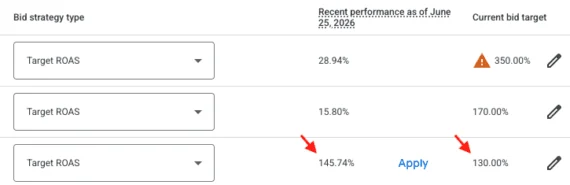
To facilitate this transition, Google Ads has introduced a bid target adjustment tool. This utility provides advertisers with a clear view of their current target settings alongside their recent campaign performance data. This comparative insight is designed to empower advertisers to make informed decisions about necessary adjustments.
An illustrative example provided showcases a campaign with a target ROAS of 130.00%, which has recently been achieving a performance of 145.74%. According to the new system, without any intervention, this campaign would be optimized downwards to meet the 130.00% target. This scenario highlights the critical need for advertisers to actively manage their targets if they wish to sustain performance levels that exceed their previously set goals.
The bid target adjustment tool, as depicted, offers a comparative view of recent performance against established targets. In one scenario, a campaign exhibiting 145.74% ROAS against a 130.00% target is flagged. This signifies that the campaign is outperforming its goal. The system’s inherent drive to meet the target means this outperformance could be curtailed. The tool also indicates other campaigns with varying performance metrics and targets, some of which may be flagged with warning icons, suggesting potential issues or areas requiring immediate attention due to significant discrepancies between performance and targets.

Navigating the New Bidding Landscape: Strategic Options
Google Ads has outlined four primary strategic options for advertisers to consider in light of these upcoming changes:
1. Maintain the Target as Is
For advertisers whose current target ROAS is set at a level they are comfortable with, even if recent performance has exceeded it, no immediate action is required. This option implies an acceptance that future performance will be guided towards the existing 130.00% ROAS goal, potentially sacrificing the higher recent returns of 145.74%. This strategy is suitable for those who prioritize stability and predictability within a defined range, even if it means foregoing potential overperformance.
2. Maintain Recent Performance
Advertisers who have consistently achieved performance significantly above their set targets may opt to increase their bidding targets to align with their actual results. This approach aims to ensure that the system continues to optimize towards a more ambitious goal, thereby maintaining current performance levels. However, Google Ads recommends a gradual approach to increasing targets. If a campaign’s performance is exceeding its target by a substantial margin, such as a 20% differential, it is advisable to increase the target incrementally. For example, if recent ROAS is 200% against a 130% target, an initial adjustment to a target of no more than 156% (130% + 20% of 130%) is suggested. Further gradual increases can be made after observing performance for a couple of weeks. This iterative process allows advertisers to experiment with the new system and learn how it responds to adjusted targets, while minimizing the risk of sudden performance drops.
It is crucial, however, to consider the broader impact on overall account performance. If individual campaign targets are not adjusted accordingly, an account-level ROAS goal could be negatively affected. For instance, a single high-performing campaign that delivers a 500% return against a 300% goal will, under the new system, have its performance capped or adjusted closer to 300%. If other campaigns are not similarly optimized or if their targets are too low, this reduction in the performance of a star performer could drag down the aggregate account performance, even if the individual campaign itself is still meeting its adjusted target.
3. Adjust the Custom Target
For advertisers who have a clear understanding of their realistic performance potential, adjusting the custom target to a new, more ambitious figure is a viable option. If, for example, a campaign consistently achieves 400% ROAS and a 300% target is deemed too low, a direct adjustment to a 400% target might be more appropriate than a gradual increase. This strategy is best suited for advertisers who have strong data-backed insights into their achievable returns and are confident in setting a higher, more precise goal that reflects their maximum potential within current market conditions. This bypasses the incremental approach and directly aligns the campaign’s objective with a higher, desired outcome.
4. Switch to Maximize Strategy
In situations where the primary objective is to maximize the volume of conversions or the total conversion value within a fixed budget, switching to a "Maximize Conversions" or "Maximize Conversion Value" strategy might be the most suitable path. These strategies are designed to achieve the highest possible volume of desired outcomes without strict adherence to a specific CPA or ROAS target. While this could lead to an increase in overall conversion volume or revenue, it is important to note that efficiency (e.g., ROAS or CPA) might decline as the system prioritizes volume over a precise return. This option is ideal for advertisers whose business model prioritizes market share, lead generation at scale, or revenue growth, even if it means a lower per-conversion return.
Historical Context and Broader Implications
The evolution of Google Ads bidding strategies reflects a continuous effort by Google to refine its algorithms and better serve the diverse needs of advertisers. Historically, automated bidding strategies have become increasingly sophisticated, moving from basic bid adjustments to complex machine learning models that analyze vast datasets in real-time. The introduction of tCPA and tROAS represented a significant leap, allowing advertisers to focus on outcomes rather than manual bid management.
However, the inherent complexity of digital advertising, coupled with fluctuating market dynamics, consumer behavior shifts, and competitive pressures, often leads to performance variations. Google’s stated aim to improve predictability suggests a response to advertiser feedback regarding the perceived randomness or unexpected swings in performance that sometimes occurred with previous iterations of automated bidding.
The current change can be viewed as a recalibration, where Google is reinforcing the primacy of the advertiser-defined target. This could lead to a more stable, albeit potentially less opportunistic, performance landscape. For businesses that rely on precise forecasting for budgeting and financial planning, this increased predictability could be a significant advantage. Conversely, for advertisers who have benefited from campaigns that consistently overachieve their targets, this change necessitates a more strategic approach to target setting and continuous monitoring.
The timeline for these changes, starting August 17, necessitates immediate action for advertisers to review their campaigns. The success of this transition will largely depend on how effectively advertisers understand and adapt to Google’s redefined approach to target-based bidding. The introduction of the bid target adjustment tool is a positive step, offering a tangible resource for this adaptation.
Expert and Industry Perspectives
While Google’s official communication emphasizes enhanced predictability, some industry analysts have voiced concerns about the potential for unintended consequences. For instance, a scenario where a highly profitable campaign is artificially capped at a lower ROAS could stifle growth and limit the advertiser’s ability to capitalize on market opportunities.
One industry expert, speaking on condition of anonymity, noted, "Google is essentially tightening the leash on performance. While this might reduce the risk of campaigns drastically underperforming against a target, it also removes the upside potential of campaigns that are naturally outperforming. Advertisers will need to be far more proactive in setting and adjusting their targets to ensure they aren’t leaving money on the table."
Another perspective suggests that this move could push advertisers towards strategies that offer more explicit control over volume, such as "Maximize Conversions" or "Maximize Conversion Value," if their primary goal is sheer growth. This could lead to a broader shift in how advertisers approach their bidding strategies, moving away from strict efficiency targets towards volume-driven objectives when necessary.
The implications extend beyond individual campaigns. For agencies managing multiple client accounts, this change requires a systematic review and potential restructuring of bidding strategies across their entire portfolio. The success of their clients will hinge on their ability to anticipate and navigate these algorithmic shifts effectively.
Ultimately, the August 17th update to Google Ads’ bidding system represents a significant evolution. Advertisers are presented with a clear mandate: understand your goals, leverage the new tools, and be prepared to adapt. The promise of predictability is appealing, but the journey to achieving it will likely involve a period of adjustment and careful strategic planning for all involved.

