
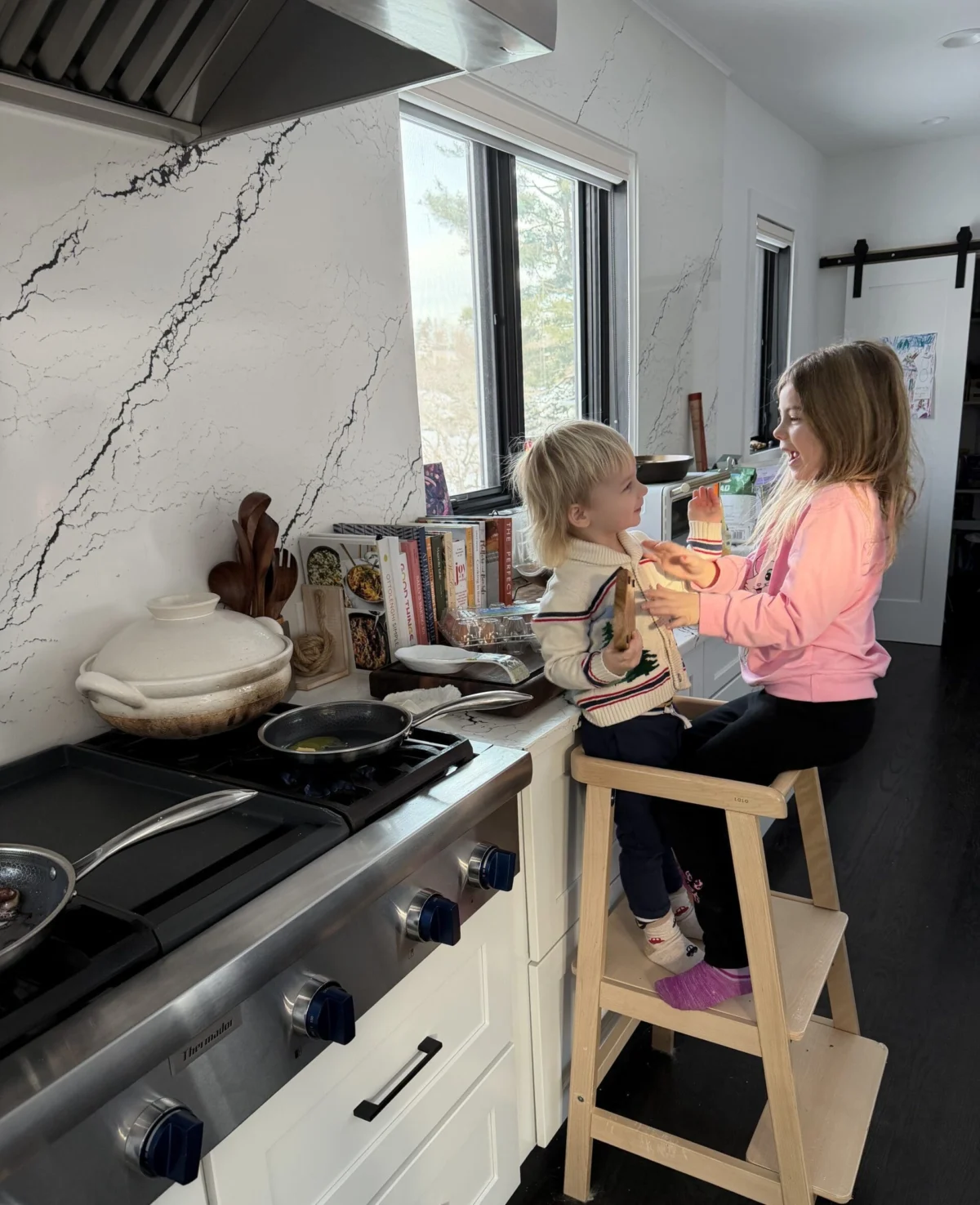
ESPN anchor Laura Rutledge, known for her fast-paced work environment covering major sports events like NFL Live, has emerged as a vocal advocate for the profound benefits of involving children in the daily ritual of cooking, transforming what might seem a mundane chore into a powerful arena for fostering family bonds, practical skills, and lasting memories. Drawing from her own experiences with her children, Reese and Jack, Rutledge highlights how the kitchen, far from being merely a place for meal preparation, serves as a dynamic classroom and a sanctuary for genuine interaction, challenging the notion that busy parents lack the time for such enriching activities. Her insights resonate with a growing body of research emphasizing the critical role of shared family experiences in child development and well-being.
Rutledge’s journey into shared culinary endeavors began almost out of necessity, with her earliest memories of cooking involving her baby, Reese, on her hip, necessitating a one-handed approach to stirring and preparing meals. This pattern continued with her son, Jack, establishing the kitchen as a central hub for family life from their earliest days. Despite a professional life demanding constant readiness and rapid decision-making, she views cooking with her children not as an additional burden, but as one of her most cherished routines. This perspective offers a compelling counter-narrative to the pressures of modern parenting, where time constraints often push families towards convenience foods and segmented activities. Her personal anecdotes, such as wiping flour and sauces from every surface within a three-foot radius of her son, underscore the inherent messiness of the process, yet she firmly asserts that "the mundane is anything but ordinary" when children are involved.
Fostering Natural Family Connection and Communication
One of the most significant benefits Rutledge identifies is the creation of quality time that feels inherently natural and unforced. Unlike structured activities or dedicated "talks," the shared space at the kitchen counter, with Jack on his step stool and Reese meticulously measuring ingredients, spontaneously ignites conversation. Topics range from their daily school experiences to their latest imaginative ideas and humorous observations about their family dog, George. This environment, devoid of pressure or a predefined agenda, allows for authentic dialogue, strengthening emotional bonds without the conscious effort often associated with "family time." Child development experts frequently cite unstructured, shared activities as crucial for fostering strong parent-child relationships and enhancing communication skills. Research published in the Journal of Family Psychology, for instance, consistently points to the positive correlation between regular family meal preparation and improved familial communication, reduced behavioral problems in children, and enhanced academic performance. The collaborative nature of cooking fosters a sense of teamwork and mutual purpose, allowing children to see their parents not just as providers, but as partners in creation.
Cultivating Healthy Eating Habits and Food Ownership
Rutledge candidly admits to previously expending considerable energy attempting to persuade her children to eat meals she had prepared. However, a transformative realization occurred: when Reese and Jack actively participated in making dinner, their investment in actually consuming it dramatically increased. This observation aligns perfectly with principles of child psychology, where ownership and agency are powerful motivators, even for preschoolers. By assigning age-appropriate tasks – stirring soup, sprinkling cheese, or carefully pouring pasta – children develop a sense of contribution and pride in the final product. This hands-on involvement can significantly alter a child’s perception of food, particularly vegetables they might have previously rejected. Studies from institutions like the Rudd Center for Food Policy & Health at the University of Connecticut have shown that children who are involved in food preparation are more likely to try new foods, consume more fruits and vegetables, and make healthier dietary choices overall. This early exposure to the origins and preparation of food demystifies the eating process and empowers children to become more adventurous and mindful eaters, combating the prevalent issue of picky eating and promoting long-term nutritional well-being.
Developing Essential Life Skills and Cognitive Abilities
Beyond the immediate goal of a meal, cooking with children serves as an invaluable, often subconscious, platform for skill development. Rutledge observes her children acquiring a range of competencies without even realizing they are learning. Jack, for instance, practices gentleness and fine motor skills when attempting to crack an egg, even if the current outcome involves crumbled shells. Reese, meanwhile, builds confidence in her ability to follow a recipe and create something tangible and special for her family. This process implicitly teaches critical foundational skills such as measurement (mathematics), following sequential instructions (logic and problem-solving), understanding cause and effect (science), and developing fine motor coordination. Investing in kid-safe tools – a child-friendly knife, a sturdy mixing bowl with handles, a reliable step stool – transforms the kitchen into an accessible and secure learning environment. This approach removes parental anxiety over sharp edges and hot surfaces, allowing for a more relaxed and productive shared experience. Educational psychologists frequently highlight that experiential learning, especially in practical contexts like cooking, leads to deeper understanding and retention of concepts than abstract instruction alone. These early experiences lay groundwork for future academic success and foster a proactive approach to learning.
A Counterbalance to Fast-Paced Modern Life
For a professional like Rutledge, whose career at ESPN demands constant vigilance, quick thinking, and adaptability, cooking with her children offers a necessary and profound counterpoint. The inherent slowness of a toddler meticulously spooning tomato sauce into a pot, one tiny spoonful at a time, forces a deliberate deceleration. This enforced patience provides a vital mental break from the relentless pace of her professional life. In these moments, her focus shifts entirely to her children’s pace, celebrating their small victories, such as Jack remembering to "stir slowly." This immersive engagement pushes aside professional anxieties about upcoming segments or unanswered emails, anchoring her firmly in the present. The collection of these "tiny wins" – trying a new food, mastering a small skill – becomes a source of genuine joy and fulfillment. In an era dominated by digital distractions and the constant pressure to be productive, intentionally slowing down for meaningful interaction is increasingly recognized as crucial for mental health and family well-being. The kitchen becomes a mindfulness zone, where the simple act of creation takes precedence over external demands, offering a therapeutic escape for parents and a comforting rhythm for children.
Empowering Children as Valued Contributors
Perhaps one of the most heartwarming and impactful aspects Rutledge observes is the visible pride and increased stature children display when they feel like important, real contributors. When Reese precisely slices fruit or Jack enthusiastically squeezes tomatoes for a sauce, they are not engaged in pretend play; they are genuinely assisting in the creation of a family meal. This sense of authentic responsibility is a powerful builder of self-esteem and confidence. Rutledge advocates for allowing children to "own their task completely," even if the execution isn’t perfectly aligned with adult standards. A slightly overcooked scrambled egg, made by a child beaming with pride, becomes "a meal worth eating" precisely because of the effort and ownership invested. This practice of assigning real responsibilities, rather than merely superficial ones, is fundamental to developing a child’s sense of capability and agency. Developmental psychologists emphasize that opportunities for competence and contribution are vital for a child’s healthy self-concept. The kitchen provides a tangible arena where children can see the direct results of their efforts, fostering a belief in their abilities to impact their environment and contribute meaningfully to the family unit.
Expert Perspectives and Supporting Research
The benefits articulated by Rutledge are strongly corroborated by broader educational and psychological research. Organizations like the American Academy of Pediatrics encourage family meal preparation as a cornerstone of healthy family development. Dr. Catherine S. Johnson, a clinical child psychologist, notes that "shared activities like cooking provide a low-stress environment for children to practice executive function skills, such as planning, organization, and impulse control, all while building strong emotional connections with their caregivers." Furthermore, studies on food literacy indicate that early exposure to cooking not only improves diet quality but also instills a greater appreciation for food systems and sustainable practices.
A 2014 study published in Public Health Nutrition found that children who frequently cooked with their families consumed more vegetables and fruits and were less likely to be overweight. This evidence underscores the long-term health implications of such family practices. Moreover, the social-emotional benefits extend beyond the immediate family. Children who regularly engage in household chores, including cooking, tend to develop a stronger sense of responsibility, empathy, and community awareness, which are critical for navigating social interactions and becoming engaged citizens.
Practical Considerations and Broader Implications
While the benefits are clear, Rutledge also implicitly addresses the practicalities. The investment in appropriate tools, such as kid-safe knives and sturdy step stools, transforms the kitchen into a more accessible and safer space for young learners. This minor logistical adjustment significantly lowers the barrier to entry for parents, making the process less daunting.
The broader implications of integrating children into the culinary process extend beyond individual family units. In an increasingly complex world, fostering self-sufficiency and practical life skills in children is paramount. Cooking teaches resourcefulness, adaptability, and the fundamental ability to nourish oneself, skills that are invaluable throughout life. As Rutledge demonstrates through her own high-profile career, even the busiest schedules can accommodate these enriching activities, suggesting that the perceived time constraints often mask an underestimation of the profound returns on such an investment. Her personal endorsement, coming from a figure in the demanding world of national sports broadcasting, lends significant weight to the argument that making time for the family kitchen is not a luxury, but a vital component of modern family life.
Ultimately, Laura Rutledge’s advocacy for cooking with children transcends simple recipe sharing. It presents a compelling case for re-evaluating the kitchen’s role in contemporary family dynamics, positioning it as a vibrant, essential space for fostering connection, cultivating crucial life skills, promoting healthy habits, and building confident, contributing individuals. Her experiences with Reese and Jack offer a tangible model for parents seeking to enrich their family lives, proving that even amidst chaos and mess, the shared act of creation can yield immeasurable joy and lasting developmental benefits. Her recommendation for a kid-friendly spaghetti carbonara recipe, which rotates through her kitchen, serves as an invitation for other families to embark on their own culinary journeys, transforming mundane moments into extraordinary memories.

