
Brands leveraging creator programs are reporting extraordinary surges in conversion rates, with some experiencing lifts of 30%, 40%, and even a staggering 214%. This significant improvement is not attributed to a shift in creator talent or increased commission rates, but rather to a critical, yet often overlooked, adjustment: the destination of traffic after a click. This emerging pattern has been consistently observed across thousands of creator programs over the past 18 months, indicating a profound shift in effective influencer marketing strategies.
The Overlooked Conversion Gap: A Destination Problem
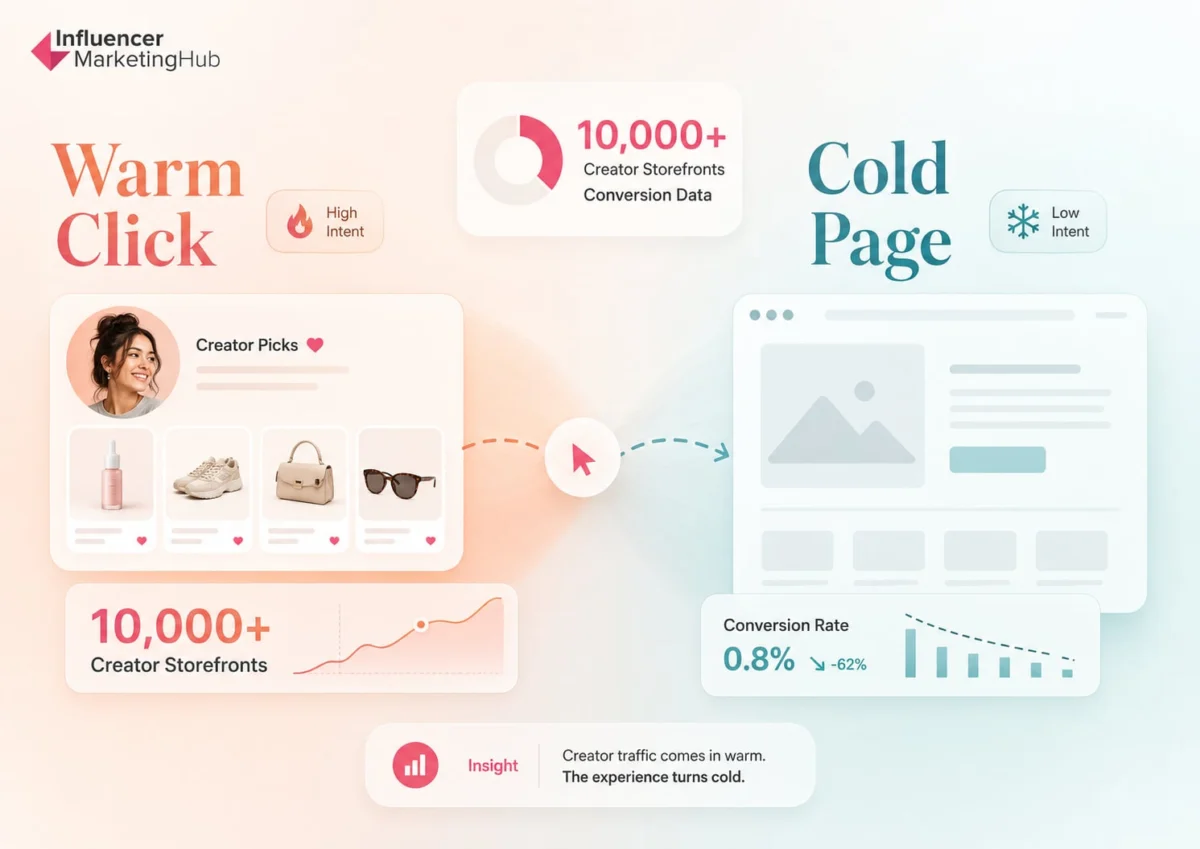
For years, the focus of influencer marketing has predominantly been on the initial stages of the funnel: identifying the right creators, crafting compelling content briefs, and negotiating attractive commission structures. Brand teams meticulously audit creator selections and refine creative messaging, yet a crucial element has remained largely unexamined: the post-click landing experience. Data now unequivocally points to a consistent conclusion: the conversion gap in influencer marketing is primarily a destination problem, not a creator problem. Creators are successfully executing their primary role – generating a "warm click" – but the subsequent landing page frequently fails to capitalize on this initial trust and engagement.
The traditional approach often sees creator-referred traffic directed to a brand’s generic homepage, a standard product page, or a universal discount-code landing page. These destinations, however, are fundamentally ill-equipped to continue the personalized journey initiated by the creator. They lack the context, personalization, and trust continuity that the audience expects after engaging with a trusted voice.
The Genesis of the "Warm Click, Cold Page" Problem
The rapid evolution of the creator economy, projected to grow significantly, has seen brands pour substantial investments into influencer marketing. Initially, the emphasis was on reach and brand awareness, with conversion often treated as a secondary outcome or assumed to follow naturally from brand exposure. However, as the market matures and competition intensifies, performance metrics have become paramount. This shift has exposed a fundamental disconnect in the customer journey: the "warm click, cold page" phenomenon.
When a creator, having cultivated months or even years of trust and authority within a specific niche (e.g., skincare, fitness, cooking), recommends a product, their audience clicks because that trust is already established. This click is inherently "warm," carrying a high degree of pre-purchase intent. The follower is not merely curious; they are already "half-sold" by the creator’s endorsement.
However, upon landing on a generic brand page, this crucial context often evaporates. The page does not acknowledge the creator who sent them, nor the long-standing relationship between the creator and the follower. It presents a standardized experience, identical to that encountered by someone who typed the brand name directly into a search engine. The personalized connection that drove the click is abruptly severed, leading to a "cold handoff" that fails to extend the creator-buyer relationship. While the affiliate mechanics may correctly track the click and attribute it, the customer-facing experience does little to nurture the pre-existing trust, resulting in sub-optimal conversion rates.
![What Conversion Data From 10,000+ Creator Storefronts Reveals [Warm Click, Cold Page Problem]](https://influencermarketinghub.com/wp-content/uploads/2026/07/5a619d4d-chatgpt-image-jul-3-2026-12_33_04-pm.jpg)
This issue exacerbates as creator programs scale. A brand managing hundreds or thousands of creator relationships cannot realistically hand-craft unique landing experiences for each creator without specialized infrastructure. The default solution—routing all traffic to generic pages—becomes a bottleneck for conversion, despite the creators’ best efforts.
Empirical Evidence: Data-Driven Success Stories
Recent case studies from diverse direct-to-consumer (DTC) brands across various categories provide compelling evidence of the impact of optimizing the landing experience:
- Cozy Earth, a premium bedding and apparel brand, conducted a comprehensive comparison across its creator program. By transitioning creator traffic from standard affiliate links to co-branded creator pages hosted on their own domain, they observed an average 214% increase in conversion rate. Alongside this remarkable conversion lift, the average order value (AOV) also saw a substantial 67% increase. This dramatic improvement was achieved with the same traffic and the same creators, highlighting the profound effect of merely altering the arrival experience.
- Healf, a UK-based health and wellness marketplace, managing over 1,700 creator partnerships, achieved an impressive 40.8% conversion rate for its creator-referred traffic. This figure significantly outperforms typical e-commerce baselines in the competitive health category, which often hover between 1% and 3%. Healf’s affiliate lead noted that the creator-page model not only boosted conversions but also "opened the door to attracting more affiliates" because creators were genuinely proud to share personalized pages that also facilitated higher earnings. This suggests a virtuous cycle where better landing pages attract more engaged creators.
- Buttah Skin, a beauty brand, reported a similar structural shift within the beauty sector. Dedicated creator pages led to 30% higher conversion rates and a 78% increase in average order value compared to directing creator traffic to standard product pages. This demonstrates that even in highly visual and competitive industries like beauty, the continuity of the creator’s influence through the purchase journey is paramount.
- Electro, an electrolyte gum brand, revealed that its creator storefronts now contribute to 81% of its total e-commerce revenue. Crucially, this was achieved not by merely increasing creator spend or expanding the program’s volume, but by strategically optimizing where the generated traffic lands. This indicates that focusing on conversion efficiency through personalized landing pages can yield disproportionately high returns.
While the exact magnitude of improvement varies depending on the brand, product category, and maturity of the creator program, the consistent direction of these findings is undeniable: personalized landing experiences significantly outperform generic ones. The image depicting conversion lifts across these four brands concretely illustrates this trend, showing substantial gains simply by replacing generic affiliate links with creator-specific landing pages.
Key Drivers of High-Converting Creator Pages
Analysis of successful creator programs reveals two consistent patterns that differentiate high-performing landing experiences:
- Curation Depth Trumps Catalog Size: Creator pages that feature a curated selection of 6-15 products consistently outperform pages mirroring the brand’s full catalog, often by a factor of two to three in relative conversion. The audience arriving from a creator’s link has already been influenced by that creator’s specific taste and recommendation. The landing page’s primary role is to validate and facilitate this pre-existing inclination, not to re-initiate the entire consideration process with an overwhelming array of options. When a creator thoughtfully selects a limited number of products they genuinely use, provides brief, personal descriptions for each, and prominently features this curated list, the shopper arrives pre-primed for purchase. The page merely needs to avoid disrupting this established trust and intent.
- Sustained Creator Visibility Through Purchase: It is insufficient for the landing page to merely match the creator’s content tone or aesthetic. The creator’s identity – their name, image, and authentic voice – must remain visibly present on the page itself, ideally through the checkout process. When the creator’s presence vanishes immediately after the click, the "warm click" trust built with the audience dissipates with them. Conversely, maintaining their visibility ensures that the context and trust that drove the initial click are preserved through the critical moment of purchase. This continuity of trust is the fundamental differentiator between a generic campaign landing page, optimized solely for conversion metrics, and a creator page, optimized for trust continuity, which then inherently drives higher conversion.
Implementing the Solution: The 30-Day Diagnostic
Brands do not necessarily need a complete overhaul of their creator tech stack to address this issue. For smaller teams or those new to this approach, a straightforward landing page builder can be sufficient to conduct an initial test before committing significant engineering resources to manual, per-creator page development.
A recommended 30-day test involves selecting 5-10 active creator relationships and developing bespoke landing pages for each. These pages should clearly feature the creator’s identity, their curated product selections, and integrate seamlessly with the brand’s checkout system, all hosted on the brand’s own domain. The traffic from these creators should then be directed to these new pages, while all other variables (creator, commission, content strategy) remain constant. The following three key metrics should be tracked:
![What Conversion Data From 10,000+ Creator Storefronts Reveals [Warm Click, Cold Page Problem]](https://s.influencermarketinghub.com/imaginary/convert?type=webp&url=https://influencermarketinghub.com/wp-content/uploads/2026/07/d15fc009-image3-1024x490.jpg)
- Conversion Rate (CVR): Compare the conversion rate from the new creator page against the brand’s existing generic affiliate link destination. A well-designed creator page should yield at least a 20-30% lift in CVR within the initial 30 days. If the improvement is marginal, it suggests the page may still be functioning more like a standard catalog than a personalized, creator-curated experience. Brands should then review if the creator’s identity is sufficiently visible and if the product selection is genuinely curated, rather than just a filtered view of the entire catalog.
- Average Order Value (AOV): Creator pages featuring authentic editorial curation—where the creator uses their own language to describe each product and arranges them in a narrative or thematic order—consistently demonstrate a lift in AOV alongside CVR. If conversion rates improve but AOV remains stagnant, it may indicate that while the page is effectively capturing creator traffic, it is not fully leveraging the creator’s persuasive "taste" or authority. Adding a stronger editorial layer can often address this.
- 30-Day Repeat Rate of the Acquired Cohort: This metric is crucial for discerning whether a "warm click" translated into a truly engaged customer or merely a one-time transaction. Creator pages that successfully maintain the creator’s context through the entire purchase journey consistently generate higher repeat rates than generic arrival pages. This is because the audience arrives with genuine alignment and trust, fostering loyalty beyond the initial purchase. A suboptimal repeat rate after 30 days signals that while the landing experience might have matched the traffic volume, it failed to solidify the audience fit and long-term customer relationship.
A quick diagnostic before initiating this test: if creator links are yielding conversion rates below 2%, while the brand’s own product pages convert at 3-4%, the disparity is almost certainly driven by the landing experience. In such cases, addressing the destination of clicks should precede any renegotiations with creators or content strategy revisions.
Scaling Challenges and the Future of Creator Commerce
The creator economy is rapidly maturing, moving beyond initial phases driven by sheer volume and broad discount codes. Brands that previously gained momentum through these tactics are now encountering diminishing returns. The programs demonstrating sustained growth and compounding returns are those that integrate the landing experience as an intrinsic part of the creator relationship. This involves building sophisticated creator pages that creators are proud to share, that audiences trust implicitly for purchases, and that effectively convert the warm, engaged traffic generated by creator content.
The operational challenge at scale—managing 100, 500, or even 1,000+ creator relationships—lies in the ability to construct and maintain these creator-specific pages without requiring an individual engineering ticket for each creator. This technological "unlock" is critical for widespread adoption. For brands lacking internal conversion rate optimization (CRO), design, or web production resources, specialized landing page agencies can provide the expertise and infrastructure to transform creator traffic into a structured, high-conversion system. Landmark successes, such as Crocs driving 350,000 sessions from a single creator page linked to a product drop with Kai Cenat, exemplify the potential. Such event-scale results are simply unattainable when creator traffic is routed to a generic homepage.
Expert Perspectives and Industry Shift
Industry analysts emphasize that this strategic shift represents a maturation of digital marketing. "The days of treating influencer marketing as a pure awareness play are over," states Dr. Anya Sharma, a digital marketing strategist. "Brands are now recognizing that the consumer journey doesn’t end with a click; it begins a new, critical phase. Neglecting the post-click experience is akin to spending heavily on a billboard but then sending interested customers to a closed store."
This new paradigm benefits both brands and creators. Brands achieve significantly higher ROI on their creator investments, transforming perceived marketing costs into direct revenue drivers. Creators, in turn, are empowered with tools that enhance their credibility and earning potential. When a creator can offer their audience a personalized, curated shopping experience that feels like an extension of their own brand, they are more invested and more successful. This fosters deeper, more authentic partnerships, moving beyond transactional relationships to collaborative commerce.
Ultimately, brands that continue to route all creator traffic to generic, undifferentiated destinations are leaving a substantial portion of potential value on the table. This underperformance is not a reflection of their creators’ efforts or influence, but rather a direct consequence of allowing the "warm clicks" they meticulously generate to land "cold," failing to convert the inherent trust and intent into tangible sales. The future of creator marketing lies in seamless, personalized post-click experiences that mirror the trust cultivated by the creators themselves.

